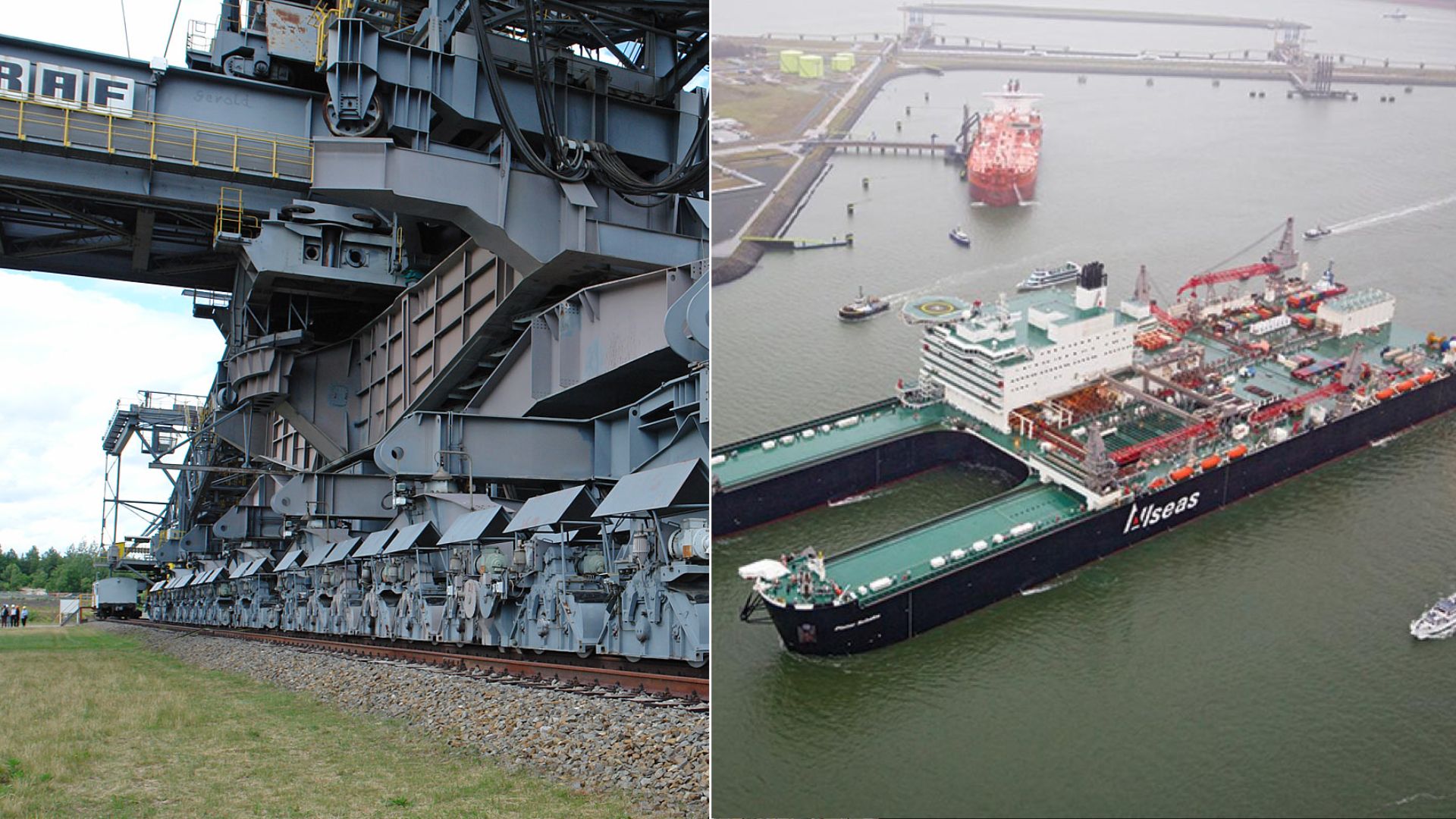
Some machines are so large that describing them as “vehicles” or “equipment” almost feels inadequate. They can stretch for hundreds of meters, weigh thousands of tonnes, or operate on a scale normally associated with entire industrial facilities. From a 14,196-tonne excavator that crawls through open-pit mines to a giant particle accelerator, these are seven of the biggest machines ever built. Rather than simply ranking them by one measurement, this list considers overall physical scale, mass and engineering significance. 1. Large Hadron Collider – CERN The Large Hadron Collider (LHC) is officially recognized by Guinness World Records as the largest machine ever built, with a circumference of about 26.6 kilometers. Built beneath the Franco-Swiss border near Geneva, it uses 1,232 large superconducting dipole magnets to guide particle beams around its enormous ring. The accelerator began operating in 2008 and has since been used for experiments probing the fundamental structure of matter, including the discovery of the Higgs boson. Unlike the other machines on this list, its immense size isn’t about moving earth or cargo. It is about controlling particles traveling close to the speed of light. 2. Bagger 293 – Germany The Bagger 293 is arguably the most spectacular machine on Earth. This bucket-wheel excavator weighs 14,196 tonnes, stretches roughly 220 meters long, and reaches 94.5 meters high. Guinness recognizes it as both the heaviest land vehicle and largest mobile industrial machine. Its rotating bucket wheel is about 21.6 meters across and carries 18 buckets, each capable of holding thousands of liters of material. The machine can shift approximately 240,000 cubic meters of earth per day. It moves incredibly slowly, but its enormous size allows it to continuously remove overburden from open-cast mines. 3. Pioneering Spirit – Offshore construction vessel At 382 meters long and 124 meters wide, Pioneering Spirit is less like a conventional ship and more like a gigantic mobile industrial platform. Guinness lists it as the world’s largest ship by gross tonnage, at 403,342 gross tonnes, while its operator Allseas calls it the world’s largest construction vessel. Its unusual twin-hull design allows the vessel to straddle offshore platforms and lift enormous structures in one piece. Its lifting system can handle topsides weighing up to 48,000 tonnes according to its current specifications. It has also been engineered for ultra-heavy pipeline installation, making it one of the largest machines ever built for offshore construction. 4. F60 Overburden Conveyor Bridge – Germany The F60 is effectively a 500-meter-long moving bridge built for surface mining. Constructed in Germany between 1989 and 1991, the machine is 502 meters long, 204 meters wide, and almost 80 meters high. It was designed to remove and transport layers of overburden above brown coal deposits, working together with giant excavators. The F60 was capable of spanning enormous mining areas while continuously transferring excavated material. Although its working life was short, it operated from 1991 to 1992; the machine remains one of the world’s most extraordinary examples of mobile industrial engineering. Today, the retired structure is preserved as an industrial monument. 5. NASA Crawler-Transporter 2 – United States NASA’s Crawler-Transporter 2 (CT-2) may be the slowest machine on this list, but few can match its combination of mass and purpose. Guinness officially recognized it in 2023 as the heaviest self-powered vehicle, weighing approximately 6.65 million pounds (about 3,020 tonnes). NASA built the crawler-transporter concept in the 1960s to move Saturn V rockets from the Vehicle Assembly Building to their launch pads. Today, CT-2 supports NASA’s Artemis program and can carry a load of up to 18 million pounds. It moves on enormous crawler tracks along specially constructed crawlerways rather than conventional roads. 6. Big Muskie – United States Big Muskie no longer exists, but it deserves a place in any serious history of gigantic machines. Completed in 1969, the Ohio coal mine’s walking dragline weighed about 13,200 tonnes and was the largest dragline excavator ever built. Its bucket could carry approximately 325 tonnes of earth, while hydraulically powered walking shoes allowed the machine to reposition itself around the mine. Big Muskie could move about 17,500 tonnes of earth per hour. It operated until 1991 and was eventually dismantled in 1999. Its enormous scale illustrates how dramatically the demands of 20th-century surface mining pushed heavy machinery engineering. 7. Caterpillar 6090 FS – Mining shovel The Caterpillar 6090 FS represents a different approach to extreme machine scale. Concentrating enormous digging power into a comparatively compact mining shovel. The machine has an operating weight of about 1,000 tonnes, produces 4,500 horsepower, and can carry a bucket payload of up to 103 tonnes. Its bucket capacity can reach 55 cubic meters depending on configuration. Rather than continuously cutting into a mine like a bucket-wheel excavator, the 6090 FS loads giant haul trucks one bucket at a time. It demonstrates how modern mining equipment has evolved toward enormous payloads, hydraulic power and high productivity.These machines reveal that “big” can mean very different things. The LHC is enormous because it needs a 26.6-kilometer path for particles; Bagger 293 is enormous because moving mountains requires extraordinary machinery, and NASA’s crawler is enormous because it must carry some of humanity’s largest spacecraft.Get the latest in engineering, tech, space & science - delivered daily to your inbox.Kaif Shaikh is a journalist and writer passionate about turning complex information into clear, impactful stories. His writing covers technology, sustainability, geopolitics, and occasionally fiction. A graduate in Journalism and Mass Communication, his work has appeared in the Times of India and beyond. After a near-fatal experience, Kaif began seeing both stories and silences differently. Outside work, he juggles far too many projects and passions, but always makes time to read, reflect, and hold onto the thread of wonder.
Top 7 biggest machines: From mining giants to particle accelerators
Full Article
Original Source
Read the full article at Interestingengineering →KhanList aggregates and links to publicly available news content. We do not host full articles from third-party sources. Always verify important information with original sources.