
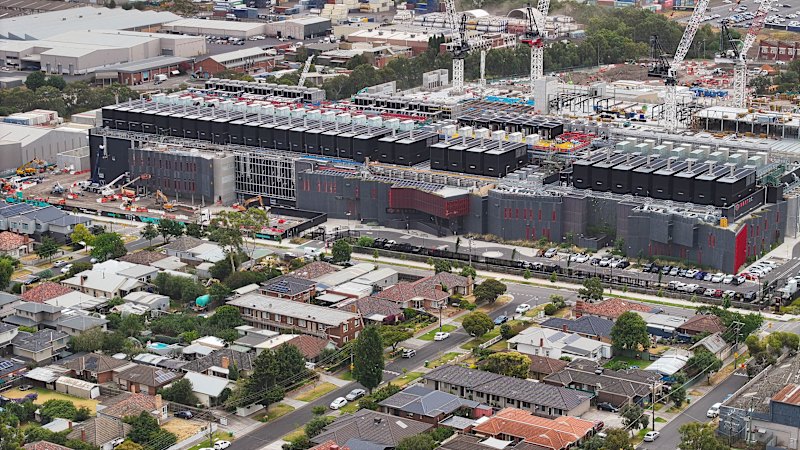
September 22, 2026 — 7:30pmBuffer zones to keep data centres at least 150 metres from homes have arrived too late to stop three so-called hyper-scale projects in Melbourne’s west, exempting developers who lodged plans before Labor tightened the rules.Premier Ben Carroll revealed on Tuesday Labor’s policy to ban data centres near homes, while also introducing new power, water and community investment standards for developers.NextDC’s West Footscray data centre. New rules to stop data centres being built closer than 150 metres from homes won’t affect the project’s coming stages.Joe ArmaoBut the changes will not be retrospective. Projects already under way or which have lodged planning applications will be unaffected by them – including a data centre about 60 metres from homes. Projects yet to be approved must still be approved under existing planning rules.At least three proposed data centre projects will breach the government’s 150-metre buffer, in communities which have protested against the AI infrastructure and raised concerns about noise, pollution and other impacts.The Department of Planning and Transport is accepting public submissions over an application by Australian data centre giant NextDC to expand its West Footscray facility, with more computing infrastructure to be built adjacent to homes. The land the data centre sits on, zoned industrial and adjacent to a residential zone, once had small factories and warehouses on it.Developer GreenSquare has also lodged an application to build a data centre in Spotswood which would breach the government’s 150-metre buffer – even though it is proposed for badly contaminated land that once housed Mobil’s fuel storage tanks.The site of the proposed GreenSquare data centre in Spotswood was once Mobil’s main Melbourne fuel terminal.Joe ArmaoA planning report for the project notes that houses are “more than 60 metres away and separated by the [Werribee] railway corridor, ensuring that the development will not result in unacceptable amenity impacts”.Resident Jacqui Glover’s property boundary in West Footscray is just 15 metres from the edge of the sprawling NextDC data centre, which began construction in 2021 after initial approval by Maribyrnong City Council. The data centre will eventually fill almost the entire 10-hectare block.Glover said while she welcomed the new rules, “it’s too little, too late for us in Tottenham and West Footscray”.Another planned data centre, on land owned by the Scalzo family that sits just 200 metres to the east of the NextDC campus, was approved by the state government last year. It too faces onto housing in the same street as Glover, but will also be unaffected by the new rules.Jacqui Glover, pictured in February, says the changes are too little, too late for people like her.Justin McManus “If Labor genuinely believes in these proposed guidelines they should be applied to every data centre development,” Glover said.She said the 150-metre rule would not help when data centres ran their back-up generators, which generally run off diesel fuel stored on site. “Diesel emissions aren’t going to just stop 150 metres away from homes.”The premier said the changes would prevent suburban streets being transformed by multi-level data centres, while also allowing Victoria to capitalise on the economic benefits brought by AI’s rapid expansion.Asked if the changes were coming too late to protect neighbourhood character, Carroll said no.“I am a premier that gives certainty to industry. So applications that were made under the old rules will proceed.”The government intends to strengthen the regulations before it enters caretaker mode from November 3 in the lead-up to the state election, but Carroll could not offer certainty that the changes would be locked in by then.The new requirements, outlined in Labor’s Sustainable Data Centre Action Plan, will also enforce guidelines for water and energy use and air and noise pollution.They come as global tensions over AI increase. Industry chiefs and world leaders have warned that the technology’s growth may outpace governments’ ability to regulate it, and that it could cause human extinction.At the United Nations this week, Prime Minister Anthony Albanese signed a joint declaration calling for international oversight of AI models. On Wednesday, a federal inquiry into the technology will hold its first public hearings in Melbourne.CDC Data Centres welcomed on Tuesday the state government’s plan, and chief executive Greg Boorer said clear guidelines would help comfort investors considering making funding decisions. He said discussions about data centres were no longer just about planning but were “fundamentally a conversation about Australia’s digital future and the infrastructure required to support it”.CDC Data Centres chief executive Greg Boorer.Alex Ellinghausen“As one of Australia’s most important data centre regions, the policy settings adopted by Victoria have an important role to play in supporting investment, innovation and Australia’s long-term digital capability,” Boorer said.“Communities want confidence that the organisations developing and operating critical infrastructure are responsible contributors to the places where they invest.”But Data Centres Australia, an advocacy group representing developers, technology companies and other related businesses, criticised the decision to include 150-metre buffer zones.Chief executive Belinda Dennett said operators already supported most aspects of the government’s rules, but the setback requirements would hurt projects where investments had already been committed.“It is disappointing to see Victoria, the state that recognised the economic opportunity to attract data centre investment and proudly declared its ambition to be a global data centre leader, now move to impose requirements on data centres that apply to no comparable industrial use,” she said.Dennett said data centres were already restricted to industrial land, and individual projects had to go through environment and planning approvals.She said the 150-metre setback added a restriction that warehouses and logistics hubs did not have to meet, and that industrial land was already scarce.“It can render an otherwise suitable site unviable,” Dennett said.She also said the government’s faster approval process, the Development Facilitation Program, had recently not been making decisions on applications under the government’s old rules, leading to a “de facto freeze” that would force developers to spend elsewhere.Artificial Intelligence Minister Anthony Carbines said setting clear regulations would give businesses certainty and Victoria a competitive edge over other states.But Liberal frontbencher James Newbury said Carroll could not be trusted to regulate data centres, pointing to the suburban projects which ignited community protest.“Every Victorian can look on and see the track record of what they’ve allowed and the places they’ve allowed it to be built, and feel unfortunately certain that that would continue under a Labor government,” he said.The Greens said the government’s policy was a major retreat that had come after pressure from communities. But the party’s data centres spokeswoman, Sarah Mansfield, said noise could still be experienced from beyond 150 metres, and called on Labor to show the modelling for why that distance was chosen.“There’s also a glaring hole in this announcement: what happens to the people already living next to these massive data centres?” she said. “Labor can’t admit these facilities need a buffer and then abandon the residents already living inside it. Big tech should pay to compensate those communities.”Start the day with a summary of the day’s most important and interesting stories, analysis and insights. Sign up for our Morning Edition newsletter.From our partners
‘Too little, too late’: Data centre buffer carve-out leaves some residents vulnerable
Full Article
Original Source
Read the full article at Smh →KhanList aggregates and links to publicly available news content. We do not host full articles from third-party sources. Always verify important information with original sources.