
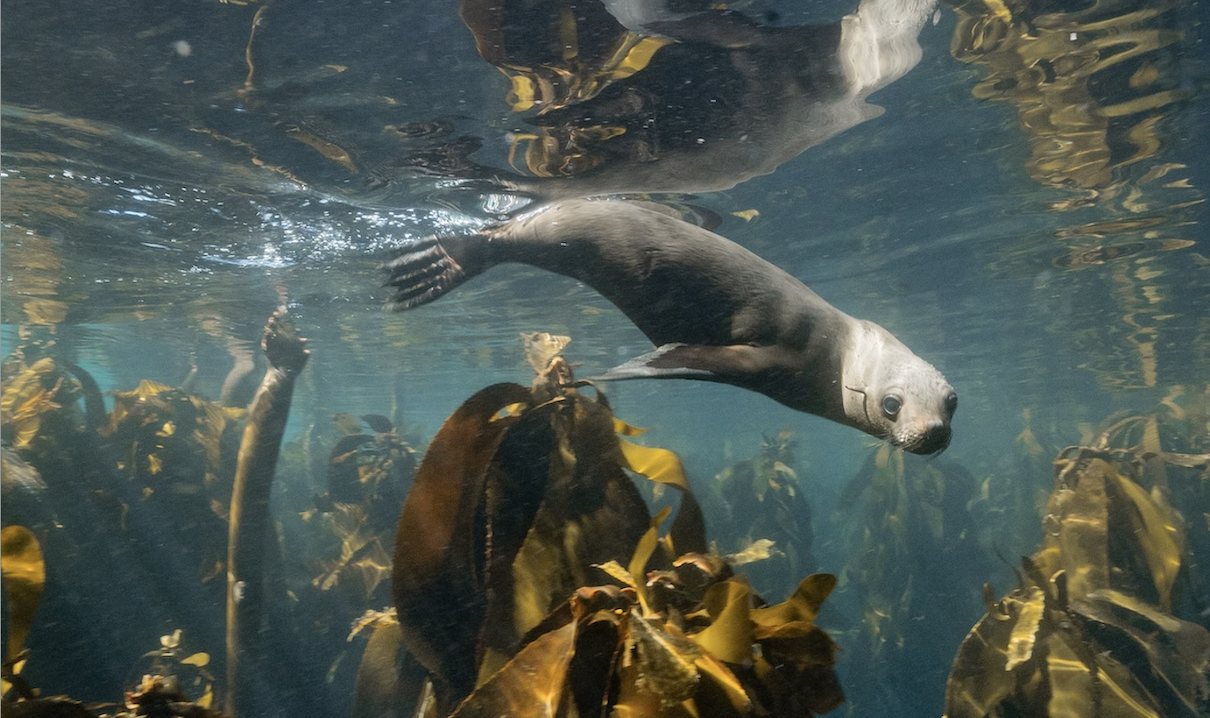
A new op-ed from the team that produced the Oscar-winning film My Octopus Teacher argues it’s time for kelp forests to be named, recognized and celebrated like coral reefs are.Reefs, mangroves, salt marshes and seagrasses have all secured their own named presence in international conservation frameworks — which boosts conservation support for them — but kelp forests so far have not.This oversight has led to less conservation effort and programming to protect kelp forests, of which less than 2% of are meaningfully protected, despite being one of the most biodiverse nearshore ecosystems on the planet.This article is a commentary. The views expressed are those of the authors, not necessarily of Mongabay. Beneath the coppery fronds of the only floating bamboo kelp forest in the world, a creature shapeshifts across the reef. A tuberculate cuttlefish (Sepia tuberculata) has just escaped a predator using “pseudomorph-ink” — a ‘false body’ strategy of emitting ink clouds that resemble its shape — while the actual animal jets away in the opposite direction. Once hidden under a rock or in a crevice, its superb camouflage and mimicry will protect it from detection. This animal lives in the Great African Seaforest, which stretches for more than 1,300 kilometers (just over 800 miles) from South Africa to Namibia. This ecosystem is just one of many such kelp forests across the world that together house thousands of kinds of creatures all hiding, breeding, sheltering and feeding. However, their homes are in trouble. Proponents say kelp forests like the Great African Seaforest deserve the same attention that other marine ecosystems like coral reefs and mangrove forests receive. Image courtesy of Jannes Landschoff / Sea Change Project. Fringing a third of the world’s coastlines in temperate and polar waters, kelp forests are one of the most biodiverse nearshore ecosystems on our planet and are probably as biologically important as rainforests. Despite this, less than 2% of them are meaningfully protected and warming water could wipe out up to 25 million hectares (almost 62 million acres) of kelp forests by 2050. Then, this August, the global ocean surface hit its highest temperature on record. Kelp forests are biodiversity powerhouses that provide valuable ecosystem services. They provide food to millions of people living in coastal communities, help buffer coastlines during storms, and kelp also transfers marine nutrients to the land when it’s washed ashore. These ecosystems also help to reduce ocean acidification and are culturally important to many communities around the world. Yet there are no global legal or policy instruments that focus explicitly on kelp. Kelp forests are losing the policy battle not because science has failed them, but because language has. They don’t have an independent identity, but are rather clubbed in with red, brown and green algae as a ‘seaweed.’ Classifying these large brown algae under the seaweed umbrella diminishes their stature as three-dimensional, foundational ecosystems, and the consequences of this are real and measurable. Naming this ecosystem the Great African Seaforest has helped create a unique identity to build conservation efforts. Image courtesy of Helen Walne / Sea Change Project. Across the world, kelp forests are often seen through the lens of carbon sequestration, and in the past two decades, industrial demands for kelp have continually grown. Long used in alginate production, it’s now added to aquaculture feeds and is even being explored as an alternative to plastics and biofuels. This second-most vulnerable marine ecosystem to warming after coral reefs needs to come out from under the seaweed umbrella. Kelp forests need to be recognized and celebrated with their own identity. A 2023 policy brief called kelp forests “unseen and unheard,” and its analysis of 13 international environment governance regimes showed that they consistently receive the least global attention. For every single mention of kelp forests in international law and policy, mangrove forests were cited 43 times, coral reefs 38 times, salt marshes 20 times and seagrass seven times. Tasmania and northern California have each lost 95% of their kelp forests, while Sussex, England, has also lost 96%. Some parts of British Columbia have lost around 40% of their kelp beds, though losses vary along the coast. Kelp forests are lost to a mix of causes that vary by place, including marine heat waves, urchin overgrazing after the loss of predators, bottom trawling and pollution. While coral reefs, mangroves, salt marshes and seagrasses have secured their own named presence in international conservation frameworks, kelp forests have not. The Simonstown cuttlefish is one of at least 15 cephalopod species that occur in the Great African Seaforest, many of them endemic. Image courtesy of Craig Foster / Sea Change Project. Recognizing them officially can help countries work toward achieving many of their biodiversity, climate and sustainable-development goals via frameworks like U.N. Sustainable Development Goal 14, Life Below Water. Power of naming Up until the 1970s, a different marine ecosystem — mangrove forests — were in a dire state. They were seen as impenetrable tropical scrub and were cleared for aquaculture, firewood and coastal development with almost no regulatory oversight. Then, in 1975, the International Union for Conservation of Nature (IUCN) included them — along with seagrasses, coral reefs and salt marshes — in a bid to conserve marine coastal ecosystems. Today, 42% of the world’s mangrove forests are protected, they are celebrated with an annual International Day for the Conservation of the Mangrove Ecosystem adopted by UNESCO in 2015, and actually increased in global extent between 1985 and 2025. Naming this ecosystem helped embed it in the public consciousness. Likewise, coral reefs are celebrated on World Reef Awareness Day and the month of September is annually marked as Coral Bleaching Awareness month. Seagrasses and salt marshes also have an annual day on March 1 and June 11 respectively, and World Seaweed Day is observed annually on June 4. Kelp forests need their own day. In partnership with the Save Our Seas Foundation, Sea Change Project is promoting the 1001 Seaforest Species project, which combines storytelling and science to piece together the puzzle of this highly biodiverse ecosystem. Image courtesy of Helen Walne / Sea Change Project. Storytelling and awareness campaigns, in collaboration with coastal and Indigenous communities, can help to bring kelp forests into the public consciousness. Funding for increased science and exploration would increase understanding and visibility of these sea forests, which will help build an identity. Systematic, long-term observations and mapping of these ecosystems can build a real-time log of their progress or decline. Globally, the Kelp Forest Challenge is gaining momentum. Endorsed by the United Nations Framework Convention on Climate Change, it brings together kelp experts, professionals, and citizens from 25 countries with one mission: To restore a million hectares (2.5 million acres) and protect three million hectares (7.4 million acres) of kelp forests by 2040. The organization currently has three government signatories, with more expected in the coming months. Like these actions, language also counts: Naming the Great African Seaforest has helped create a unique identity. Many local languages have words for kelp even though the forests themselves have no name. This naming process is slowly being introduced across the world, with a kelp forest in South Korea being referred to as ‘Ullim,’ Argentina’s seaforest as ‘Auken Aiken’ and Australia’s as ‘Yangaa.’ Our organization, Sea Change Project, in partnership with the Save Our Seas Foundation, is currently working on the first complex living baseline of the Great African Seaforest. The 1001 Seaforest Species Project combines storytelling and science to piece together the puzzle of this biodiverse, relatively intact ecosystem. Through this, researchers, citizen scientists, communities and the public will gain insight into the thousands of species that call this place home. Seaforests around the world need something similar. For now, the little tuberculate cuttlefish hiding under a rock is safe. How long it and other creatures of the world’s sea forests stay safe depends on how visible we can make them. Helen Walne is a writer and underwater photographer with Sea Change Project, the team that brought the Oscar-winning film “My Octopus Teacher” to audiences worldwide. Swati Thiyagarajan is an environmental journalist and a storyteller for the Sea Change Project. Banner image: Cape fur seal glides through a kelp forest. Image courtesy of Helen Walne / Sea Change Project. See related coverage: The world’s kelp needs help — less than 2% is highly protected Mangroves gain ground globally, marking turnaround after decades of loss Citations: Filbee-Dexter, K., Pessarrodona, A., Krumhansl, K. A., & Wernberg, T. (2026). Seaweed carbon removal cannot keep up with climate-driven loss. PLOS Biology, 24(9), e3003949. doi:10.1371/journal.pbio.3003949 Arafeh-Dalmau, N., Villaseñor-Derbez, J. C., Schoeman, D. S., Mora-Soto, A., Bell, T. W., Butler, C. L., … Cavanaugh, K. C. (2025). Global floating kelp forests have limited protection despite intensifying marine heatwave threats. Nature Communications, 16(1), 3173. doi:10.1038/s41467-025-58054-4 Mora-Soto, A., Schroeder, S., Gendall, L., Wachmann, A., Narayan, G., Read, S., … Costa, M. (2024). Back to the past: Long-term persistence of bull kelp forests in the Strait of Georgia, Salish sea, Canada. Frontiers in Marine Science, 11, 1446380. doi:10.3389/fmars.2024.1446380 Credits Topics
To boost conservation of kelp forests, start by naming them (commentary)
Full Article
Original Source
Read the full article at News →KhanList aggregates and links to publicly available news content. We do not host full articles from third-party sources. Always verify important information with original sources.