
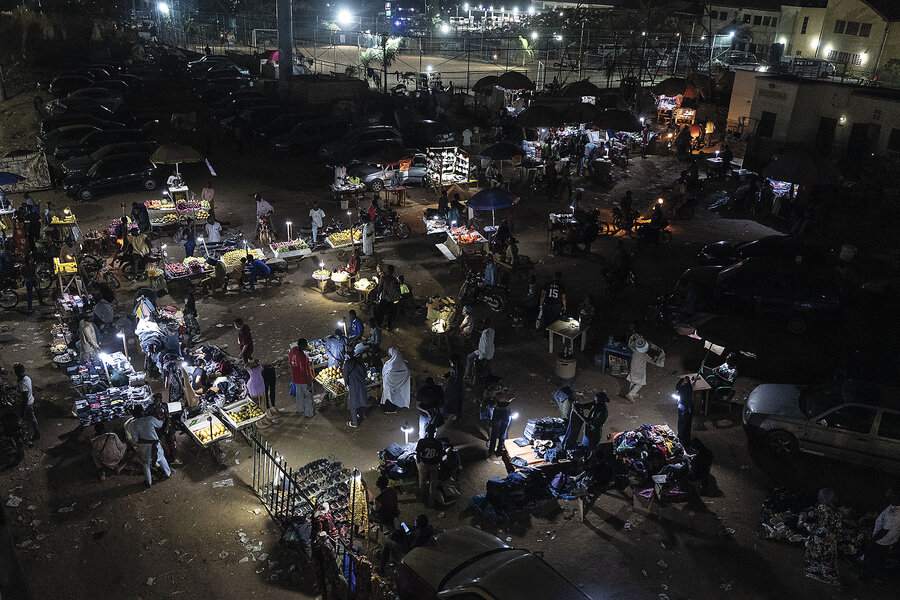
Sandra Ogbebor hunches over her softly humming refrigerator and scours through bottles before finally yanking out an orange juice. She hands it to a customer who has been waiting in her food stall, one of many informal shops tucked in an open-air food market in the Nigerian capital. The customer gulps it down in a single stretch and drops it into a bin – visible proof of his relief, at least for this moment, from the sweltering heat.Ms. Ogbebor runs her cold-drinks business mostly off a rickety, gas-powered generator, as Nigerians are unable to rely on the country’s dodgy electric grid.Some 90 million of Nigeria’s 242 million people live with limited access to electricity, a problem that the World Bank estimates costs the economy $29 billion annually. Decades of corruption and mismanagement of the power sector have forced many businesses to use alternative sources, such as generators. Why We Wrote This Some 90 million of Nigeria’s 242 million people live with limited access to electricity, a problem the World Bank estimates costs the economy $29 billion annually. For small-business owners, resourcefulness is the name of the game. But with war in the Middle East also sending fuel prices soaring, small businesses in Nigeria are bearing the brunt. In Abuja, creativity is the name of the game.At beauty shops, for example, frequent power outages don’t stop the flow of commerce. Workers do their clients’ eyelashes by that 21st-century form of candlelight – their cellphone flashlights. ENERGETIC: Ahmed Umar (left) works with a client at a gym powered by a solar inverter at night. The gym where Abuja resident Ahmed Umar works installed solar panels, and switched its hours to operate in the early morning and late evening, cutting out the hottest part of the day to save on air conditioning. The work-arounds have hardly dampened his sales pitch. Electricity or not, he’s always ready to do business.“I sell gymwear; I sell gym equipment, too,” Mr. Umar, one of Nigeria’s ubiquitous jack-of-all-trades entrepreneurs, eagerly tells this Monitor contributor. “If you need gym equipment, I’m your guy. I can facilitate your gym. I can design your gym.”Vincent Nwonye, who used to do brisk business in Abuja as a generator repairman, has seen the work dry up as residents abandon even their backup energy source amid the high cost of gas.“They call us the giant of Africa,” Mr. Nwonye says wryly. “Maybe it’s yet to come.”Meanwhile, Ms. Ogbebor buys ice blocks to keep her business afloat – five blocks when there is no “light,” as Nigerians colloquially refer to electricity. Even when the light is on, she buys two blocks, to cut down on generator time. And she won’t let the heat defeat her.“You cannot sit down at home,” she says. “If you sit down at home, you will even be worse. So, you have to be coming out.”Resting under the shade of a red canopy near her stall, a group of young men signals to Ms. Ogbebor to bring out more drinks. She dashes to the refrigerator. Business, unlike the light, cannot stop. A DRAIN ON BUSINESS: Vincent Nwonye pull-starts a gas-powered generator after repairing it at a workshop. His business has dried up amid high fuel costs. STOVE LIGHT: Aisha Umar (no relation to Ahmed Umar) cooks a meal over an open firewood flame using a flashlight. CLEAN ENERGY: Teenager Gambu Tijani washes his clothes by flashlight. Some 90 million of Nigeria’s 242 million people live with limited access to electricity. SOLAR SCHOLARS: Children read under a rechargeable solar lamp at night. POWER BROKER: Mustapha Yahaya, who charges customers’ devices for a fee, plugs in a phone.
To beat a rickety electric grid, Nigeria’s capital gets creative
Full Article
Original Source
Read the full article at Csmonitor →KhanList aggregates and links to publicly available news content. We do not host full articles from third-party sources. Always verify important information with original sources.