
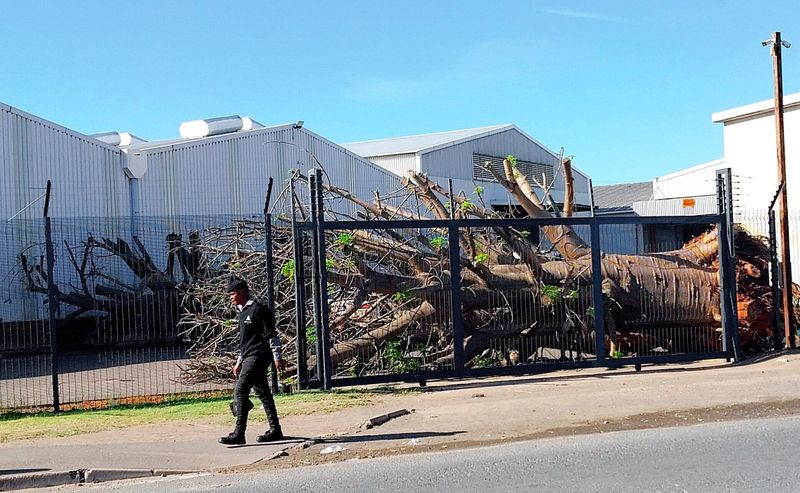
At least five large baobabs – with their roots and branches mostly severed – have been impounded at a Durban warehouse owned by Africa Global Logistics (AGL), a Paris-based subsidiary of the MSC Group (Mediterranean Shipping Company).According to the South African Department of Forestry, Fisheries and the Environment (DFFE), criminal charges have been laid against various parties after the exporters failed to produce a valid possession or export permit, as required by the National Forests Act.Baobabs, an iconic African tree species that can live for up to 2,000 years, are among the nearly 50 specially protected indigenous tree species that may not be cut down, damaged, moved, stored, sold, transported or exported without a special official licence from the DFFE.A large baobab framed against the sunset in Limpopo. (Photo: Tony Carnie) The identities of the Georgian buyers or their agents have not been disclosed, while AGL regional marketing manager Candy Botha proclaimed: “Our position remains that AGL, as a logistics service provider, is not the owner, exporter or permit holder in respect of the goods referred to in your enquiry.”The Eurasian nation of Georgia, located between Russia and Turkey, is home to several billionaires, including politicians, business owners and fintech moguls. The climate features subtropical summer temperatures along the Black Sea coast, along with snow and sub-zero temperatures in the continental and inland mountain areas.While AGL insists that it is simply a “service provider”, University of KwaZulu-Natal environmental law expert Professor Michael Kidd suggests that the activity of transporting protected trees could trigger legal prohibitions on both possession and transport.The Durban baobab bust came to light after Daily Maverick, acting on a tip-off, visited an AGL warehouse on the corner of Bluff and Hutchinson roads in the Mobeni industrial area last week and took photographs of at least five baobabs visible through the metal mesh fencing surrounding the facility.All the trees were lying on their sides in a paved area and appear to have remained in this position, unsheltered from the sun, for between two and three months.One of at least five large baobabs lying on their sides at an AGL warehouse in Durban. (Photo: Tony Carnie) The AGL warehouse on the corner of Bluff and Hutchinson Roads in Mobeni, Durban. (Photo: Tony Carnie) When Daily Maverick knocked on the AGL gates to request further information about the legal status of the trees, staff said that the warehouse manager was on leave and they were unable to provide any information immediately.When we sent emails to AGL’s Johannesburg-based head of legal, Anel Coetzee, COO Fergus Fitch and MD Graham Petzer, the company issued a brief response, stating:“AGL acted in its capacity as a logistics service provider in relation to the goods referred to in your enquiry. The issues raised in your questions extend beyond AGL’s role and responsibilities in relation to the cargo. Accordingly, we do not consider it appropriate for AGL to comment on these matters and respectfully suggest that the relevant enquiries be directed to the appropriate parties and/or competent regulatory authorities.”When we persisted, requesting details of the “appropriate parties” – such as the owner and exporter of the trees – and whether AGL could verify that the protected tree shipment to Georgia was legally authorised, company spokesperson Botha remained adamant that AGL was simply a “service provider”, rather than the owner or exporter of the trees.“For that reason, we are simply not the appropriate party to confirm or comment on permit compliance, origin, destination, or related regulatory matters, as these fall within the remit of the owner/exporter and the competent regulatory authorities, including the DFFE, whom you have already mentioned.“We also highlight, in the same spirit, that because we are not the permit holder, we are not in a position to confirm compliance either way and we suspect the same may apply to the information available to you at this stage.”“... We are unable to disclose the identity or contact details of AGL’s client as this is confidential information. Should any competent authority require AGL’s assistance in identifying the relevant parties for regulatory purposes, we will of course cooperate through the appropriate official channels.”We also invited AGL to advise its clients of our interest in the matter in order to clarify their position on the matter.Now, following Daily Maverick’s separate inquiries with the DFFE, it has come to light that there are, allegedly, no valid export licences – nor any valid permits for the uprooting and removal of the trees, which are believed to have been removed from the Waterberg district in Limpopo.Forestry professor Brian Bredenkamp and a group of youngsters dwarfed by the massive Ga Ratjeke baobab near Modjadjiskloof in Limpopo in 2009. (Photo: Supplied / Brian Bredenkamp) Geoff Nichols, a veteran indigenous plant specialist, author and landscaper, said he could not comment on the legal issues in this case. However, based on our photos, he estimated that the trees were more than 50 years old if they were removed from the wild, or possibly 20 to 30 years old if they were cultivated trees that had benefited from artificial watering.Nichols also voiced concern about the current conditions of storage and suggested that they should rather be stored upright, or preferably moved to a nursery to aid their survival while the legal issues are resolved.“Two or three months is a very long time for a succulent to be lying horizontally on a hot paved surface in full sun. With most succulent plants, if dug out of their original home, they need to be transferred to their new home as quickly as possible.”Responding to our queries, a spokesperson for the DFFE said: “When the trees were intercepted at Africa Global Logistics on 17 July 2026, the exporter failed to produce a valid licence issued under the National Forests Act authorising the disturbance, removal, possession, transportation, selling and exporting of the protected trees.“On 27 July 2026, the exporter submitted an application to the Department for a licence covering the removal, possession, collection, transportation, export, and purchase of the five protected trees. The application was declined on 31 July 2026 because the matter is under criminal investigation and the Department will not issue a licence retrospectively to regularise allegedly illegal criminal activities. The applicant lodged an appeal on 8 August 2026, which is currently before the appeals administrator.”On whether the exporters had complied with regulations, the department said:“No, the applicants have not complied with the provisions of the National Forests Act. The trees were harvested in the Lephalale Local Municipality, Waterberg District, Limpopo province, and were scheduled for export to Georgia, Europe.“The Adansonia digitata (baobab) tree species is also protected under the provincial legislation, the Limpopo Environmental Management Act (LEMA), 2003 (Act No. 7 of 2003). No permit was acquired under the LEMA.”As a result the DFFE had opened criminal charges, in a case where the law provided for a fine or jail terms of up to three years.The DFFE has not responded yet to requests for clarity on the identity of all the parties facing criminal prosecution.In its latest sustainability report, AGL pledges the company’s commitment to “protecting and preserving biodiversity and ecosystems” and to “reduce the impact of its activities on natural environments”. DM
TIP-OFF AND BUST: Baobab trees seized in Durban ship warehouse probe
Full Article
Original Source
Read the full article at Dailymaverick →KhanList aggregates and links to publicly available news content. We do not host full articles from third-party sources. Always verify important information with original sources.