
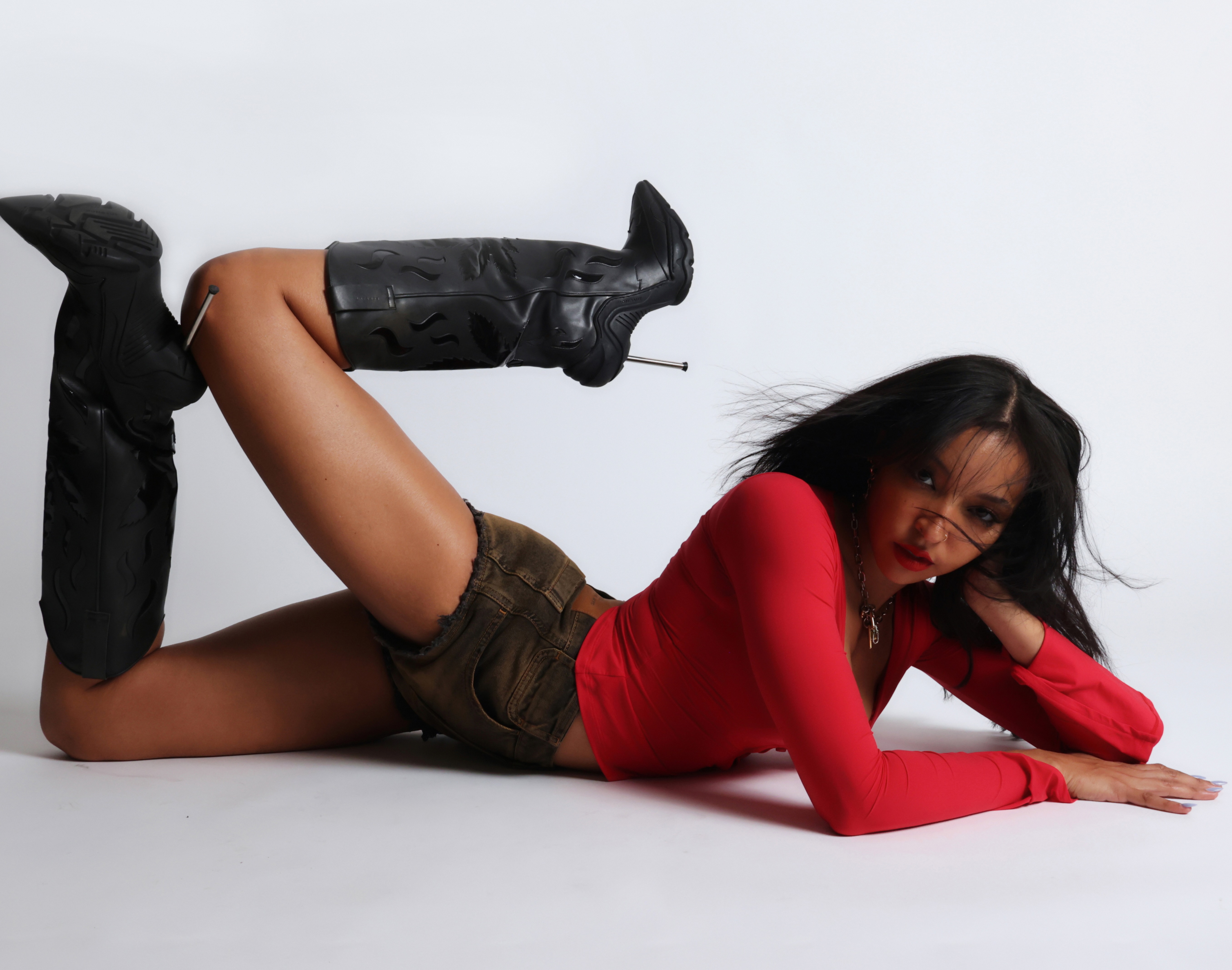
Tinashe has an eye for detail. This becomes clear a few minutes after she arrives at the airy Bishop Gallery in Brooklyn, wearing a Denim Tears shirt aptly emblazoned with a photo of New York art world icons Lee Radziwill and Andre Leon Talley. Surveying the exhibit, a collection of native son Jean-Michel Basquiat’s early work, she pauses in front of a handwritten page from an abandoned screenplay. “His E’s,” she observes. “They’re all over the place.” Too busy trying to make sense of the plot, I had missed the strange beauty of the E’s. Maybe it’s predestined — as an Aquarius, a child actor, an oldest daughter — but the 33-year-old singer, songwriter, dancer, and actor has the keen ability to dig into what’s different. “I like to try to challenge myself to make something that is unexpected,” she says. “People will come with an idea of what they think I want to hear, or the direction I want to go. Oftentimes, it's way more interesting to challenge their idea of what that is and make the opposite of that.”Popstar is a record that bucks expectations. Tinashe’s eighth album, which she’ll release this Friday, is technically the last in a trilogy she started with 2023’s BB/Ang3l and 2024’s Quantum Baby. But when she began writing this album two years ago, “It felt like something else,” she recalls. "I was following my inspiration and what felt right, and it didn't feel complete until I made a lot of songs."Longer than her last two releases combined, Popstar pulls from R&B and trap, jazz and new age; there are TikTok samples and spectral, reverberating interludes. “Sunglasses,” produced by Arca, combines sparse electronics with a shuffling beat and Tinashe’s hazy falsetto. Anchored by a four-on-the-floor rhythm, “Melatonin” hits the ground running and picks up steam as it incorporates rubbery synths and acid breaks. There is a palpable energetic shift on the meditative “Empty Stadiums,” a chorus of violins echoing Tinashe’s anxieties about being “enough.” But these transitions feel natural in the context of the record, grounded by her chameleonic voice—blunt and staccato on “Too Easy,” belting to the back row on “I’d Rather Be Alone.” “Popstar is an energy,” Tinashe explains. “It’s a persona one can embody.” There’s a detachment implied by the idea of a “persona,” the contradictory need to be both universally known and larger than life. The album’s cover — an extreme close-up of her face looking past the camera, irises dotted with stars — captures this “uncanny valley” of fame. “There's this glamorous side, which is very real,” Tinashe says. “I get to do really fun things, have great adventures every day, meet great people, connect with fans.” But of course, there’s the other side: “Hyperawareness in public, the surveillance of it all, the judgment, the media.” Popstar is an album about embracing the nuance of living in both realities. “The good and bad coexisting creates this weird gray area. I think it's fun to represent that.” Tinashe is also wary of the “authenticity” trap, the premise that every song should reveal something deeply personal about its singer. “People want music to be personal and autobiographical, but I just think that authenticity can be performative,” she says. “On the flip side, things that seem inauthentic a lot of times can be very authentic.”"I'm pushing back on the TikTokification of it all, splintering creative projects into micro moments."TINASHEShe resists the idea that her art has to closely mirror her life offstage. “I've always found a lot of agency in expressing my sexuality through music,” she says about her steamy 2024 single “Nasty.” “I don't really date that much, and I find a lot of my expression of my sensuality is through the art, and in my performance.”As far as her ur-popstars, her north stars of charisma, talent, and style, Tinashe keeps returning to Janet Jackson and Britney Spears. “These are gals who never put themselves in a box, but embodied [being a popstar].” The unspoken follow-up question, of course, is how to avoid the worst fates of these women: buckling beneath the scrutiny of the public, experiencing the inevitable “Crash Out” Tinashe sings about on Popstar. Ever-aware of these extremes, there’s a relentless self-scrutiny that carries throughout Popstar. The bravado on “Too Easy” and the easy swagger on “Overdramatic” are delivered with a wink. “There’s a lot of sarcasm on this project,” Tinashe says. “I'm both serious and kidding at the same time. With the performance of it all, I do have to be committed to the bit of being ‘a celebrity.’ But do I actually feel that way in my day-to-day life, or biologically? Not really.” For Tinashe, who was raised in Los Angeles, her local community outside of the Hollywood machine has helped keep her grounded. “I'm really close to my family, my parents, my brothers, my best friend,” she says. “I've had the same best friend since I was eight years old. It’s very stable and secure amidst all the instability of the industry.”Walking around the gallery, passing drawings Basquiat did for his high school newspaper, I wondered how Tinashe related to her early work. Is she the same person she was when she released Aquarius in 2014? “Certainly not,” she says. “I’ve just grown up a lot, as a person, as a woman artist.” And yet she still finds common threads from her past. “Sometimes I listen to my earlier works and, especially thematically, it feels like something I would write now. Things that I wrote 10 years ago, I find them to still be relevant now.” And whereas her self-assurance back then feels “naive,” she says, now it feels earned. “At first, I just thought, ‘Art, isn't it great?’ And then life sinks in. It's not all butterflies. Now, I've circled back to ‘Wow, it's great, it’s amazing.’”But perhaps the biggest change she’s noticed is her confidence in the studio. “In my younger days, I had a harder time being firm with my ideas. I was much more open to the collaborative process, which I think is a truly good thing,” she recalls. “But at the end of the day, it is my art.” Now, when she’s in the studio, she’s not afraid to say, “Let’s get weirder.” She is definitively anti-AI in her art because it strips away that kind of emotional intuition. “The whole purpose of making art is to go on the exploration, to make something — good or bad — yourself,” she says. “I've never heard an AI song that I was moved by.”For Popstar, Tinashe followed her inspirations. The album took shape over two weeks last Christmas, at a sun-speckled studio in Los Angeles. As a creative outlet, Tinashe set up easels to paint in between sessions. She was joined there by a small cohort of her closest collaborators, including Ricky Reed, Zack Sekoff, and Travis Stewart (aka Machinedrum). “She challenged me and continues to challenge me,” Stewart says of his production work with Tinashe. For Popstar, he initially came into the studio with beats based on songs she had liked in the past, but “I was striking out,” he recalls. “So I really went deep into the crazier parts of my library, the stuff I almost never play artists, and of course, those were the ones she liked. The rest is history. It was really inspiring to see.”To Tinashe, the album format is almost sacred. “I'm pushing back on the TikTokification of it all, splintering creative projects into micro moments and like sound bites and little ideas,” she explains. “For me, the album is so much better in its entire context. Bite-sized pieces are just really never gonna get the full idea. I hope that people take all these bite-sized moments and use that motivation to dig deeper into long-form ideas.”Popstar, then, is perhaps best consumed like a film, a plot carried through in both lyrical and melodic crescendos and crests. “We go on an adventure throughout the album,” Tinashe says. “It starts very confident and in your face, and then evolves and gets a bit more introspective.” The last song, “Heavy Weight,” is strikingly pared back, just a guitar and Tinashe’s voice. “I think it's nice to end with this touch of nuance to the whole concept,” she says. A few days after our museum visit, throngs of sweaty dancers filled the halls of a cavernous carriage house on the Lower East Side. We shuffled and swayed to the musical selections of the Dare (“SexyBack,” “Move Your Feet”) as we waited for the reason we were all there that night. Finally, just after 10, Tinashe stepped behind the booth. In sunglasses, headphones, and a baseball hat, she projected an air of ineffable coolness, an effortless ease. As she turned up the mix and “Crash Out” started to play over the booming soundsystem, she looked out onto the crowd and smiled. Here, finally, was a real popstar.Writer: Arielle GordonPhotographer: Sydney JacksonEditor-In-Chief: Scott LapatineStyling: Anna TrevelyanMakeup: Brittany WhitfieldHair: Karen MillerVideo: Spencer KellyVideo Interviewer: Rachel BrownSUPPORT STEREOGUM
Tinashe Is Her Own Kind Of Popstar
Full Article
Original Source
Read the full article at Stereogum →KhanList aggregates and links to publicly available news content. We do not host full articles from third-party sources. Always verify important information with original sources.