
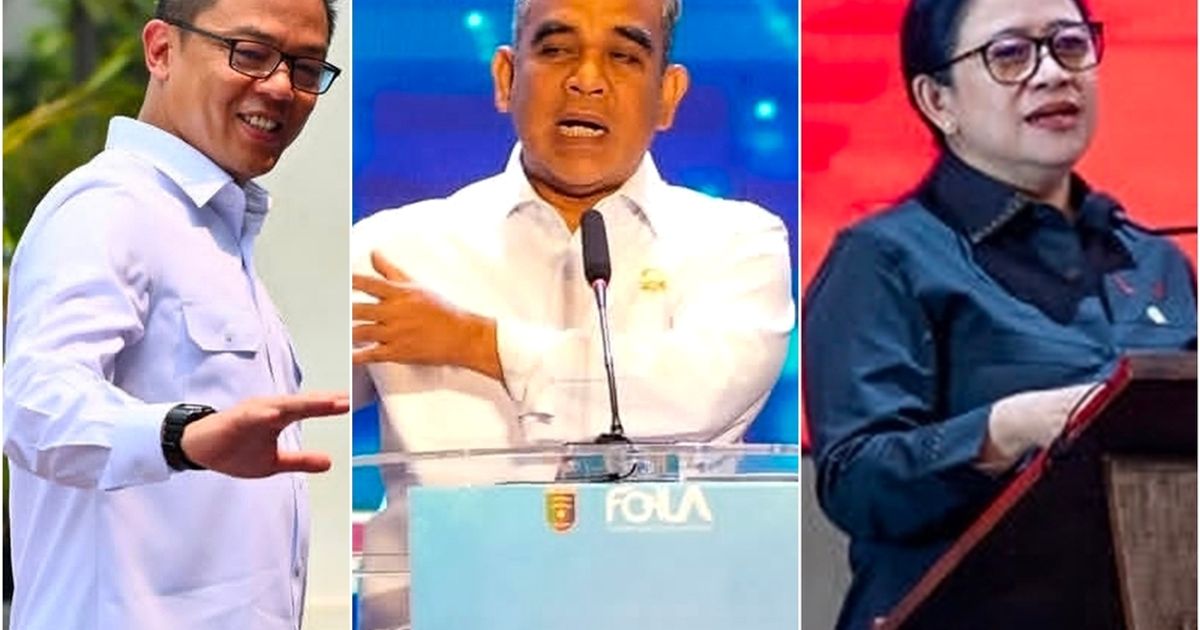
JAKARTA – Indonesian President Prabowo Subianto is seeking a new vice-president following Gibran Rakabuming Raka’s resignation on Nov 12 and three names stand out.Two are from his own party, Gerindra: Sugiono and Ahmad Muzani. The third is House of Representatives Speaker Puan Maharani of the opposition Indonesian Democratic Party of Struggle (PDI-P).Each reflects a different priority – loyalty, political networks or stability – and the pick could reshape the balance of Prabowo’s coalition and his plans for the 2029 presidential election.Two of Prabowo’s most trusted aides have narrowed the proposed candidates to two, sources following the discussions told The Straits Times on condition of anonymity.One aide favours Muzani, who is Speaker of the People’s Consultative Assembly (MPR) and was Gerindra’s secretary-general for 17 years until 2025. Another close aide backs Sugiono, Gerindra’s current secretary-general and Coordinating Minister for Human Development and Cultural Affairs, who served as foreign minister until Oct 1.“Muzani’s strengths lie in his charisma and his strong network among MPs and other politicians,” a senior Gerindra official, one of the two sources, told ST by phone on Nov 13.Sugiono is the loyalty pick, said the other source, a senior government official. A Gerindra-Gerindra pairing removes any risk of a vice-president with an independent power base or ambitions – a problem Prabowo once faced with Gibran.Observers say that Puan, the daughter of PDI-P chairwoman and former Indonesian president Megawati Soekarnoputri, is the stability pick.PDI-P is the only party in the House outside the government, and bringing in one of its members would give Prabowo “total control” of the House, with every seat behind him, said Ambang Priyonggo, a political analyst at Multimedia Nusantara University.Any vocal opposition would then have to come from political forces unaffiliated with parties in the House. PDI-P’s village-level network, loyal to its elites, would also give the administration a grassroots reach that Gerindra, as a younger party, cannot match.The trade-off is control versus cover, according to political analyst Firman Manan of the University of Padjadjaran and observers ST spoke to. Sugiono keeps power concentrated but adds no new political weight, and any Gerindra pick could leave coalition partners like Golkar feeling sidelined. Puan delivers stability and reach, at the cost of sharing the palace with a party that has stayed outside the cabinet so far, and with a figure who could use the post as a launchpad for 2029.ST understands that Prabowo is still gathering inputs from the public, ruling coalition party leaders, academics among others before deciding on the two nominees.The choice will be made by the People’s Consultative Assembly (MPR), a joint assembly of the 580 members of the House of Representatives (DPR), and the 152 members of the Regional Representative Council (DPD), which speak for the provinces.The MPR, which swears in the president and vice-president, will pick a new vice-president from two candidates nominated by the President.The DPR is the country’s main law-making body. It passes laws, approves the state budget and oversees the government, and its seats are held by party blocs. Its members make up nearly 80 per cent of the MPR, so the parties, or a coalition of parties that control the DPR, have the biggest say in who becomes vice-presidentGibran, 39, handed his resignation letter to the MPR on Nov 12.Around 120 MPs from all eight factions had proposed a motion to start impeachment proceedings against him, after rulings by the Constitutional Court and the Supreme Court questioned the overseas school documents he used to qualify for the 2024 election. Parliament said the vice-presidency became vacant on Nov 12 and that the MPR must fill it within 60 working days.The President has 14 working days from the MPR’s request letter to submit two nominees. Ambang of the Multimedia Nusantara University told ST that the outcome depends on Prabowo’s priorities. If the aim is consolidating his own party, a Gerindra figure is the right fit, though that could stir tensions because Prabowo has so far been propped up by a big coalition of other parties, he said.Agung Baskoro, executive director of political research group Trias Politika Strategis, said the choice will most likely be a Gerindra figure. The President needs political consolidation and stability, he said, and coalition partners would understand that.Political analyst Firman Manan, of the University of Padjadjaran, said a Gerindra vice-president would be least likely to cause trouble. Such a figure would be “fully under the President’s command”, he said, so there would be no manoeuvring by the vice-president, “including in 2029”. The 2029 election factorThat calculation matters because Prabowo can still seek a second term, Firman said. He expects the President to weigh whether any candidate could become a rival in 2029. That is why he considers Democratic Party chairman Agus Harimurti Yudhoyono an unlikely choice, as appointing him to the post could pave the way for a future rival.Puan faces the same question, though Firman said it could be resolved given that Prabowo and her family have known each other for very long decades. She could still be chosen if a political deal ensures she remains Prabowo’s running mate in 2029, he said.Ambang said Prabowo has so far appointed coalition party chiefs to cabinet posts no higher than coordinating minister. They include Golkar’s Bahlil Lahadalia, the National Awakening Party’s (PKB) Muhaimin Iskandar, the National Mandate Party’s Zulkifli Hasan and the Crescent Star Party’s Yusril Ihza Mahendra. Picking one over the others would be hard, he said, as their political weight is relatively balanced.That leaves PDI-P, the only big party outside the coalition. Even though PDI-P’s strength poses little threat to the government, Ambang said, choosing a figure from the party would give Prabowo total legitimacy. It would cement his hold on power in both the executive and legislature by removing any potential for opposition.Economist Wijayanto Samirin of Paramadina University agreed that a PDI-P pick would be the most beneficial politically but said PDI-P may not accept the offer.ST understands some circles in PDI-P want to reject any such offer, saying Prabowo’s administration is underperforming and the party should not be associated with it. Others in the party argue that if PDI-P joins the ruling coalition, it deserves ministerial posts as well.Firman said a Puan pick would carry its own costs. Parties that backed Prabowo early, such as Golkar and PKB, would expect compensation, probably through a cabinet reshuffle. They would also complain that PDI-P received bigger concessions, he said.Other options: a technocrat?Ambang sees a third possibility: a technocrat with no political background.If Prabowo’s priority is government performance rather than politics, such a figure could be a strategic choice, particularly to answer growing public criticism of his administration, he said.Economist Wijayanto said the ideal replacement would run with Prabowo in 2029, keep the coalition steady, and not become a Gerindra rival in the 2034 presidential election. If PDI-P declines the offer, the pick is likely to be someone from Gerindra or without a party background, he said.He named Muzani; Mahfud MD, a former coordinating minister for political, legal and security affairs; religious affairs minister Nasaruddin Umar; former tourism minister Sandiaga Uno, among others, as relatively safe options.
Three names that stand out in race to succeed Gibran as Indonesia vice-president
Full Article
Original Source
Read the full article at Straitstimes →KhanList aggregates and links to publicly available news content. We do not host full articles from third-party sources. Always verify important information with original sources.