
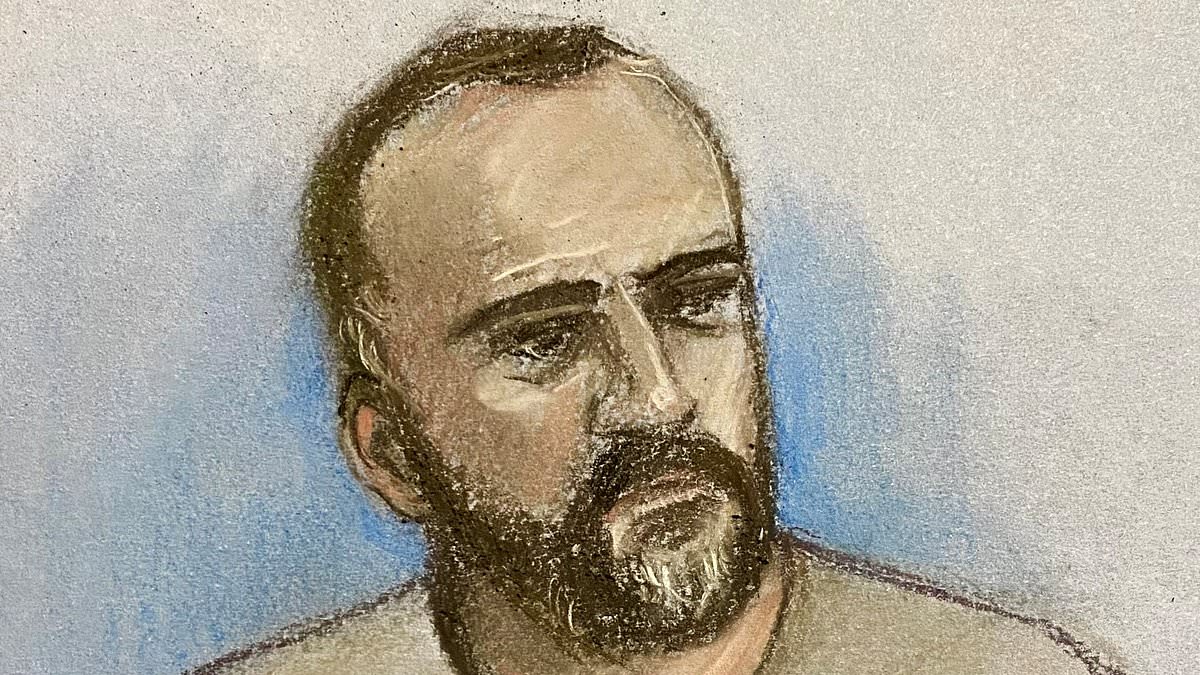
Three alleged Iranian spies ran a surveillance operation in the UK as they plotted to 'eliminate' dissident journalists, a court has heard.London-based Mostafa Sepahvand, 41, Farhad Javadi Manesh, 46, and Shapoor Noori, 57, allegedly used Chat GPT to help conduct research and then engaged in surveillance and reconnaissance.Sepahvand was intended as the hit man, who would conduct 'serious violence' as 'retribution' for their criticism of Tehran, Woolwich Crown Court was told.Bill Emlyn Jones KC, prosecuting, said: 'In this trial, we are concerned with steps being taken, here in London, on behalf of the Iranian regime, to target journalists and others considered to be hostile to, or just critical of, the Iranian regime.'The evidence illustrates that these defendants carried out surveillance and reconnaissance, visiting addresses linked to their targets - taking photos and taking videos and doing online research about them.'The men allegedly used AI to research where their targets lived and where they worked and conducted surveillance to work out what their routine was, what cars they drove, how the relevant buildings were laid out, and who they spent time with.'This information will help the planning where these targets may be susceptible to an attack. Such information is of obvious value to a foreign intelligence service seeking to monitor and target these individuals,' Mr Emlyn Jones said.The prosecution allege that the men were carrying out surveillance and reconnaissance to locate and target at least two journalists associated with news agency Iran International between August 2024 and March 2025. Mostafa Sepahvand, 39, was the alleged hitman for the plot Shapoor Qalehali Khani Noori, 55, is also charged in connection with the plot Farhad Javadi Manesh, 44, is the third defendant on trial at Woolwich Crown Court'During that period the three defendants were engaged in what is very obviously a form of spying,' the prosecutor said.'It is the prosecution case that their ultimate objective was that one or perhaps more than one of their targets would be subjected to serious violence - no doubt as retribution for their criticism of the Iranian regime - and to try to silence and deter others who might dare to voice such criticism.'Mr Emlyn Jones said the Islamic Republic of Iran and its rulers, 'do not and cannot, tolerate dissent' and those who criticise the regime, 'do so at their peril'.'This is true within Iran, where those responsible for any press or media coverage which is critical of the regime are harassed and intimidated, to the point where the media within Iran almost exclusively tends to echo and support the regime's official ideology.'However, even overseas, critics of the Iranian regime are at risk. Persian language satellite TV channels broadcasting from abroad and outside the immediate reach of the Islamic Republic have come under increasing attack.'Mr Emlyn Jones said that Iran International was critical of the regime and was 'therefore very much in its sights'.He added: 'Eliminating hostile, critical voices or dissident actors overseas has become effectively a staple policy of the Islamic Republic.'None of this was particularly high-tech, or very sophisticated but it served a simple purpose - to gather enough information about their targets, so that they could be made to suffer the consequences of daring to criticise the Iranian regime.'Manesh and Noori accept going to the relevant places to take photos and videos but say they did not know they were doing so for the Iranian intelligence services, the court heard.Sepahvand accepts carrying out surveillance and reconnaissance for the Iranian regime but says he only did so because he feared the consequences of refusing.'His case is also that he deliberately did a bad job of it, so that the Iranian intelligence service would not actually get the assistance they wanted,' Mr Emlyn Jones said.The men also targeted a barrister who founded the UK Lawyers for Israel, the court was told.'The Islamic Republic of Iran is profoundly hostile towards the state of Israel, and it would appear that being a lawyer for Israel is enough to put you on the radar of the Iranian intelligence services, and so to have your details circulated between these two defendants,' Mr Emlyn Jones said.Two aerial images sent over WhatsApp by Sepahvand to Manesh on August 14 2024 referred to the 'subject's' work address and 'possible aerial location of the subject's apartment'.The images showed the registered office of UK Lawyers for Israel and the barristers' chambers in Chancery Lane for Jonathan Turner, one of the group's founders.The TV station Iran International reports on Iran's human rights violations, economy, political developments, LGBTQ+ rights and other topics sensitive to the government in Iran, the court was told.'You can probably guess how the Iranian regime feels about Iran International,' Mr Emlyn Jones said.Evidence from Sepahvand's mobile phone showed he had asked Chat GPT for the address of Mojtaba Pour Mohsen, one of the station's journalists.It was unable to help but he still acquired the details which appeared in a 'targeting package' in Farsi, later found on his phone.The document included details about the office of Volant Media, Iran International's parent company and the nearby Clayton Hotel, on Chiswick High Street in west London, adding: 'The subject's meetings and interviews with people are held in this hotel.'Mr Mohsen had security concerns about his home address and had been living in the Clayton Hotel around Christmas 2024.'That coincides with the period when the defendants were conducting their surveillance. He had every reason to take this seriously,' Mr Emlyn Jones said.The Iranian Ministry of Intelligence and Security is the 'pivotal' intelligence agency within the Iranian government with 'significant influence' in safeguarding the Islamic Republic's interests domestically and internationally, including targeted assassinations of dissidents in Iran and abroad.'The selection of targets is guided by the government's perception of the threat posed by the individual in question,' Mr Emlyn Jones said.'This reflects the regime's determination to quell dissent and eliminate perceived adversaries, reinforcing its grip on power. The agency has adopted an aggressive approach.'The Islamic Revolutionary Guard Corps Intelligence Organisation is a second 'crucial pillar' in the intelligence structure and has gained notoriety for its involvement in the abduction and assassination of dissidents inside Iran and beyond its borders.Sepahvand, from St John's Wood, Manesh, from Kensal Rise, and Noori, from Ealing, deny assisting a foreign intelligence service.The trial continues.
Three Iranians accused of spying on journalists in UK as part of wider plot to attack dissident TV station staff
Full Article
Original Source
Read the full article at Dailymail →KhanList aggregates and links to publicly available news content. We do not host full articles from third-party sources. Always verify important information with original sources.