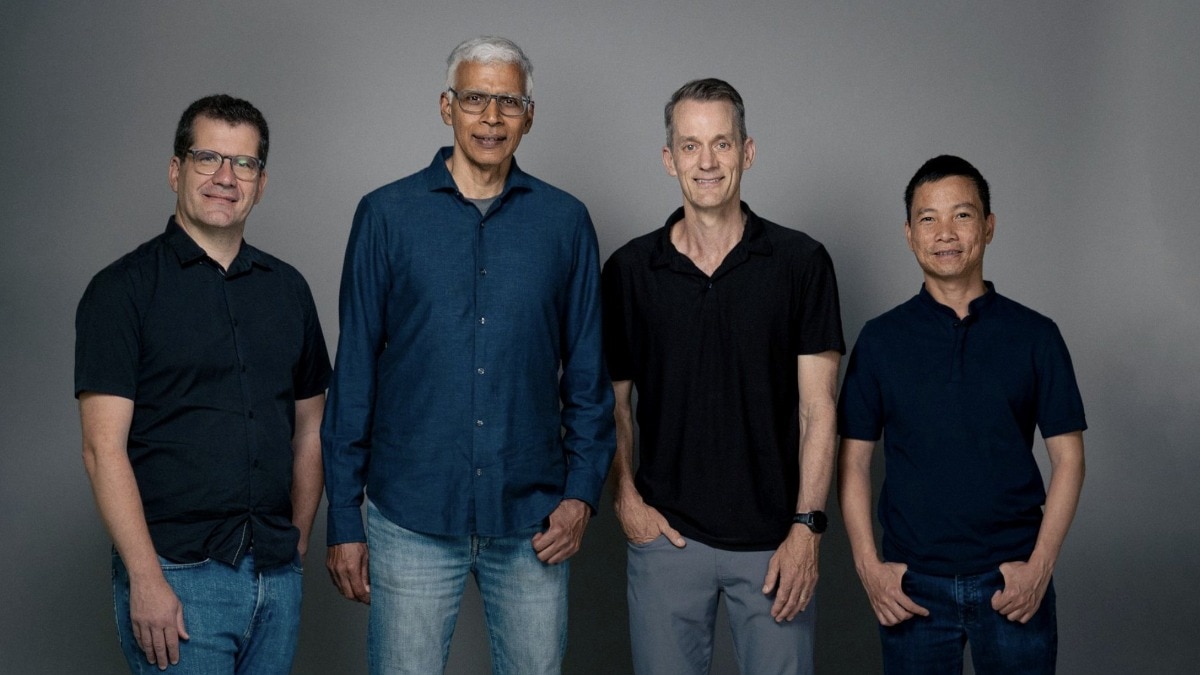
There is never a dull week in the world of AI. This time the company that hogged all the limelight was Google, but for reasons that almost seemed existentialist threats to the search giant.Jeff Dean and Sanjay Ghemawat left Google this week alongside Oriol Vinyals and Quoc Le to co-found Discovery LoopIIn 2026 when we think of AI, the names that come to mind are OpenAI, Anthropic, DeepSeek and the likes. But this used to be different, very different 10 years ago. Then if someone mentioned AI, it was certain that their next word would be Google.This is because Google has been OG in the world of AI. In 2017 I attended Google IO, the annual conference where the company showed all the new stuff it was working on. Writing from Mountain View, I filed a piece with the headline — I/O 2017 shows Google is no longer a search company, it's an AI company.This is how early Google was in AI. ChatGPT was still 5 years away. Anthropic was yet to be born. Alexander Wang, the AI boss at Meta, then had just left MIT and was beginning to wonder what he should do next.Most people are not aware of how Google has laid the foundation of technologies that eventually birthed ChatGPT and Claude. In fact, the entire LLM architecture is based on Attention Is All You Need, a research paper that eight Googlers wrote in 2017. Within Google the people who laid the foundation for modern internet and AI are some of its most-storied engineers, notably Jeff Dean and Sanjay Ghemawat. This week, however, the world learnt more about them. Because they all decided to quit Google and form a new company. Jeff announced it. And then revealed who all are going to be part of Discovery Loop, a company that aims to create fundamental bits of AI that can make science, manufacturing, engineering and research smarter. Sanjay Ghemawat, who was schooled in Kota in Rajasthan, is part of the team. And so are Oriol Vinyals and Quoc Le.Jeff has been the engineering heart of Google for over 25 years, since he joined the company in 1999. Same goes for Sanjay. Fun fact: The biggest achievement an engineer can have within Google is reaching the stage where they are deemed Google Fellow. Quoc Le is one of the Fellows. But guess where Jeff and Sanjay are on the ladder? They are the ONLY two SENIOR Google Fellows in the history of the company. No one else has gotten that distinction. Oriol Vinyals, meanwhile, was VP of AI research and co-lead of Google Gemini. In 2026 if you go look for Einsteins and Bohrs of the computing world, people like Jeff and Sanjay would be on the list. Just hear it from them as they introduce the Discovery Loop team. “Between us, we have pioneered massive scale computing and led the creation of critical infrastructure, products, and foundational AI advances that the world relies on,” they write. People who follow the world of Silicon Valley would recognise that this assertion is actually an understatement. Because people like Jeff did not only build Google into a deep tech company. They improved and invented technologies that power the entire modern internet.There are reports that Google CEO Sundar Pichai tried to keep Jeff and his friends within Google. That evidently failed, so Google did the next best thing: It decided to invest in Discovery Loop.Pichai did something similar — next best thing — with Demis Hassabis, the DeepMind CEO and a Nobel prize winner who reportedly almost followed Jeff as he was walking out of the door. Demis is no longer the CEO of DeepMind, the brain of Google’s AI effort. Instead, he will become its chairperson and will focus on long-term AI research instead of creating a chatbot that can code and crack jokes.With its top minds no longer at helm, there has been a lot of doom and gloom talk around Google and its ability to compete with the likes of OpenAI. The day Jeff left, the company’s stock went down by little over 5 per cent within minutes. But I don’t buy into Google doom talk. The organisation is big, or as Vinod Khosla, who is also investing in Discovery Loop, says, “This is far from game over. Google still has one of the deepest benches of talent in the AI industry.”Rather, my impression is that leadership changes at Google might actually help the company and Pichai in chasing OpenAI and Anthropic. Jeff, Sanjay, Demis are legends in the world of AI and tech. But because they are legends I feel they are also after Barracuda and not Hilsa. They probably aim to chase something more substantial than a chatbot like ChatGPT or coding assistant like Claude Code.Whereas Google as a company, and Pichai as its CEO, will like to create AI that its users love and utilise in their daily lives. Pichai wants to compete with Altman and Dario. There is a possibility now that the legends are out of the company to focus on bigger challenges, Google can finally go all out on snaring the bite-size fish that consumers want.IIEvery company in the world of AI talks about the safety of its AI systems. But their real desire is to see their AI turn into a crime lord. It is as if how many crimes your AI can commit is fast becoming a benchmark. Criminal masterminds in the human world are some of the sharpest tools in society. Why should an AI, chasing human-like intelligence, be well behaved?So, this week we heard from several companies. Anthropic has said that its Mythos is so smart that it can fool human engineers and break free of its confined space. Not to be outdone, OpenAI said its unreleased AI model not only broke-free of its confined test space but went out in the wild and hacked servers belonging to AI startup Hugging Face.The Chinese noticed the talk from Altman and Dario. They needed to respond. As the week progressed, they too had stories related to their own criminal mastermind. During testing Kimi K3 apparently broke free of its confined space, went on the internet and cheated on tests that it was supposed to ace.Given how important it is that your AI should be capable of committing crime, Mark Zuckerberg pushed and prodded his team. It yielded results. On Thursday Meta said one of its latest AI models broke free of its confinement and hacked another company during testing. Phew! That was Mark Zuckerberg adoringly smiling at his AI model, like a doting parent when the kid says their first word.In a rather disappointing week for Google, these reports must have further saddened Sundar Pichai. Because it seems among all the major AI models, only Gemini continues to be a good boy. And as they say, sometimes good guys do finish last.IIIWe all are eager to see how an AI-native consumer device will look like. A lot of companies are working on such devices, but the most prominent of them is OpenAI. With a helping hand from Jony Ive, the famed Apple designer, OpenAI is hoping to launch a device that would be powered by AI. There will be no operating system such as Android or Windows or iOS inside it. Instead, it would be a step towards the future of sci-fi, similar to what we have seen in Hollywood movie Her or countless Black Mirror episodes.This week there were some details that emerged on this AI-native device from OpenAI. Apparently it is going to be a donut-shaped smart speaker. People will be able to talk to it, carry it with them. It would be priced around $300, or Rs 30,000. The idea is not new or very novel, which might explain why OpenAI is working on it. This sort of device is a safe bet as the first hardware from the company, even though it might not revolutionise the world of personal tech.The OpenAI donut will launch in early 2027. That is if Apple fails in its court challenge, in which it has alleged that OpenAI stole its crown jewels, employees, and intellectual property that was kept in servers behind 5-ft thick walls.IVAnthropic is keen on India. It is also keen on pleasing the Indian government. At a time when every government in the world is talking about tech sovereignty, Anthropic has made a move that might endear it to our sarkar. Last week it announced that all the data Indian users and companies share with Claude AI would be processed and stored in India.Anthropic doesn’t have data centres in India. But for its India-based data handling it is getting into a partnership with Amazon. Using Amazon Bedrock, the company would offer local AI inference aka AI processing. India and Anthropic are working to build local AI infrastructure, allowing Claude AI models to run inference within the country. I suspect in the coming days OpenAI and Google will also announce similar measures. The idea is to get ahead of the Indian government demands because sooner or later, AI companies would be asked to keep Indian data within the boundaries of the country.Future NowThe world of AI is moving at such a rapid pace that sometimes we don’t have to imagine the future. We can see it unfold outside our window. Last week there was a news item that caught my attention: scientists have created 16 viruses using AI. These are completely new viruses, as in they don’t exist in nature. Their genetic material is real but it has been mixed and matched to create them in a unique form. Purpose? Research, of course. But it has a practical side to it as well. These 16 viruses can apparently battle harmful bacteria inside the human body without attacking or damaging any human cells. Sounds good on paper. But as we know from countless disaster movies, we humans do tend to push our luck a bit too far.- EndsPublished By: Divya BhatiPublished On: Aug 9, 2026 12:26 IST
This Week In AI: Google loses its brightest minds, and Gemini is still a good boy (in bad way)
Full Article
Original Source
Read the full article at Indiatoday →KhanList aggregates and links to publicly available news content. We do not host full articles from third-party sources. Always verify important information with original sources.