
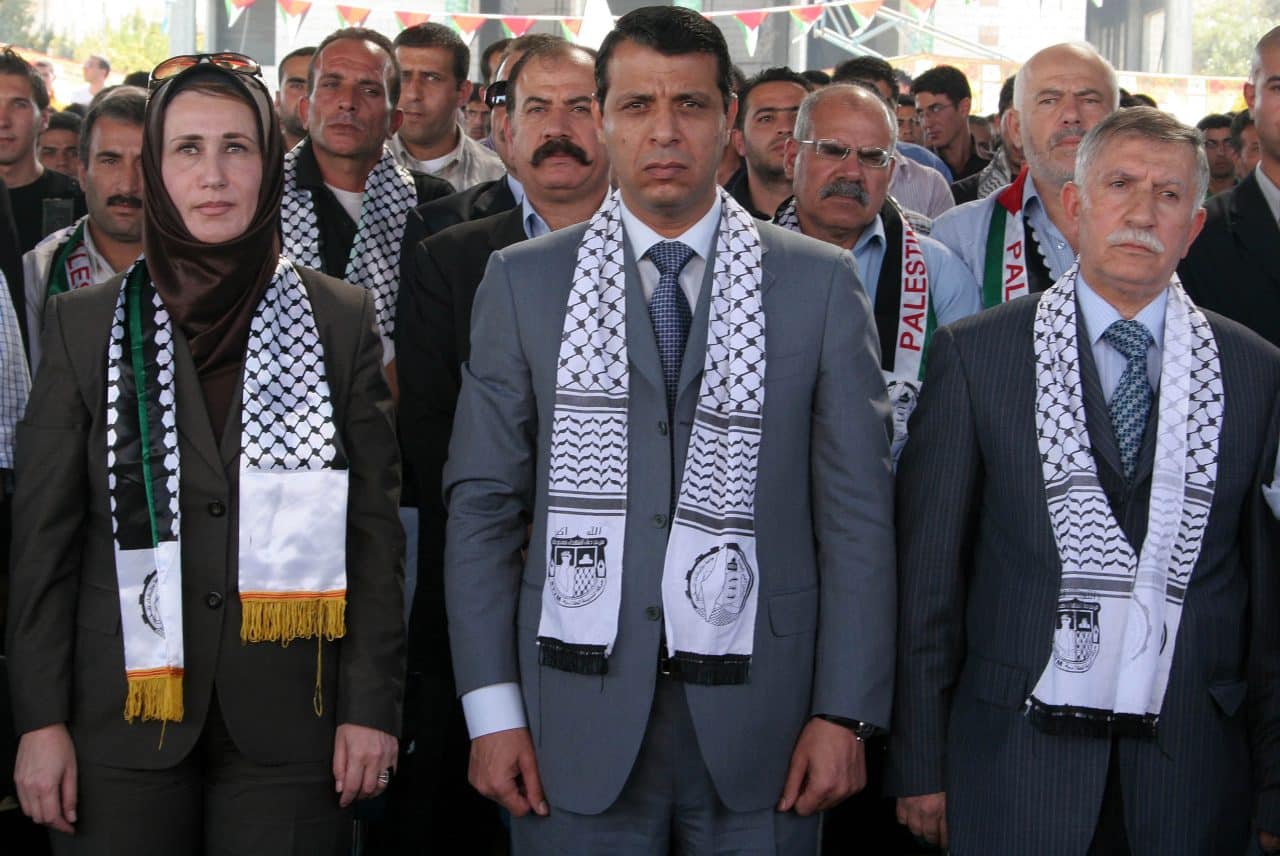
The Palestinian legislative elections scheduled for next November are already shaking up Palestinian politics in ways not seen in years, with different actors across the Palestinian political spectrum making power moves in an attempt to secure their position within a shifting political landscape in the fallout from the Gaza genocide. The latest of these moves is the announcement of a plan by UAE-based dissident Fatah leader Muhammad Dahlan to “end Palestinian division.” Dahlan’s plan is more than an election program, going so far as to propose a complete remaking of the Palestinian political system and a change to the decades-old way power balances have been managed in Palestinian institutions. Dahlan’s move doesn’t come in a vacuum. It follows the earlier announcement of an electoral alliance between Hamas, the Palestinian Islamic Jihad (PIJ), and the two main dissident currents in Fatah — one led by former Palestinian diplomat and nephew of the late Palestinian leader Yasser Arafat, Nasser Al-Qudwah, and the other led by Dahlan. The alliance brings together most of the main Palestinian political forces, with the exception of the leftist factions and the dominant Fatah leadership of Mahmoud Abbas, who runs the Palestinian Authority (PA) and serves as its President. Dahlan’s plan hasn’t been endorsed yet by his electoral allies, but they haven’t disavowed it either. The presentation of the plan right after forming the alliance establishes Dahlan as the alliance’s leading figure and puts him at the center of the Palestinian political game, closer than ever to a comeback to Palestinian leadership and decision-making. Long exiled to the UAE and declared persona non grata in both Gaza and the West Bank, Dahlan now seeks to claw his way back into political relevance with the financial backing of his Gulf sponsors. The reason he has a chance of succeeding is that his plan offers all sides — Hamas, Abbas, and the UAE-U.S. axis pushing Gaza’s postwar order — a way to claim national unity without settling who actually governs. That ambiguity is precisely what has kept such plans alive. Who is Muhammad Dahlan? Muhammad Yousef Shaker Dahlan was born in 1961 in the Khan Younis refugee camp in the southern Gaza Strip to a Palestinian refugee family from the village of Hamama near Asqalan, destroyed by Israeli forces in 1948. He joined Fatah as a teenager and spent five years in Israeli jails for his activism. In 1987, he was released and later deported by Israel shortly before the start of the first Palestinian Intifada. He joined Fatah’s exile apparatus, moving among multiple Arab capitals for several years, during which he grew closer to Yasser Arafat and eventually returned to Palestine with him after the Oslo Accords. Upon the establishment of the Palestinian Authority, Arafat named Dahlan head of the Palestinian Preventive Security Forces in Gaza, making him the main security officer in the Strip. As the man in charge in his own hometown, Dahlan increased his support base among Gaza’s Fatah supporters, all while strengthening his contacts with Israeli intelligence through his role in security coordination between the PA security and Israel. This role also allowed Dahlan to cultivate contacts within regional governments, mainly the Egyptian government, and with U.S. officials. Dahlan became an outspoken critic of Hamas and was accused by the group of arresting many of its members. Hamas and Dahlan: a complicated relationship During the Fatah-Hamas conflict in 2007, Dahlan was seen as Hamas’s number-one nemesis in Gaza, publicly challenging the group and trading accusations of treason. Dahlan was one of the first Fatah leaders to leave the Strip after Hamas’s takeover of the PA’s institutions in Gaza in June 2007. In 2011, tensions grew between Dahlan and the dominant current in Fatah, led by PA President Abbas, culminating in Abbas’s official expulsion of Dahlan from Fatah. Dahlan left for the UAE, where he began to reorganize his alliances. In 2017, while Gaza was marking 10 years of strict Israeli blockade and isolation from Palestinian political life, Hamas was scrambling to find a way out of the crisis. The group released a new “political charter” that year, in which it accepted the PLO’s legitimacy to represent the Palestinian people, as well as the principle of a Palestinian state within a two-state solution framework. The same year, Hamas announced its complete organizational disconnection from the global Muslim Brotherhood and its independence as a Palestinian movement. These moves to achieve progress in Palestinian reconciliation reached a dead-end as the PA imposed its own set of restrictions on Gaza’s bureaucracy, halting the payment of salaries to thousands of employees hired by the Hamas administration. Hamas needed a political lifeline, and it found an unlikely one in its old foe: Muhammad Dahlan. Dahlan and Hamas announced an understanding which included a “social reconciliation,” paying reparations to families of victims of the inter-Palestinian fighting of 2007 through a special fund supported by the UAE. It also included a plan to facilitate humanitarian and social aid, and the entry of fuel through Qatar. The implementation of the plan would involve Gulf states and Egypt, in addition to U.S. approval. While some parts of the understanding were implemented, namely the social reconciliation part, the political part of reaching a full agreement didn’t go through, as both the PA and Hamas saw that the political part of the reconciliation needs to be reached between them, and not between Hamas and Dahlan. The continuous stagnation of the political scene, the continuation of the Israeli blockade, and the deteriorating conditions of Gaza’s population led to the 2018 Great March of Return protests, which were violently repressed by Israel and ignored by the international community. Dahlan went back to the shadows, but only for a while. What is Dahlan’s plan? Dahlan’s plan is based on a simple idea: separating political competition between Palestinian factions from the running of Palestinian institutions, by making the Palestinian Authority a “neutral” body, where decisions on who gets to hold key positions are irrelevant to power balances between parties. Dahlan’s plan calls this a “national partnership instead of a struggle for power.” This would mean a dramatic change from the way things have been handled in Palestinian politics for decades, where the larger and more dominant factions controlled most positions in the PLO and the PA, to the point that public institutions became practically an extension of party organizations. Political affiliation, or loyalty, has also been a criterion for holding office and even getting a job in government, which was one of the reasons why the reconciliation between Fatah and Hamas became so difficult, since thousands of Hamas-hired public servants in Gaza were payrolled on the Ramallah-based, Fatah-run PA budget. Dahlan’s proposal is to keep the competition between factions limited to elections for political office, and leave the rest of the PA body of institutions separated from politics. To do this, Dahlan’s plan proposes a “new national social contract,” through a new Palestinian constitution that recognizes the people as the only source of legitimacy, and elections as the only way through which a Palestinian may hold office. The current Palestinian Basic Law already stipulates popular legitimacy through elections, as well as the separation of powers and the impartiality of public institutions, but political practice has been following unwritten rules inherited from the “revolutionary” era of the PLO in the 1960s and 1970s, where parties secured their share in the PLO institutions based on the size of their support base. Even in that era, the idea of “national partnership” through collective decision-making among factions was a celebrated principle, practiced or ignored depending on the particular conditions of any given day. Dahlan’s plan doesn’t offer a practical approach to solving these inherited gaps between principles and practice. It only reaffirms the principles. Gaza: the gateway to Palestinian politics and regional deals For both Hamas and Dahlan, the main goal remains finding a way back into Palestinian politics and participation in the Palestinian decision-making process, which has been monopolized by the PA leadership represented by Fatah’s dominant faction under Abbas. Both Hamas and Dahlan have their main support bases in Gaza, at precisely the same moment that Gaza has now become the center of gravity of the Palestinian cause. After the Israeli genocide in Gaza, international and regional focus shifted to how Gaza will be run in the future phase, after Hamas’s handing over of its control over the Strip. The plan of U.S. President Trump, including handing the administration of Gaza to a Palestinian technocratic committee under the so-called “Board of Peace,” remains in limbo, waiting in Egypt and unable to enter Gaza due to Israel’s insistence that the reconstruction will not move forward without Hamas’s total disarmament. Israel has also continued to reverse its partial withdrawal to the so-called “Yellow Line” during the October 2025 ceasefire by moving the Line further west, eating up more territory under Israeli control while hemming Gaza’s population into tighter spaces. Politically, moving Trump’s plan to its second phase depends largely on the potential understandings over who would be in charge of Gaza on the Palestinian side. Hamas has agreed to give up its control of the strip, and even to disarm. But its main focus is to keep a place in Palestinian politics as a partner in national decision-making. But this internal Palestinian issue has been affected by the international dimension of the future of Gaza, which has become a regional political question in which several forces are vying for influence. To the U.S., resolving the question of the future of Gaza is important to move on with the normalization efforts between Israel and Arab countries, which are themselves important for larger economic mega-projects in the region. The UAE is a key player in this regional normalization and in regional economic plans, and Dahlan — being the Palestinian leader enjoying the lion’s share of support from the UAE — has positioned himself as the figure to secure the missing piece of the puzzle: a Palestinian administration of Gaza with roots in internal Palestinian politics, enjoying a support base in Palestine, and capable of garnering the trust of regional players and the U.S. What does this mean for Palestinian politics? Dahlan’s election allies, namely Hamas, haven’t officially endorsed his plan, but they haven’t rejected it either. This places Dahlan as the leading figure in the alliance and makes his plan the de facto election platform of the alliance. The overall logic of the plan gives space for all players, including Hamas and Abbas, to maintain their status and their influence, while providing a patriotic, reconciliatory, and democratic discourse to present the Palestinian need to accept Trump’s plan in order to alleviate the humanitarian catastrophe in Gaza. The core idea of the plan is already the product of a Palestinian consensus: Palestinians need national unity to have any leverage over their own destiny. But the idea of this unity being reached through a figure who has been at odds with every party to the Palestinian division — sponsored by an Arab country leading normalization efforts with Israel, and aligned with Trump’s agenda — was not expected to have a serious chance of success under different conditions. Today, it does have a chance, and in the background are the Palestinians’ hope to bring some relief to Gaza’s devastated population and have some chance to face Israel’s offensive in the West Bank united. Dahlan’s serious attempt to make a comeback in Palestinian politics through an alliance with Hamas speaks to how much Palestinians are ready to reconsider and politically accept under the shock of three years of genocide, destruction, and devastation.
This UAE-backed Fatah dissident is allying with Hamas and pushing a proposal to change Palestinian politics
Full Article
Original Source
Read the full article at Mondoweiss →KhanList aggregates and links to publicly available news content. We do not host full articles from third-party sources. Always verify important information with original sources.