
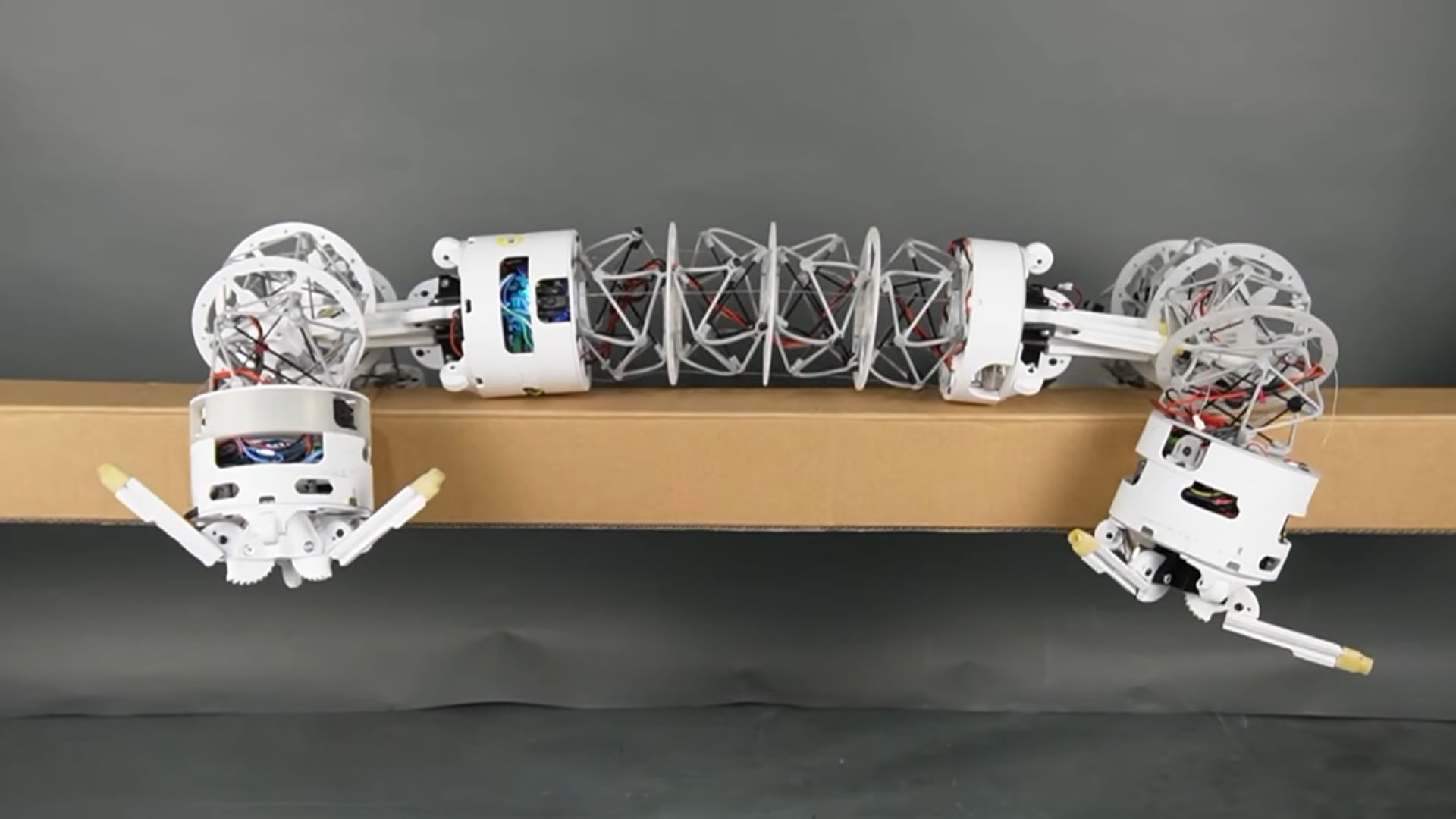
Key TakeawaysColorado State University’s Adaptive Robotics Lab researchers have developed a new robot that can bend, grab, and combine to make an entirely new machine.The new robots are roughly 23 inches (59 cm) long and are incredibly lightweight.While the researchers have demonstrated autonomous docking, most of the robots' movements and cooperative tasks still require human control. Colorado State University’s Adaptive Robotics Lab researchers have developed a new robot that can bend, grab, and combine to make an entirely new machine. Called the TeCoBot, these new robots are something of a blend of Hasbro’s Transformers combiners and Big Hero Six “Microbots.” The new robots are roughly 23 inches (59 cm) long and are incredibly lightweight. Each one can act independently or as a module for larger constructions. Unlike conventional robots, TeCoBot does not have a rigid arm with elbows and joints. Instead, its body is a flexible structure that can change shape continuously. Thanks to this, each robot can shorten, lengthen, and bend in different directions. They can also grip objects at either end. The robots also demonstrated an ability to crawl, roll, and climb, and, as explained, connect to other TeCoBots. It is this last ability that grabs eyeballs. TeCoBots combine The researchers called it task-adaptive morphology: the ability to change a machine’s physical arrangement to suit a particular task. To this end, a single robot might be useful for picking up an object, but connect three or four of them together, and they can form a ring, a walker, or a longer manipulator. At the core of all this is a structural principle called tensegrity, or “tensional integrity,” in which tension and compression elements work together to maintain a structure’s shape. In each TeCoBot, carbon-fiber rods are incorporated into an elastic lattice, with three motor-driven cables running lengthwise through the body. When all three cables are pulled equally, the robot compresses along its length, a bit like squeezing a concertina. However, when only one cable is pulled more than the others, that side shortens more, causing the body to bend towards it. By varying the cable tensions, the robot can bend in different directions without needing conventional hinges or rotational joints. And because the body is compliant (meaning it can deform under an external force), it can absorb impacts and accommodate uneven surfaces without every contact requiring an immediate control adjustment. As for its ability to combine with others, this could prove incredibly valuable for things like search and rescue. Each one could navigate through gaps individually and, when needed, combine to overcome obstacles or manipulate things. Instead of requiring an entirely different machine, they could connect and change their collective geometry. Another interesting feature is that the robots are described as being autonomous, at least up to a point. Human control needed While the researchers have demonstrated autonomous docking, most of the robots’ movements and cooperative tasks still require human control. The ability to independently assess a situation, choose an appropriate configuration, and complete unfamiliar tasks remains to be demonstrated. All well and good, but there are some limitations with the robots. The first is load capacity. Since these robots are lightweight, it is not clear if they are able to handle heavy loads, even combined. It is also unclear how much endurance these robots have, since actions like motion and gripping will consume a fair amount of power. Moreover, it is unclear whether the coordination of large numbers of these robots is possible, and long-term durability is yet to be established. You can view the study in the journal Nature Machine Intelligence. Get the latest in engineering, tech, space & science - delivered daily to your inbox.Christopher graduated from Cardiff University in 2004 with a Masters Degree in Geology. Since then, he has worked exclusively within the Built Environment, Occupational Health and Safety and Environmental Consultancy industries. He is a qualified and accredited Energy Consultant, Green Deal Assessor and Practitioner member of IEMA. Chris’s main interests range from Science and Engineering, Military and Ancient History to Politics and Philosophy.
This shape-shifting robot looks like real transformer; can bend, grab and combine for new role
Full Article
Original Source
Read the full article at Interestingengineering →KhanList aggregates and links to publicly available news content. We do not host full articles from third-party sources. Always verify important information with original sources.