
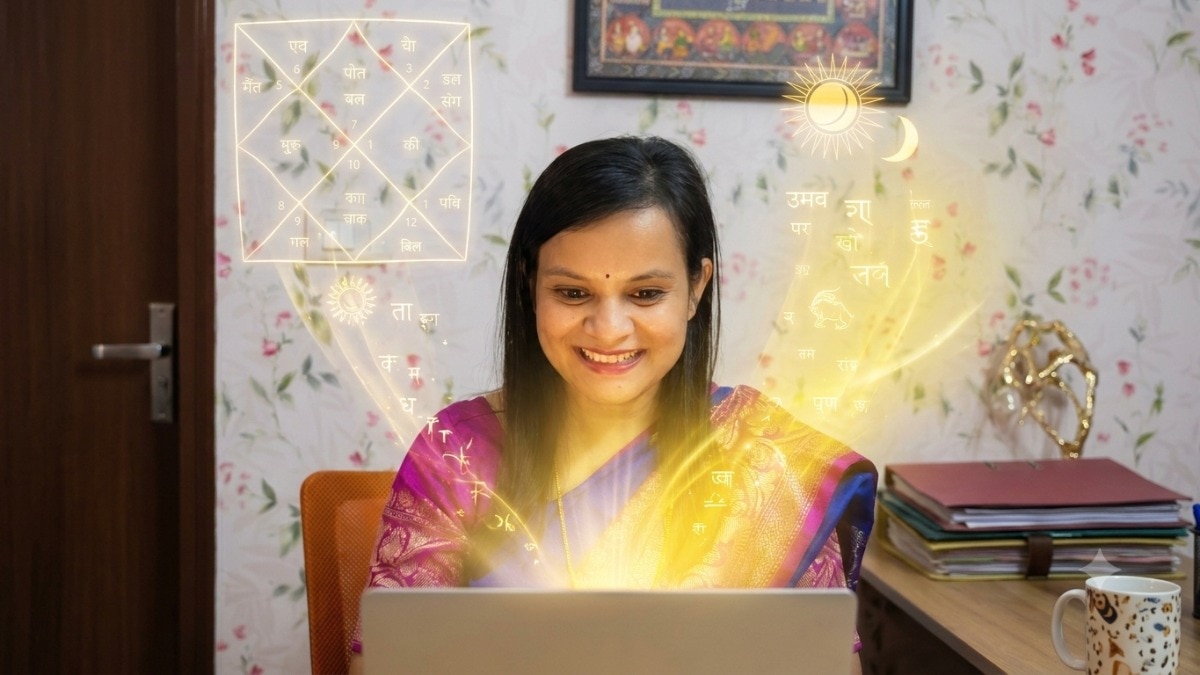
NIT Durgapur alumna Antara Sarkar was working as an engineer when she decided to build a business. She began learning software while pregnant, continued as a new mother and eventually built an AI-powered astrology platform that now gets over 2 lakh daily impressions.NIT Durgapur alumna Antara Sarkar was working as an engineer when she decided to build a business. (AI-edited image)When Antara Sarkar decided she wanted to build a company, she did not have a computer science career behind her. She was also learning how to be a mother.She had a BTech from NIT Durgapur, an eight-year engineering career and experience across structural engineering and project coordination.She had once tried building a travel company with a friend. But that earlier startup experience left her with a lesson that would shape her next move: technical dependency can slow a business down.Her co-founder handled the technical side of their travel venture while Sarkar focused on business. The venture was doing well, but because her co-founder also had a full-time job, getting technical support when needed was difficult. "I therefore decided to build those capabilities myself rather than continue depending on someone else for the technical side," Antara says.That decision took her back to learning. She joined Scaler to study software development, data engineering and machine learning. And she was doing it at a time when most people would probably have considered adding another major commitment a bad idea.She was pregnant. And she was raising a toddler on the side."I was balancing my learning at Scaler with my full-time job and raising my 6-month-old-child," she says.For Antara, pregnancy did not become a reason to postpone the plan. Instead, it became part of a period in which she was trying to become more technically self-reliant."I chose to learn it myself and gradually build the confidence to execute my ideas independently," she says. Antara working on developing Vedas THEN CAME AN IDEA ROOTED IN SOMETHING INDIA ALREADY LOVESThe eventual business idea was not simply a technology product looking for a use case. It started with something Sarkar was already interested in: astrology.She was interested in the connection between astrology and human behaviour, particularly the conversations people have with astrologers during difficult or uncertain periods."I believe that when people interact with an astrologer, the conversations often encourage introspection and help them look for positive ways to move forward," she says.That observation became the starting point for Vedaz.io, which Sarkar began in 2023.Her entrepreneurship story is not about putting "AI" in front of astrology. It is about how she took something familiar to Indian consumers and began asking what happens when technology removes some of the traditional barriers around access.Today, Vedaz is experimenting with AI astrologers that can converse with users in Indian languages and regional idioms. Human astrologers are also part of the platform, with complex readings handled through a human-in-the-loop system.The company says it has more than 1,200 active astrologers, including tarot readers and numerologists, across metros and tier 1 and tier 2 cities.But Antara's own transition from engineer to founder remains the more revealing part of the story. (AI-generated image) SHE HAD TO LEARN MORE THAN JUST CODINGLearning software was only the beginning.Once she started building the business, Antara realised that knowing how to make a product was not enough. Someone also had to figure out how users would find it, what they wanted and which features were actually worth building.So she learnt SEO and digital growth. Then came business analytics, operations, hiring, team retention, user acquisition and customer engagement."Building a good product alone was not enough to bring users to the platform," she says.That became especially clear during Vedaz's first two years.The platform was improving, but its traffic remained low. Eventually, Antara shifted her attention from simply building the product to understanding how people were discovering it.That change appears to have made a difference.Daily impressions rose from approximately 2,000 to more than 200,000 without a corresponding increase in advertising spend. The platform now gets around 3.15 million impressions a month.That growth also tells a larger story about the business -- the technology may be new, but the demand it is trying to serve is not. Antara with her two children FROM 2,500 DAILY CONSULTATIONS TO A BIGGER AI BETVedaz currently sees around 2,000 sessions a day with its AI astrologers and another 500 with human astrologers, according to Sarkar.That works out to roughly 2,500 consultations a day.One of the ideas behind the AI model is accessibility. A person who may not have easy access to an astrologer, or who is more comfortable speaking in a regional language than English, can use the service at any time.For Antara, the move into AI is also a continuation of the learning process that began years earlier."We have introduced AI astrologers on the platform and have been researching AI-related initiatives for the past six months," she says.Importantly, she is not presenting the current phase as a revenue story.Vedaz is deliberately keeping its service free while it pilots its advanced AI astrologer models and gathers data from real conversations. Human astrologers handle complex cases, and those interactions are used as feedback for the AI system.So there is no annual revenue figure to celebrate yet. Instead, Antara says the immediate focus is on testing whether the experience works at scale before monetising it. (AI-generated image) A CAREER CHANGE THAT STARTED WITH GOING BACK TO SCHOOLAntara Sarkar’s jump from engineering to entrepreneurship didn’t happen overnight.She had an engineering degree from an NIT. She had spent years working in her field. She had already tried entrepreneurship once. Then she decided that if a lack of technical skills had held back her first venture, she would learn those skills herself.She did all that while working and raising a young child.Then she built a business around an idea sitting at the intersection of an old Indian habit and new technology. Now, her bootstrapped venture is looking beyond India, with the US identified as its next market.Sarkar says the platform has reached a stage where it can grow without requiring her constant day-to-day involvement.Her advice to women considering a career change is to start before they have everything figured out.“You may not have everything figured out when you begin, but the journey itself teaches you what you need to learn,” she says.For her, that journey began with a decision to learn the technical skills she once depended on someone else for. It eventually became a business of her own.- EndsPublished On: Sep 9, 2026 16:47 IST
This NIT grad learnt coding while pregnant, then built her own AI astrology startup
Full Article
Original Source
Read the full article at Indiatoday →KhanList aggregates and links to publicly available news content. We do not host full articles from third-party sources. Always verify important information with original sources.