
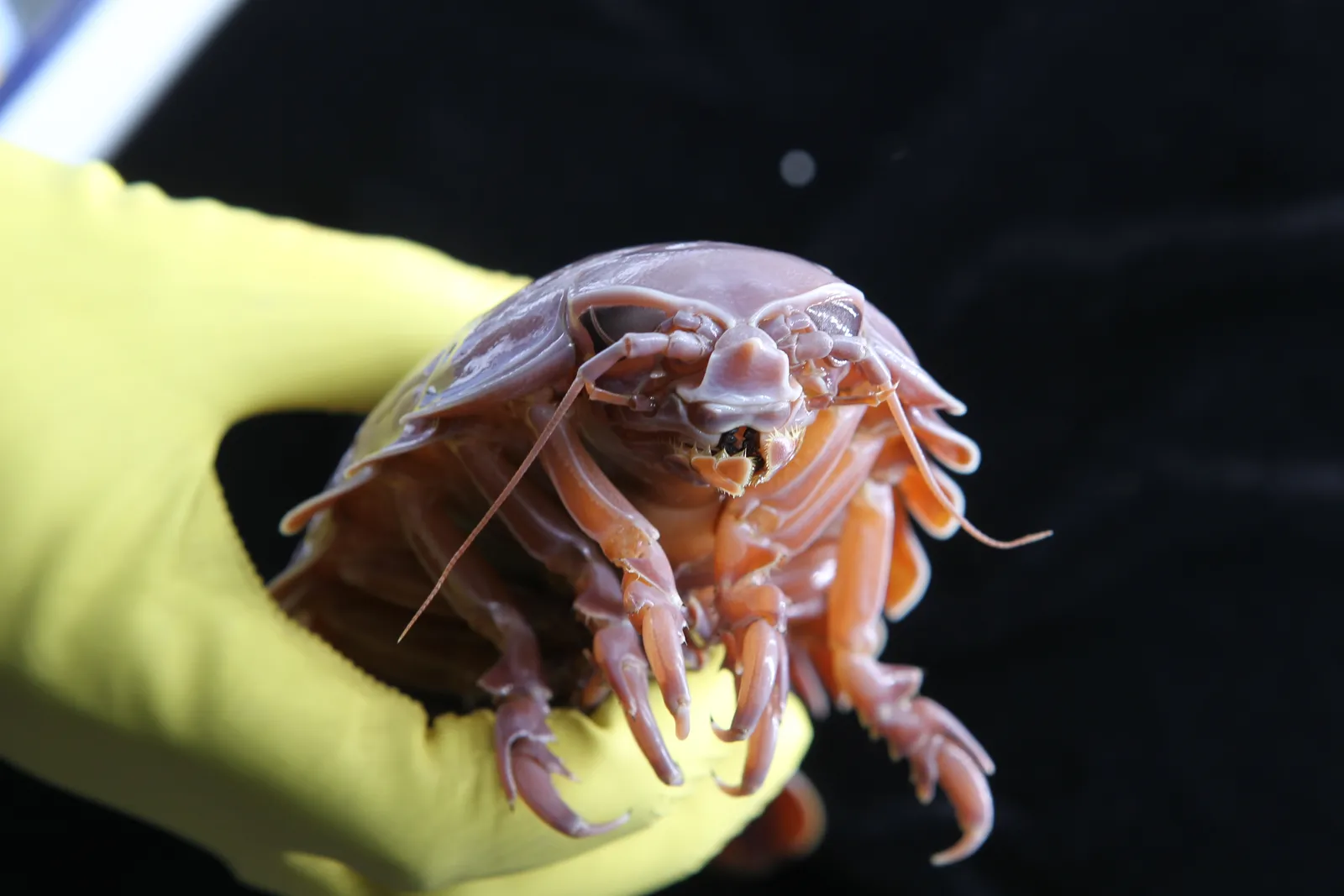
The ancestors of the giant isopod Bathynomus jamesi—a seafloor-dwelling creature that resembles a huge pill bug—acquired the snippet of DNA from bacteria more than 16 million years ago, according to a new study. The gene helps the animal slow its metabolism September 28, 2026 3:53 p.m. A giant isopod plucked from the ocean near China Institute of Oceanology of the Chinese Academy of Sciences / Handout via Xinhua The deep sea has no shortage of unusual creatures, from methane-eating spiders to shape-shifting octopuses. Among them are giant isopods—essentially bowling pin-sized pill bugs. Some of these curious crustaceans can survive for more than five years between meals, a feat that has puzzled researchers, given the isopods’ massive size. Now, they’ve learned that the secret behind some deep-sea roly polies’ impressive endurance comes from a combination of a large stomach and evolutionary thievery. Millions of years ago, the isopods’ ancestors stole an energy metabolism-related gene from a bacterium and transferred it into their own DNA. The findings, published in the August 6 issue of the journal Cell, offer new insight into how some organisms can survive in extreme environments. Surviving at the bottom of the ocean is no easy task: it’s dark, cold, under high pressure, and there’s little food. “It is a world of perpetual night and crushing pressure, yet life finds a way,” says study co-author Jianhai Xiang, a biologist at the Chinese Academy of Sciences, to Marta Serafinko at Reuters. Giant isopods scuttle around the seafloor at depths of up to nearly 7,000 feet in the Atlantic and Indo-Pacific oceans. The massive creatures, which are related to garden-variety pill bugs on land, can grow to 11 to 20 inches long. To better understand what the researchers call the “paradox of deep-sea gigantism,” they examined the anatomy and genomes—complete sets of genetic instructions—of two giant isopod species that live at different depths. They collected Bathynomus jamesi specimens from nearly 3,000 feet below the surface in the South China Sea and B. doederleini from a depth of almost 1,000 feet in the East China Sea. The team also compared the giant isopods to the intertidal isopod Cleantiella isopus, gathered from Qingdao, China. Did you know? New species In 2022, researchers described a new species of giant isopod called Bathynomus yucatanensis. A specimen collected from Mexico’s Yucatán Peninsula in 2017 had been misidentified as a larger relative. Analyses revealed the deepest-dwelling isopod had a huge stomach that took up around two-thirds of the creature’s body cavity, proportionally much larger than the stomach of the other giant species. The researchers suspect the cavernous compartment acts as a storage container. That means B. jamesi can gorge itself on food—generally scavenged bits of fish, crabs and dead organic matter—whenever it comes across tasty morsels and stockpile much of its meal in its body. What’s more, both B. jamesi and B. doederleini had a gene called ND1. The latter species, which lives at a depth with more food sources, had few copies of the gene and little was expressed, or “turned on.” But in B. jamesi, which resides at a more extreme depth, the gene appears to help slow the production of energy, thereby preserving it and helping the animals endure starvation. To learn more about the gene, the team genetically engineered zebrafish, nematode worms and human cells that contained ND1. Doing so reduced the different specimens’ metabolic rates at cold temperatures. Moreover, at a chilly 64 degrees Fahrenheit, food-deprived zebrafish with the gene lived 37 percent longer than normal fish. Creating a family tree helped the researchers figure out that the ancestors of giant isopods acquired the ND1 gene more than 16 million years ago. They suspect it came from a bacterium that lived in the ancient creature’s stomach. The two types of beings are extremely different, so this kind of gene transfer is “extremely rare,” Yuan tells Reuters. “The gene gives the isopod an extra tool to fine-tune its energy use, especially when it needs to slow down.” Giant isopods offer an example of how traits aren’t limited by the genes already within a creature, says Yang Li, an evolutionary biologist of the University of Michigan who wasn’t involved in the study, to Jake Buehler at Science News. He wonders whether other deep-sea animals possess hijacked genes. The discovery “opens a completely new window to study the evolution of deep-sea gigantism and the role of microbiome in deep-sea adaptation,” says Torben Riehl, a marine biologist at the Senckenberg Research Institute in Germany who wasn’t involved in the research, to Saugat Bolakhe at Scientific American. Study co-author Jianbo Yuan, a marine biologist at the Chinese Academy of Sciences, agrees. “Our work not only deciphers the mystery of ultra-long starvation tolerance in deep-sea isopods,” Yuan says in a statement, “but also provides an important paradigm for understanding how life balances growth and survival in extreme environments.” You Might Also Like Get the latest stories in your inbox every weekday. More about: Animals Evolution Microbes, Bacteria, Viruses Oceans Sea Creatures Weird Animals Wildlife
This Massive, Deep-Sea Roly Poly Can Go Years Without Food Thanks to a Huge Stomach and a Stolen Gene, Study Suggests
Full Article
Original Source
Read the full article at Smithsonianmag →KhanList aggregates and links to publicly available news content. We do not host full articles from third-party sources. Always verify important information with original sources.