
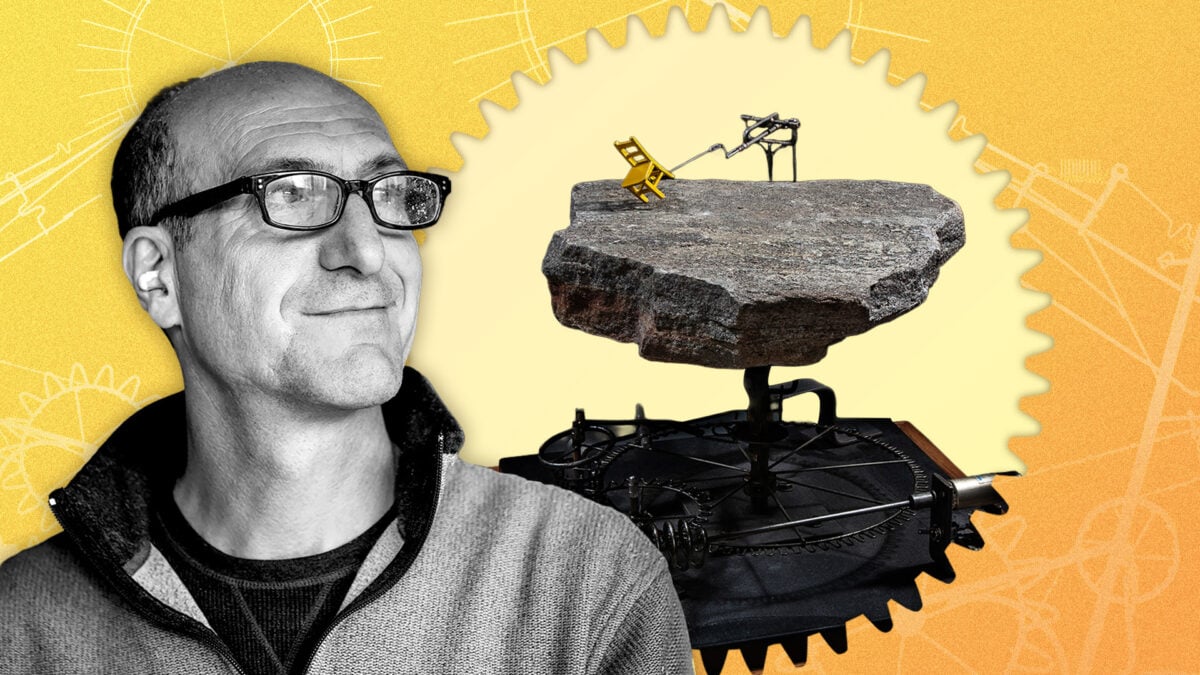
Gizmodo’s Human Generated is a series of profiles and interviews with some of the most inventive people working across tech, science, entertainment, and art. We go beyond the finished product to explore the process and person behind it. Somewhere in the MIT Museum, a tiny motor spins at 200 revolutions per minute. The motor drives a chain of 12 gears, each turning 50 times slower than the one preceding it. By the time that motion reaches the final gear, it turns so slowly that it won’t complete a full rotation for more than 2 trillion years—for reference, the universe is about 14 billion years old. Longtime kinetic sculptor Arthur Ganson bolted this time-bending machine into a block of concrete. It was engineered, with precision, to accomplish absolutely nothing. The intricate creation is called “Machine with Concrete,” and it offers as good an introduction to Ganson as you’ll find. For nearly five decades, the sculptor has built kinetic machines that incorporate real movement into their design to do the exact opposite of what machines were originally designed to do. Ganson’s machines do not increase output or simplify repetitive tasks. Instead, they move in ways that feel unmistakably alive. “I was always more interested in what could be expressed by something in motion or transition, and the subtle manner in which things move [and] gesture,” he explained in an email to Gizmodo. Ganson once built a wishbone that walked itself across the table. Another time, he decided to create a yellow chair that flies apart and reassembles itself. One piece—the aptly named “Machine with Oil”—simply oils its own gears over and over again, conceivably until the end of time. The sculptor earned his BFA from the University of New Hampshire in 1978 and began creating absurdist machines the year before he graduated. He hasn’t stopped. From 1995 to 1999, he was an artist-in-residence in MIT’s mechanical engineering department—an artist among scientists—and his “Gestural Engineering” exhibition has lived at the MIT Museum ever since. © Photo courtesy of Chehalis Hegner He didn’t limit himself to his art studio—a renovated 40-by-54 foot pole barn filled with bins of hardware, a 3D printer, and countless tools—though. For two decades, Ganson emceed the museum’s Friday After Thanksgiving (F.A.T.) Chain Reaction event, where engineers, artists, students, and their families gathered together to build a room-sized Rube Goldberg contraption, a machine that uses deliberate actions to accomplish one very simple task. Along the way, Ganson also invented a children’s toy. And as he’ll happily tell you, he’s currently chasing a patent for what he swears will be the best garlic mincer on the planet. Technology has quietly worked its way into all of Ganson’s art. The hand-bending is still there, but so is a 3D printer that lets him conjure up any gear he can dream up, instead of ordering it from a catalog. When it comes to AI, the sculptor is less certain. He doesn’t see AI as a threat to art itself, but does believe it’s changing “the arc of how art is created.” “We’re living in a moment where AI technology is moving at warp speed,” he said, “I find it fascinating—and a little scary.” This interview has been edited for length and clarity. Gizmodo: Where does your need to create come from? My art has come about from a place of naivete. I think that there’s something really important in being a child and not knowing and [learning] the process of exploring and dreaming. My particular form of art is what it is because of my natural inclinations, abilities, fears, traumas, and what I’m working through. What first attracted you to making machines? I think it was always in my nature to want to make machines. The earliest thought I ever had about making something mechanical was making a tin can robot when I was in third or fourth grade—it’s so deep in my DNA, the desire to invent things. When did you get the idea to incorporate tech, such as 3D printing, into your work? I first learned about 3D printing in the late ’80s through a friend who was working on early machines at MIT. Recognizing its power right away, I knew the process might eventually find its way into my sculpture making. But it wasn’t until the last few years that I began designing a complete piece with these tools. After a lifetime of making literally everything by hand, this is “crack” to a builder—provided the situation warrants it. For me, 3D printing doesn’t replace other tools. It adds new possibilities and capabilities. It expands the possibilities for dreaming. © Photo courtesy of Chehalis Hegner What can you express with a machine that you can’t express with a traditional sculpture? Kinetic pieces communicate through the nature of movement what static objects struggle to convey. Different possibilities and different worlds. What draws you to simplicity? Less is often more. Just enough to catalyze a dreaming moment in the observer’s mind and eye. There is an edge between clarity and ambiguity, and if the machine straddles that edge, it is more likely to successfully catalyze dreaming in the observer. I consider the aesthetic function of my machine sculptures to be their “utility.” What are the benefits and drawbacks of using tech in your work? Has it changed your process? For me, there are no real drawbacks; it’s simply another tool to use when needed, so it hasn’t fundamentally changed my process. I still use my filament plastic printer, but ultimately have the parts 3D printed in metal, perhaps bronze. I’m not using the AI capabilities now being integrated into Fusion 360 for design. I’m not interested in that. In time, I may use aspects of it to help with structural or part-strength considerations, but not for conceptual design. What drives your need to create? I’ve never been driven to make art for any reason other than to explore my own humanity, in a sense. I think that’s really at the base of it. And to be in a place of joy and play, that’s the heart of it. It takes the form it does because of… who I am, but fundamentally, it’s always been about wanting to explore and be childlike in a sense. © Photo courtesy of Chehalis Hegner What do you hope people take away from your work? Given that everyone who encounters the work comes to it with a uniquely personal perspective, there is nothing particular or specific that I can hope for. That said, if I were to step back and look broadly at the question, and consider my fundamental impulse to make and share art, perhaps I would say that I hope that the work catalyzes some inner dream in the mind, heart or body of the observer—and that, hopefully, may lead to some sort of inner transformation of the soul. How many hours does it take you to create something from start to finish? It’s so wildly different from piece to piece. Days… weeks… years…. Each piece evolves differently. Why turn machines into art instead of making them serve a “practical” purpose? My natural ideas were always about gesture and movement. To bring that to life, I needed to make machines. It’s not just a static form, but it is objects and form in motion. And a particular kind of motion that can suggest a gesture, which we ultimately interpret. I’ve always felt that communicating an idea or feeling is a kind of “utility,” in a sense. How important are movement, sound, and touch to your work? When I first began, many of the machines had hand cranks because I wanted the observer to input their own energy into the system—so that the machine was, in essence, a direct extension of the observer’s life force. After some time, the ideas demanded that the parts move at particular speeds in order to “speak” the way I was seeking. What tools do you need to create art? In the past few years, I’ve begun to integrate 3D modeling and printing into the creative workflow in many ways. This has been super exciting for me, as I can make machines in ways that were never possible before. Is there a place for AI in your work? Right now, part of me just loves working with my hands, and I get deep satisfaction from doing that. Much of my joy comes from working with materials that feel like an extension of my body. AI is an incredibly powerful tool, but none of us really knows the full extent ofwhat’s going to happen. Some people say tech threatens art. It can create paintings, write stories, compose a song, etc., in minutes. What do you think? I don’t see it as a threat to art itself, but it’s certainly altering the arc of how art is created. I believe every person is inherently creative. Take music: Our ability to record, store, and play it has gone through many stages, and those technologies changed what music is and what it can be. For some, AI-created art might diminish possibilities; that’s one downside for sure. For others, AI-generated art in its many forms may expand what’s possible. Yesterday I read about two Anthropic engineers warning that everyone on the planet could be wiped out within 10 years. I’d better get back to work! I’m imagining, humorously of course, that the moment after the Titanic hit the iceberg, some engineer scrambled around, worrying about the long-term strength of the bolts holding the handrails by the staircases. This is just a quick off-the-cuff thought. I’m sure there are many better analogies. Jeremy Glass contributed to this story.
This Kinetic Sculptor’s Machines Are Pointless—and That’s the Point
Full Article
Original Source
Read the full article at Gizmodo →KhanList aggregates and links to publicly available news content. We do not host full articles from third-party sources. Always verify important information with original sources.