
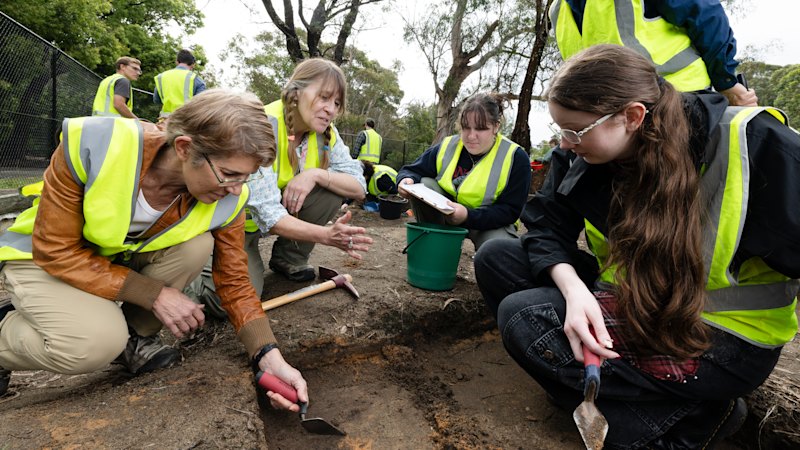
October 15, 2026 — 7:01pmAs details of the world’s oldest shipwreck rippled across the globe, the Australian archaeologist who played a pivotal role in cracking its secrets was digging in a dirt pit at a Sydney university. Dr Karin Sowada’s students watched on in awe.A leading expert on Bronze Age ceramics, the Macquarie University professor has shot to fame after helping a Turkish team identify a vessel that dates back between 4500 and 4700 years. The wreck found off the southern coast of Turkey is a contemporary of the Great Pyramids of Giza.Dr Karin Sowada and Dr Susan Lupack with students of archaeology who are being taught how to work on a dig at Macquarie University in Sydney. Dr Sowada has helped a Turkish team discover the world’s oldest shipwreck. Janie Barrett A view of the artefacts uncovered during the archaeological expedition. Anadolu via Getty ImagesShe was invited by lead archaeologist, Associate Professor Hakan Oniz of Akdeniz University, Antalya, to assist with the expedition despite the fact Sowada, an expert in Egyptology and desert excavations, had never taken part in an underwater dig.“The moment I saw the first pottery coming up from the water I thought, ‘this is going to be different’,” Sowada said.For Sowada, the wreck solved a mystery she had been researching since 2003: how silver from Greece ended up in Ancient Egypt.The excavations have uncovered about-4700-year-old amphorae, believed to belong to what is described as the world’s oldest-known shipwreck. Anadolu via Getty Images“We now have evidence – actual hard evidence – that these ships were plying the east-west trade route across southern Turkey, and that is how the silver ended up in Egypt,” she said.“This ship has, for me, delivered the missing link.”While the ship’s wooden hull is long gone, the surviving cargo has sparked new questions. Several ceramic pots hauled to the surface contained a viscous, glossy residue that has survived thousands of years underwater.Dr Karin Sowada said the discovery solves the mystery of how silver made its way from Greece to Egypt. Janie BarrettWhat’s in this jar? Sowada said pottery was “the language of archaeology”.Anadolu via Getty Images“What are the contents in these jars?” Sowada asks, buzzing with excitement. It’s a new mystery, one she cannot wait to solve.“I don’t think it’s olive oil but it could be. It could be the residue of wine, or something different. Maybe tree resin.“To see this residue preserved in a pot after 4½ thousand years is amazing.”Sowada said that “pottery is the language of archaeology”. Because most ancient sites lack written records, archaeologists use pottery’s shape, material and decoration to help date sites and trace how objects were made, used and traded.She brings this passion to her tutorial in Sydney. At Macquarie University, interest in ancient history and archaeology has surged: 226 students are enrolled in the bachelor of history in 2026, up from 170 in 2025.This is in part because of the growing employment prospects. Many graduates go on to work at excavations sites for public infrastructure, including Sydney Metro developments. In 2020, 62.5 per cent of archaeologists were spending at least half their working time on cultural heritage management.“Students are the future of archaeology. We are here to raise the next generation of archaeologists in Australia, both capable of working here and overseas,” Sowada said.Student Hayden Oldis described Sowada as “amazing”.“It’s so cool to hear that a teacher we listen to basically all year, in all our lectures, be a part of something that is so global,” they said.Start the day with a summary of the day’s most important and interesting stories, analysis and insights. Sign up for our Morning Edition newsletter.Emily Kowal is a Walkley award-winning education reporter for The Sydney Morning Herald.Connect via email.From our partners
‘This is going to be different’: Meet the Sydney professor who cracked the code on the world’s oldest shipwreck
Full Article
Original Source
Read the full article at Smh →KhanList aggregates and links to publicly available news content. We do not host full articles from third-party sources. Always verify important information with original sources.