
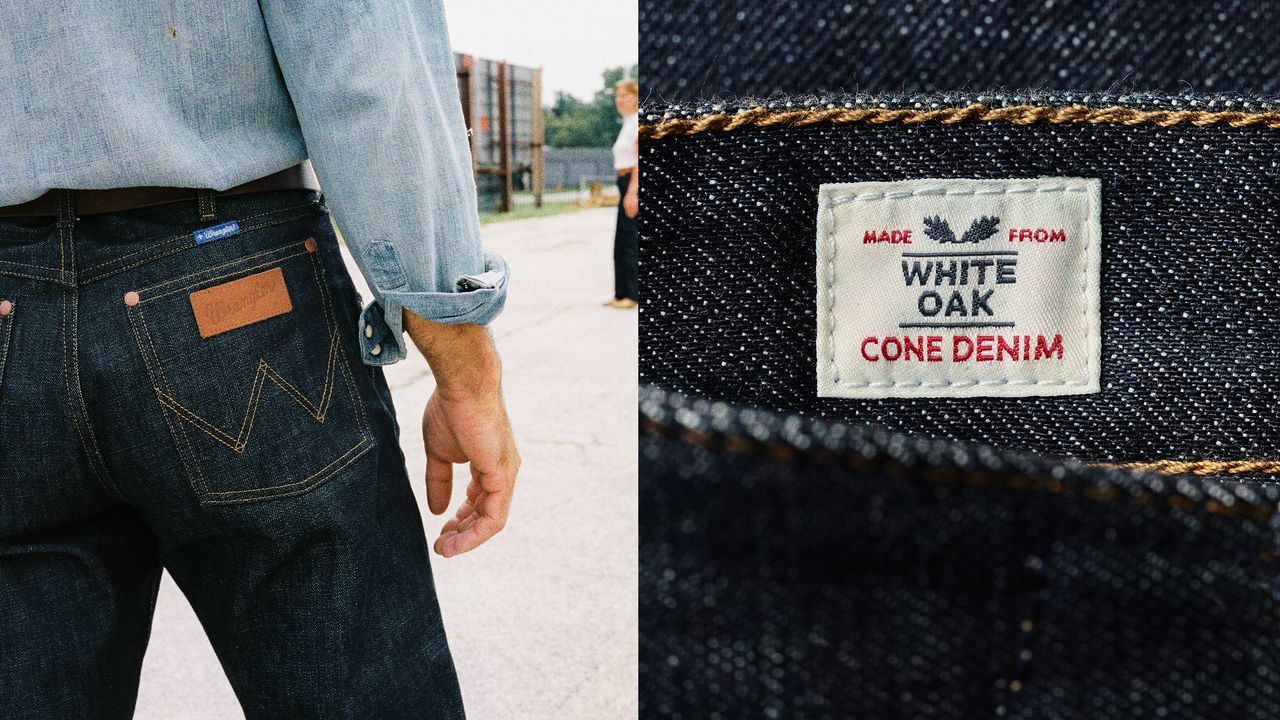
Few fabrics stir the passions of denim nerds like Cone White Oak selvedge—“Cone” to those in the know—the famed denim woven on antique shuttle looms at Cone Denim Mills’s former plant in Greensboro, North Carolina. Founded in 1905, the White Oak mill was the primary supplier of fabric to Levi’s, Wrangler, Lee, and countless other brands for most of the 20th century, and it was instrumental in making American blue jeans a cultural icon on par with rock music and muscle cars. After Wrangler, Levi’s, and many other brands moved production to Asia and Latin America, however, White Oak shut down its famed Draper looms and closed its doors for good in 2017.Tomorrow, Nashville-based indie denim brand Imogene + Willie will release a limited-edition run of jeans made in collaboration with western denim pioneer Wrangler. The first of three drops, the jeans are based on an archival design for Wrangler’s historic 10MWZ (which stands for Men’s With Zipper), the brand’s first “Cowboy Cut” jean released in 1964. Crafted from a midweight 14.75 oz sanforized selvedge and dyed a deep “Galaxy Blue," they bear Wrangler’s signature leather patch, “W” stitching on the back pockets, and an Imogene + Willie tag within. Notably, they’re also made in the USA. More importantly, though, they may be some of the last jeans ever made using Cone White Oak selvedge denim.Courtesy of Imogene + WillieCourtesy of Imogene + WillieImogene + Willie was founded in 2009 on the idea of doing things close to home. In addition to using Cone White Oak denim for most of its jeans and sewing all of its clothes in the USA, Imogene + Willie has pushed the boundaries of hyper-local production with The Cotton Project, a line of jeans and tees produced from cotton and indigo grown within 400 miles of its Nashville HQ. So when the team got word that White Oak was shutting down, they did what any reasonable American denim fanatic would: they stocked up. “We emptied our bank account to buy whatever fabric we could from them, and then we just made what we could until it ran dry,” says Jackie Berkley, Imogene + Willie’s head of people and culture. They weren’t alone. The closure of White Oak marked the end of large-scale selvedge denim production in America, and jean-makers of every kind scrambled to buy up the remaining supply before it disappeared forever.Since White Oak shut down, brands of all kinds, from the biggest of the big (Levi’s, Gap) to small-scale indies (Raleigh, Tellason), have offered limited-edition runs of jeans cut from Cone denim. In late 2024, Wrangler released a new version of its 13MWZ jeans and 11MJZ jacket made from what it called “some of the last remaining rolls of selvedge denim from Cone Mills.” In subsequent years, the scale and frequency of these drops have waned, and today, anyone in search of a pair of new White Oak jeans has very few options. Most are highly limited special editions from denim specialists like Left Field NYC, which, according to owner Christian McCann, is now down to its last 1000 yards of the stuff—enough for another 400 pairs, give or take. Earlier this year, Huckberry released a 200-piece capsule of jeans and jackets made from a cache of 1968 White Oak selvedge, which its design director, Nick Kemp, described as a “once-in-a-lifetime find.” It promptly sold out.Courtesy of Imogene + WillieWhile everyone knows there’s a finite amount of uncut Cone White Oak denim left in the world, figuring out exactly how much remains is next to impossible. “I’ve asked the question about how much Cone deadstock exists, and we have no idea,” says Berkley. The difficulty of answering this question is in large part due to the structure of the textile business. When White Oak was operational, larger brands would order their denim directly from the mill, often working with Cone’s technicians to create bespoke fabrics. Surplus and leftovers would be sold to “jobbers,” textile industry middlemen who buy fabric remainders at a discount and sell them on to smaller producers that can’t meet the factory’s minimums.These jobbers are believed to own much of the remaining deadstock White Oak, but because it’s such a low-volume, highly unique fabric, many wholesalers don’t tend to know it exists. “There was this fellow, David in LA, who would call me, and he seemed to always be wheeling and dealing with this Cone salvage denim, as he’d call it. He could never say it right,” recalled Roy Slaper, the late founder of Roy Denim, in a call with GQ in June. “‘I got that stuff you want, Roy, that salvage denim!’ The fabric trade is funny like that. There are all these guys that have been in the business forever, and they may not know that much about textiles.”Courtesy of Imogene + WillieCourtesy of Imogene + WillieFurther complicating matters is the fact that, while White Oak is synonymous with the kind of stiff, vintage-style selvedge prized by denimheads, that was just one of many kinds of denim the mill produced. “There was a jobber that I would work with here in San Francisco, and he was always telling me about this big bunch of [Cone] fabric that he wanted me to buy,” Slaper said. “I was always trying to explain to him it’s not the stuff I’m looking for. It’s Cone denim, but there are various grades, different shades, different weights—it can even be non-selvedge. All Cone is not the same.”In light of this, getting your hands on a pristine roll of the kind of Cone Mills selvedge you’re looking for is no small feat. At Tilden Jeans, a one-man denim operation in Waterloo, Montana, Tilden Yamamoto makes his “Barn Find” jeans from a trove of 13 oz. shrink-to-fit selvedge White Oak that was developed for Levi’s in the aughts. The stock was discovered by Raleigh Denim founder Victor Lytvinenko at a former Levi’s sewing contractor in North Carolina. Lytvinenko snapped it up, and later sold it to Slaper, who in turn passed it on to Yamamoto. When that supply runs out, Yamamoto says, he’s got 40 partial rolls of Cone Mills sanforized—i.e., pre-shrunk—selvedge to fall back on. “I’ll probably use all the denim I have here, which is many years' worth for my pace of production, and when it’s gone I’ll probably retire,” he says.This state of affairs suits Yamamoto, who makes his jeans one pair at a time by custom order, but it’s not tenable for larger operations like Imogene + Willie, let alone giants like Wrangler. In 2019, a Louisiana-based startup called Vidalia Mills generated excitement in the denim world when it bought White Oak’s machinery with the promise of continuing its legacy of American-made selvedge. Imogene + Willie was among Vidalia Mills’ first customers, but the company fell far short of its ambitions, and following several years of sporadic production, it shut down in 2024. “We were committed to [Vidalia] for the sake of preserving American denim manufacturing, but we were up against a lot of quality control issues and inconsistencies,” says Berkley. “I think we hoped that it would be a perfect replacement, and it was not.”Courtesy of Imogene + WillieWhen Vidalia Mills’ assets were auctioned off to pay its debts last year, denim insiders feared that White Oak’s famous looms would be shipped overseas, ending the 120-year tradition of American-made selvedge for good. Fortunately for the folks at Imogene + Willie, as well as the many denimheads who prize American-made selvedge jeans, the White Oak looms were eventually sold to Mount Vernon Mills, with plans to set them up at its plant in Trion, Georgia. Established in 1845, Mount Vernon Mills is the country’s leading denim producer, supplying Wrangler, Levi’s, and Carhartt, among many others, and after spending a better part of a year restoring and repairing the White Oak equipment, it’s said to be close to getting its selvedge production line running. “We are working very closely with them, and they are reportedly ahead of schedule,” says Berkley. “We could be manufacturing denim by the end of this year.”Located just 170 miles from Nashville, Mount Vernon Mills’ Trion plant will help Imogene + Willie continue to honor its commitment to American-made jeans. It’s not the fabled Cone White Oak selvedge, but given the dwindling supply of Greensboro-woven denim out there in the world, it’ll be arriving none too soon. In the meantime, the Imogene + Willie x Wrangler collab has 292 pairs of men’s jeans cut from the real thing. Unless a motherlode of Cone appears out of the ether, it might be your last best chance to get your hands on a piece of American denim history.
This Could Be Your Last Chance to Own America’s Most Iconic Denim
Full Article
Original Source
Read the full article at Gq →KhanList aggregates and links to publicly available news content. We do not host full articles from third-party sources. Always verify important information with original sources.