
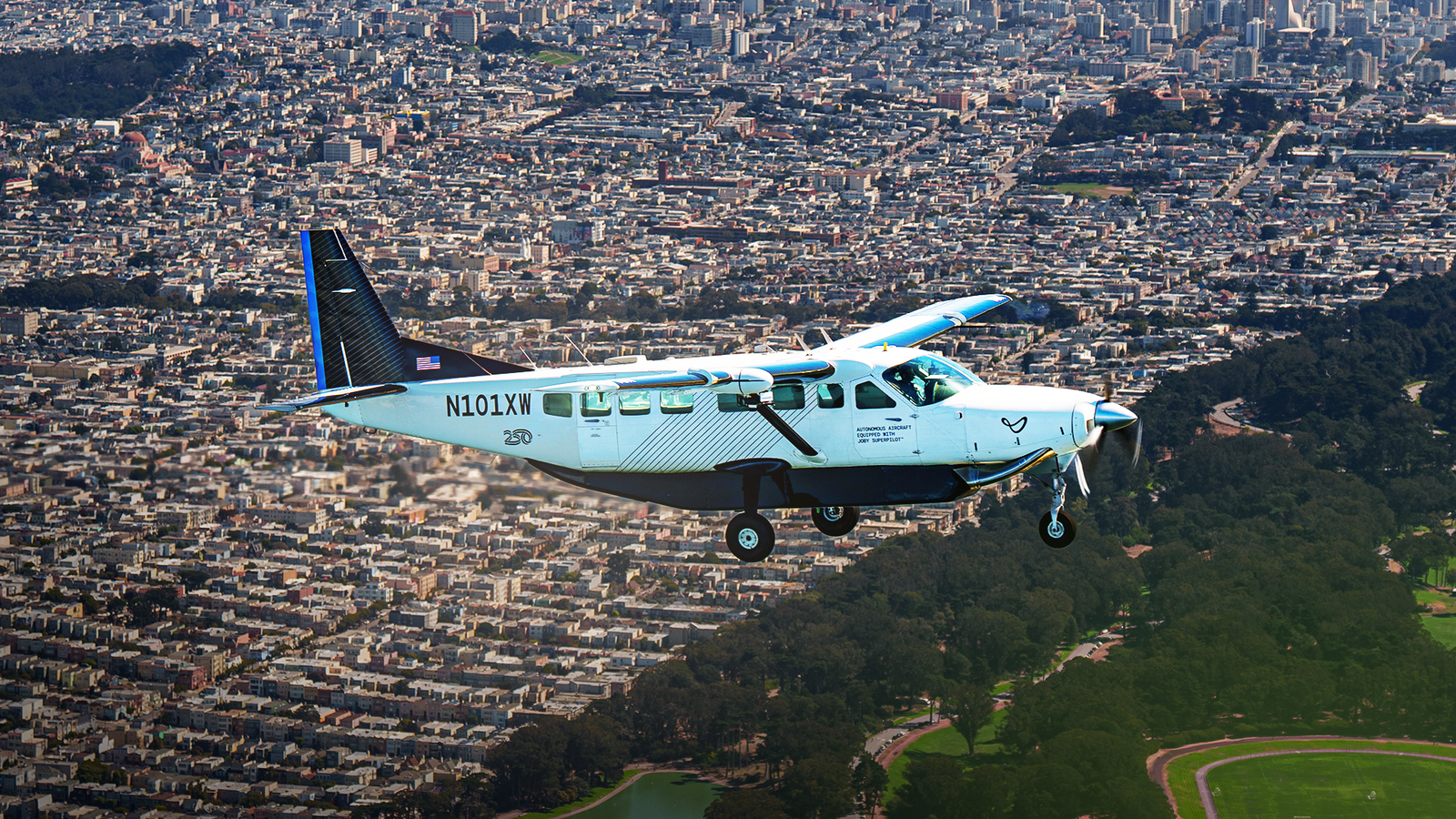
Published Oct 4, 2026, 8:00 AM EDT Brandon's passion for aviation started at a young age. He became involved in the flight simulator and VATSIM communities, which sparked his interest in aviation and eventually led him to earn his private pilot license. Outside of work, he continues to build flight hours, explore new airports, and stay involved in the aviation community. On September 7, 2026, a converted Cessna 208B Grand Caravan departed Buchanan Field in Concord, California, and began flying itself across the United States. A safety pilot sat on board for the entire journey and made zero control inputs. The aircraft taxied, took off, navigated, rerouted around thunderstorms, and landed on its own, supervised remotely from Joby Aviation's Autonomy Headquarters in California and from Shaw Air Force Base in South Carolina, with distances reaching 2,323 miles (3,739 km). It reached Dare County Regional Airport in North Carolina's Outer Banks on September 14 after covering 3,199 miles (5,148 km), and Joby announced the result on September 18. Joby is best known for its piloted electric air taxis, which began demonstration flights in New York City in April 2026. Joby got the autonomy for the Caravan from elsewhere: it acquired Xwing's autonomy division in June 2024, along with the 1993 airframe Xwing had flown autonomously since 2020. Before landing in the Outer Banks, the aircraft flew a low pass near the First Flight Monument at Kitty Hawk, 123 years after the Wright brothers made the first powered flight roughly four miles from where it touched down. 3,199 Miles With Zero Control Inputs Credit: Joby Joby Aviation announced on September 18, 2026, that an aircraft equipped with its autonomy technology had completed the first fully autonomous flight across the United States. The J208, a converted Cessna 208B Grand Caravan, departed Buchanan Field in Concord, California (CCR) on September 7 and landed at Dare County Regional Airport (MQI) in North Carolina's Outer Banks on September 14, covering 3,199 miles (5,148 km). A safety pilot sat on board for the entire journey and made zero control inputs. The aircraft handled taxi, takeoff, route navigation, and landing on its own. Anyone following the westbound return leg can track the aircraft by its registration, N101XW, on Simple Flying's Live Flight Tracker. Supervision came from the ground rather than the cockpit. Teams at Joby's Autonomy Headquarters in California and Shaw Air Force Base in South Carolina monitored the aircraft remotely from distances up to 2,323 miles (3,739 km). The autonomy system rerouted around severe weather and thunderstorms in real time during the crossing, and Joby notes that it operated at every airport on the route without prior familiarity with any of them. Joby describes the journey as a demonstration of the operational maturity, safety, and dual-use utility of its autonomy technology, covering commercial freight, emergency response, medical transport, and defense logistics. "This journey across America offers a glimpse into a new era of aviation," said JoeBen Bevirt, founder and CEO of Joby Aviation. The company is better known for its piloted electric air taxis, which makes an autonomous turboprop cargo aircraft an unexpected vehicle for its most significant flight test milestone to date. Each Stop Tested A Different Capability Credit: Joby Four intermediate stops separated the California departure from the North Carolina arrival, and each was selected to test a different capability rather than simply to refuel. Phoenix Deer Valley Airport (DVT) came first. Joby describes it as one of the busiest general aviation airports in the United States, which made it the test case for integrating an autonomous aircraft into high-density traffic. The system had to sequence itself among light aircraft, flight training traffic, and business jets while interacting with air traffic control at an airport it had never operated into before. Fort Worth Alliance Airport (AFW) in Texas followed, chosen for its position as a major industrial logistics hub and used to demonstrate the freight case Joby is targeting with the technology. The stop coincided with a separate Joby milestone. The company conducted its first air taxi flight in Texas under the White House-backed eIPP program the same day, hosted alongside US Transportation Secretary Sean Duffy and Texas Senator Ted Cruz. Having both the autonomous Caravan and a piloted air taxi at the same airport on the same day gave Joby a chance to show federal and state officials the two halves of its business in one visit. Shaw Air Force Base in South Carolina (SSC) was the military leg. The aircraft conducted what Joby describes as a capability demonstration of representative military flight operations and tactical defense readiness. Shaw also served as the second remote supervision site alongside Joby's California headquarters, meaning Air Force personnel could observe the ground control setup firsthand. The autonomy system arrived with military credentials already: Xwing, whose technology Joby acquired, became the first company to receive an Air Force Military Flight Release in 2024, and the same airframe participated in the Air Force's Agile Flag 24-1 joint exercise in early 2024, flying roughly 2,800 miles and landing at eight public and military airports. The Autonomy Came From A Company Joby Bought In 2024 Credit: Joby The software flying the Caravan across the country did not originate at Joby. The company acquired the autonomy division of Xwing Inc. in June 2024, bringing in the technology, the engineering team, and the aircraft that had been developing it. Joby framed the purchase at the time as support for its long-term vision of making aerial mobility more accessible through autonomy, and as a move expected to accelerate existing and potential future contracts with the US Department of Defense. The deal complemented Joby's 2021 acquisition of Inras GmbH, an Austrian company developing lightweight radar sensor technology. Xwing was founded in 2016 and had been flying autonomous aircraft since 2020 using Superpilot, software it developed in-house and described as the world's first fully autonomous gate-to-gate flight technology. By the time Joby acquired the division, Xwing had completed 250 fully autonomous flights and more than 500 auto-landings. The company had also cleared regulatory ground that no competitor had reached. In April 2023, it became the first company to receive an official FAA project designation for the certification of a large unmanned aerial system. In 2024, it became the first to receive an Air Force Military Flight Release. Xwing's Part 135 cargo operation was not included in the sale, since Joby already held its own Part 135 certificate. Xwing's development work focused on the specific problems a fully autonomous aircraft has to solve: vision system processing, detect-and-avoid algorithms, mission management including trajectory planning and real-time route updates, decision-making, ground control station design, remote operations, and the integration of AI and machine learning algorithms. AVweb reports that the system has now accumulated more than 400 flights and 800 automated flight hours across both controlled and uncontrolled airspace. The transcontinental crossing was not the system's first autonomous flight. It was the first time the accumulated capability was strung together across an entire continent in a single operation. Why Joby Used A 33-Year-Old Cessna The aircraft that made the flight is older than most of the technology flying it. FAA registry records list N101XW as a 1993 Cessna 208B Grand Caravan, serial number 208B0382, registered to Joby Aero in July 2024 and operating under an experimental airworthiness certificate for research and development. The Grand Caravan type certificate dates to 1984. Joby designated its converted version the J208, but the designation refers to the autonomy system, not a new airframe. Everything new on the aircraft is software and sensors. Using an already-certified airframe is the entire strategic point. Certifying a novel aircraft configuration takes years of flight testing and requires the FAA to evaluate the airframe, the systems, and the autonomy together. By installing its system on a Caravan the FAA approved four decades ago, Joby narrowed the certification question to the autonomy alone, with no new type certificate, no new production line, and no need to prove a new configuration first. The company frames it as a scalable path to autonomous air logistics, since the aircraft it would be retrofitting already exist in the hundreds. The Caravan is a deliberate choice beyond certification. The type has hauled freight into short runways and small airfields since FedEx took delivery of its first one in 1985, which means the maintenance base, parts supply chain, and pool of operators familiar with the aircraft are already in place. An operator adopting Joby's system would not have to build any of that infrastructure. The approach contrasts with Wisk Aero, which is asking the FAA to certify an aircraft whose autonomy stack carries the entire safety case. Joby has taken the cheaper and faster route to operations, at the cost of flying a turboprop rather than the electric aircraft the company is better known for. Kitty Hawk, And What Comes Next Credit: Joby Before landing at Dare County Regional Airport, the J208 flew a low pass near the First Flight Monument at Kitty Hawk, where Orville and Wilbur Wright made the first powered flight in 1903. The aircraft also passed Bodie Island Lighthouse on the approach. Joby deliberately chose the Outer Banks as the eastern terminus, framing the arrival as a connection to the site where powered flight began. The applications Joby is pursuing are more prosaic than the symbolism. The company describes the Outer Banks arrival as a demonstration of how flexible, lower-cost autonomous flights can expand point-to-point air logistics and deliver critical medical supplies and emergency freight to remote, underserved communities. The North Carolina flights supported NCDOT's eLIFT-NC initiative, which is examining statewide healthcare logistics by air. Western portions of the tour supported the multi-state uFLY coalition led by the Utah Department of Transportation, which is evaluating high-altitude and extreme-environment airspace integration for the FAA. The tour is not finished. The J208 is now working its way back west, with stops scheduled in Raleigh, North Carolina; Fredericksburg, Virginia; Louisville, Kentucky; Wichita, Kansas; Oklahoma City; Salt Lake City; and Portland, Oregon. Each leg adds flight hours and airport environments to a system Joby will eventually have to present to the FAA as a certification case, and the westbound route covers terrain and altitudes the eastbound crossing did not.
This Aircraft Just Made A Historic Flight & No One Was Flying It
Full Article
Original Source
Read the full article at Simpleflying →KhanList aggregates and links to publicly available news content. We do not host full articles from third-party sources. Always verify important information with original sources.