
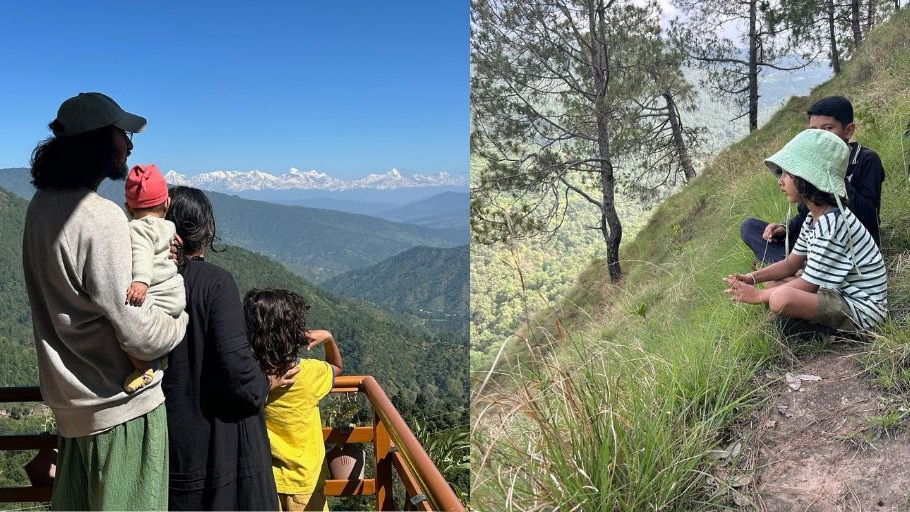
Leaving behind high-paying corporate jobs in Singapore to start afresh in a remote Uttarakhand village challenges the conventional idea of success. But for Aditya and his wife, Garima, returning to their roots meant gaining something they felt money could not buy; time, a deeper connection with nature and the freedom to raise their child differently.Instead of sending their elder son, Vedas, to a conventional school, the couple have opted for unschooling, an approach that encourages children to learn through curiosity, exploration and everyday experiences rather than following a structured syllabus or taking examinations.“The biggest wealth is not money. It is time,” says Aditya, reflecting on the decision to build a life beyond the familiar markers of professional and financial success. For him, having spent his formative years in Shimla, the move was also about reconnecting with nature and building the kind of life he had long wanted for himself and his family.Their decision was not driven by corporate burnout or professional struggles. Aditya describes his career in Singapore as fulfilling and financially rewarding. Instead, the couple chose to question conventional ideas of success and explore a different approach to their son's education, one that prioritises play, emotional well-being, nature and the freedom to simply be a child. WHY DID THEY WALK AWAY FROM A COMFORTABLE CORPORATE LIFE?Aditya remembers growing up in Shimla, where life moved at a slower pace and nature was an integral part of everyday living. That connection stayed with him even after he moved away to pursue his education and career.He studied at St Edward's School in Shimla until Class 12 and went on to pursue medicine. However, despite securing admission to a medical college, he eventually decided against becoming a doctor. Aditya felt that pursuing medicine would put him back into a race he no longer wanted to run. The decision came at a personal cost. He recalled that his father did not speak to him properly for two to three years after he gave up his medical seat.Instead, Aditya pursued footwear design and fashion management at the Footwear Design and Development Institute (FDDI) in Noida. He subsequently built a career in the fashion industry, working in merchandising and strategy for international brands.Garima, who grew up in Delhi but has roots in Uttarakhand, was also part of the fashion and design industry. The two met in college, and their careers eventually took them to Singapore, where they enjoyed financial stability and a comfortable lifestyle.Aditya is clear that leaving the corporate world was not a response to professional dissatisfaction. “My corporate life was incredibly amazing. I had a very good work-life balance,” he recalls, adding that his career was progressing and he was earning well.The turning point was their desire to live differently and raise their son closer to nature. “We didn't come into this life because of the corporate struggle. We came into this life because we wanted this more than the traditional template,” Aditya adds.Returning to India and settling in Dasgaon was about rethinking conventional ideas of success. The couple initially relied on their savings, planning to spend a few years without a regular income. Today, they conduct workshops to support their lifestyle while embracing simpler living and fewer expenses.NO CLASSROOMS, NO FIXED SYLLABUS: HOW DOES THEIR SON LEARN?For Vedas, learning extends beyond textbooks and homework. Living in a remote Uttarakhand village gives him opportunities to explore nature, observe local traditions and learn from the community around him.Aditya takes him on forest walks, introducing him to native plants, wildlife and wild vegetables. The family also spends time with villagers practising traditional agriculture, observing how crops are sown, weeded and harvested across seasons.Through these experiences, Vedas learns about his surroundings through observation and participation, with his interests guiding much of his exploration.Aditya says the couple do not deliberately design activities to make them educational. Instead, they allow their son to discover things at his own pace, following his curiosity rather than a fixed academic syllabus.For the couple, unschooling is also a process of unlearning, as they question the fears and insecurities that shaped their own ideas of success and security.Aditya believes children growing up in cities may increasingly lose touch with traditional knowledge about nature. He wants Vedas to understand local plants, their uses and their relationship with the environment.For the family, everyday life becomes an opportunity to discover the world, with learning emerging from experiences rather than being confined to formal lessons.WHAT DO THEY WANT THEIR SON TO LEARN BEFORE THE AGE OF EIGHT?For Garima and Aditya, the early years of childhood are about more than academics. They want their son to have time to play, explore and develop an understanding of his emotions.Aditya said Garima began studying child psychology and child brain science more deeply after becoming a mother and leaving corporate life. Their parenting approach eventually centred on two priorities: building a connection with nature and developing emotional intelligence.As artificial intelligence and digital transformation reshape workplaces, the couple also question whether conventional education gives enough attention to creativity, independent thinking, reasoning and learning from failure.Aditya believes children need opportunities to experiment, take risks and develop their own understanding of the world. For him, childhood should not become a race to achieve milestones, with every experience measured against academic performance.Instead, the couple prefer to let their son develop at his own pace, without the pressure to meet predetermined expectations.However, they have not ruled out formal education. Aditya said they would consider sending Vedas to school if he expresses that desire as he grows older.“We are against the idea that education can only be in a room, which we call a classroom,” he explains. The couple says their son is happy with his current life and continues to observe his development. Their choice reflects a personal approach to learning, not a claim that unschooling suits every family.Formal schools can also support creativity, social development and emotional learning. For now, their priority is to give Vedas more time for play, nature and self-discovery.‘SLOW DOWN’: THE LIFE THEY WANT TO BUILD IN THE HIMALAYASSettling in Uttarakhand has changed not only how the couple approaches parenting, but also how they think about work and the future. They are building a life centred on nature, learning and a slower pace of living.They want to remain connected to the soil, trees and plants while learning from local agricultural practices. Aditya also spoke about their interest in forest conservation and efforts to keep traditional water springs alive.Rather than following a rigid long-term plan, they want to live in the present while remaining guided by their priorities.“We are living in surrender. We are in the present. We have left the life of planning,” Aditya says, explaining that they no longer want to become overly attached to specific outcomes or worry about whether everything unfolds as expected.Their direction remains clear: to stay close to nature, work around agriculture and contribute to environmental protection, while allowing their journey to evolve without planning every step.Leaving conventional careers, however, requires financial planning, adaptability and a willingness to live with fewer material comforts. Their experience reflects their personal circumstances and may not be suitable for every family.At the heart of their journey is a larger question: how much of childhood should be spent preparing for the future, and how much should be devoted to experiencing the present?For Aditya and Garima, the answer lies in giving their son the time and freedom to explore, ask questions and learn from the world around him.Their journey is not a rejection of formal education, but an attempt to find a different path, one that places curiosity, emotional well-being and a connection with nature at the centre of childhood.- Ends
They left high-paying Singapore jobs to unschool their child in remote village
Full Article
Original Source
Read the full article at Indiatoday →KhanList aggregates and links to publicly available news content. We do not host full articles from third-party sources. Always verify important information with original sources.