
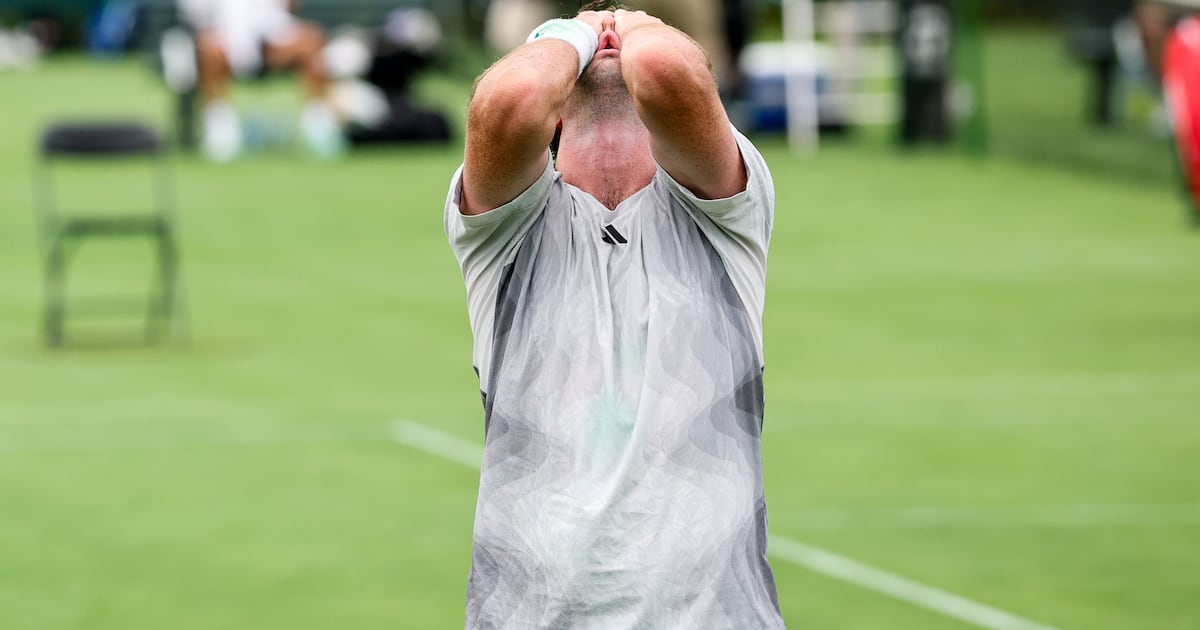
The professional levels of golf and tennis are glamorous counterparts on the global stage, but they have travelled sharply divergent paths in Ireland.When Shane Lowry won the Irish Open at Doonbeg, for instance, the US president was on hand to celebrate by removing tariffs on Irish whiskey and saving an industry millions of euro.A few weeks earlier, Conor Gannon won tennis’ Irish Open in Carrickmines and less than a month later he slept overnight on the floor of Glasgow airport as he didn’t feel it was worth stretching to pay £120 for a hotel room. A professional tennis career launched from Ireland is a hardscrabble existence.Having cracked the top 100 of American collegiate players in his final year at the University of Memphis, Gannon turned pro in June 2025. Here’s the deal as a tennis pro: you schlep around the world to collect ranking points by playing tournaments whose crowds rarely exceed, in Gannon’s words, “a racket stringer and a cat.”READ MOREWinning these tournaments is how one climbs all the way to the bright lights of the Grand Slams, but Wimbledon is hardly a speck on the horizon of these remote and uncaring places. Gannon struggled initially, languishing at 1,304 in the rankings at the end of 2025 and learned to make abashed conversation when anyone asked him how the tennis was going. Across his first 10 months as a professional, Gannon says anyone who made a concerted effort to talk him into quitting the sport would have been successful.His missing ingredient was validation, both internal and external. He wondered whether he was doing the right thing and working in the right way, while others didn’t understand the standard of competition and the challenges of life on the road.“People are asking you how’d you do,” says Gannon, “and you’re like, ‘I lost a tough one, but the guy was good’ and they ask, ‘“What was the ranking?’ I’d say, ‘He’s 1,000’, and they are like, ‘Well he’s not that good.’ That kind of thing brings you down a little bit.“In those moments, it obviously doesn’t feel like you’re doing the right thing. Maybe my family are starting to think if I’m good enough, or if I can do it. You always question yourself when you have bad losses, or when you’re in Tunisia by yourself. ‘Is this really the thing you’re put here to do?’ It definitely didn’t feel like that at the start of the year.”He struggled for focus on the court, usually when he was winning, stepping out of the moment to express a silent “surprise” at the scoreline. Conor Gannon briefly turned to a couple of sports psychologists for support but got nothing out of it. Photograph: Tom O’Hanlon/Inpho “I’m 4-2 up with a break here, what the hell is going on?’” says Gannon, repeating a voice that would worm through his head. “That’s when I would start to drift.”He briefly turned to a couple of sports psychologists for support but got nothing out of it. “I couldn’t really get them, or they couldn’t get me,” he says. “They don’t know how tough it is. They’d say, ‘Oh, you’re going to Greece this week, you should be grateful.’ And I am grateful to be a professional tennis player, but they don’t know how hard it is. I am by myself. I was in Egypt two weeks ago, playing against an 18-year-old, Thijs Boogarde, who’s supposed to be the next big thing. I was with one of my mates from Dublin, and he had two coaches, a physio, and a fitness trainer.”He found the validation he needed at home. Tennis Ireland hosted a Challenger event at Elm Park in June, the first such event hosted in Ireland in 18 years. Men’s pro tennis is divided into three tiers: the ATP is the top level, followed in descending order by the Challenger series and the ITF World Tour series, across which Gannon has been competing. Gannon was given a wildcard entry. Before his first match, he recalls being asked by someone around the club whether he was a professional player. His first-round opponent was Australia’s Bernard Tomic, a one-time Wimbledon quarter-finalist who peaked at 17th in the world rankings a decade earlier. He won in three sets, 6-7, 6-4, 7-6, and speaks in retrospect with a kind of wonder at his mindset during what was the biggest match of his fledgling career.“I unlocked a new focus,” he says. “It was crazy. I couldn’t sleep that night, because my brain was wired. I didn’t care about anything else. I’m just gonna hit this ball, and that’s it. I didn’t even care if I won or if I lost. The feeling was unbelievable, it’s almost like I was on Adderall. I could see the fluff coming off the ball.” Conor Gannon of Ireland shakes hands with Grigor Dimitrov of Bulgaria. Photograph: Tom Maher/Inpho Gannon was beaten in straight sets by Gregor Dimitrov in the next round. Three weeks later, Dimitrov lost a five-setter to Arthur Ferry in the last-16 at Wimbledon.Gannon, meanwhile, returned home at the end of July for the Irish Open, which is on the lower-ranked ITF World tour. He had a niggle in his knee and wasn’t sure he would play, requesting a late start on Wednesday to maximise his recovery time.He saved eight match points against Italy’s Lorenzo Lorusso and went all the way to the final, beating Markus Molder of Estonia to win his first title as a professional.“I felt something’s brewing here, that it was going to be a good week,” says Gannon, “and there’s a bit of a buzz around me. It’s not often at this level that people come up to you to say, ‘Good luck Conor, hope you do well today,’ and you can see little kids looking up to you, and that gives you a little bit of pride. It looks like you’re doing the right thing, finally, and getting a bit of recognition, because it’s so tough.”Gannon decided there was no time to celebrate, and took a 4pm flight to London the following day for another ITF tournament. Finding confidence on the tennis circuit is like sitting on cash at a time of inflation: you have to spend it before it loses value.Gannon played six tournaments across the next seven weeks, eager to maximise the value of his Irish Open win. These intangibles can be made to go further than hard currency: Gannon’s prize money for winning the Irish Open was €2,053.80. This is why he slept at Glasgow airport when he missed a connecting flight home from Egypt last month.He spends whatever he earns on his own career, investing in coaching, physio, or anything he believes will benefit him. Making so little money is also an expensive business, and he has approached wealthy individuals in the hope they will help sponsor his career. He admits it’s a hard sell, given his events are never on television.“I can only offer them an involvement in my career,” he says, “and give as much as I can back to them. It’s really hard, but hopefully something might pop up, or someone might want to help.”Gannon says he has sometimes had a sort of 'ranking dysmorphia'. Photograph: Tom Maher/Inpho Gannon is learning the lessons of pro sport, and has imbibed the mantra of controlling the controllables; of seeking to find confidence not in results but in performances and work ethic.He is based at Bath University, where he follows a four-hour morning session with an hour in the gym and another 90-minute session working on the specifics of technique. He says he is chasing good tennis rather than chasing ranking points, but telling a tennis player not to obsess over their world ranking is like telling an author not to Google their own name.Gannon says he has sometimes had a sort of “ranking dysmorphia”. “At the start, just cracking the top 1,000 was my big goal,” he says. “Once I cracked the top 1,000, I thought I’d feel good about myself, that I’d have a different walk about myself, or something. I went straight up to 820 after the Irish Open and though, ‘Jeez, that number doesn’t suit my name, I don’t want that now. Now I am in the 700s [his current ranking is 777], I want to get into the 600s. But in January, I would have bitten off your hand for that. I’ve halved my ranking.”His immediate ambition is to break into the world’s top 650 by the end of this year, and longer-term he is targeting the top 250, which would earn him a spot in the qualifying rounds for the Grand Slam tournaments. “I know I can beat someone ranked 500, 400, 300, even 200,” he says. “Like I beat Bernie Tomic, who was 150. My level is there. It’s about the cliche of dying every point, or just having the right focus on the right goal, and not being distracted.”He remains obsessed with his sport and trying to improve, and he points to his YouTube algorithm as proof.“I’d watch Alcaraz for two, three hours; I’d watch YouTubers playing tennis; I’d watch racket specs on how to increase your speed on your forehand if you add lead tape at 12 o’clock on the racket; I’m always trying to study and I am always thinking about tennis.”This curiosity and passion for the sport has survived contact with the harsh realities of professional life, and he says the success and validation of the last few months has stiffened his own resolve.“I was thinking about it the other day. ‘How much money would someone have to pay me to stop right now?’ Honestly, it’s in the millions. You could not get me away from tennis right now.”
‘They don’t know how hard it is’: Conor Gannon on the harsh realities of professional tennis
Full Article
Original Source
Read the full article at Irishtimes →KhanList aggregates and links to publicly available news content. We do not host full articles from third-party sources. Always verify important information with original sources.