
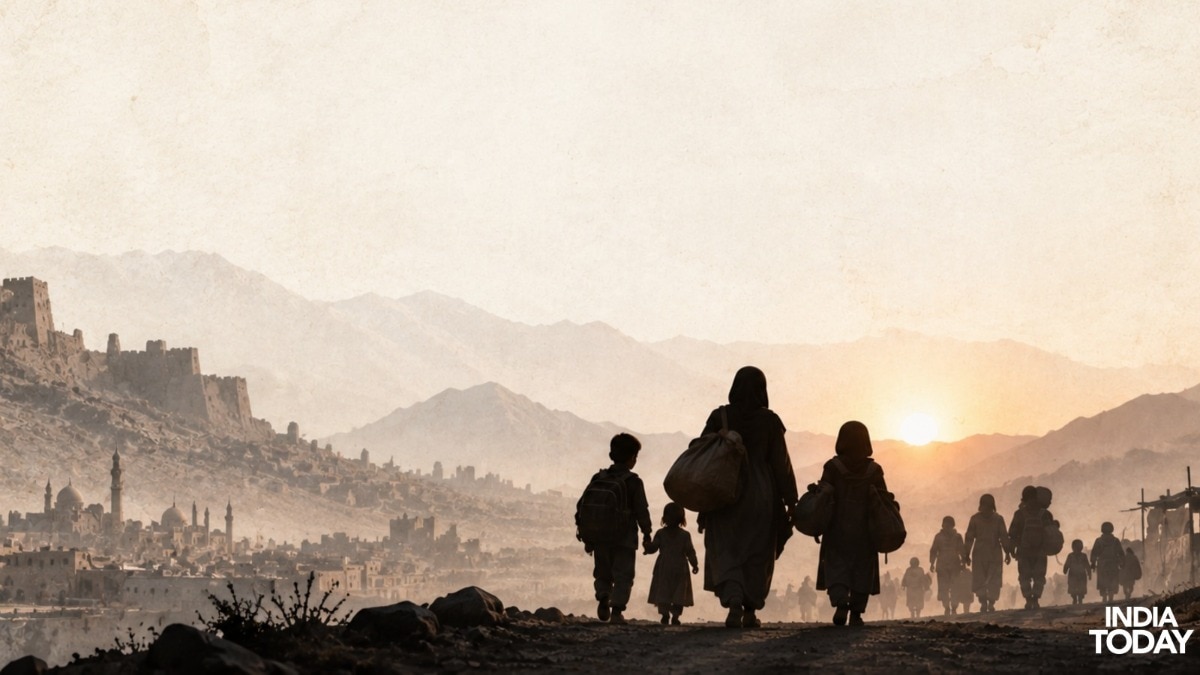
For Afghanistan, struggle has been the only constant. Even now, as fighting and killings flare along its border with Pakistan, another crisis is unfolding inside the country: millions of Afghans are returning to a home that may have little left for them.Taliban seized Kabul in August 2021, returning to power after two decades of war against US forces and a Washington-backed government. Four years later, Afghans are returning in huge numbers. Afghans are returning to districts already hit by food security They left Iran amid war. They left Pakistan amid conflict and deportations. They came home hoping for safety. But home offered little food, little work, little shelter - and for many children, no classroom.India Today’s OSINT analysis, based on reports from multiple United Nations organs and humanitarian agency data, suggests that nearly 9 in 10 returnee households earn less than 5,000 AFN a month, while 77% have faced periods without enough food or money. In districts receiving them, hunger is already widespread. For Afghan girls, the return can be even harsher: over 2 in 3 cannot attend school due to barriers. Districts facing the “heat” of returnWe identified 28 of the UN’s 35 priority districts where projected returns from Iran and Pakistan between April and December 2026 could add at least 10% to the existing population.Where Afghan returnees intend to goIntended destination provinces of assisted returnees from Pakistan Afghanistan province map showing intended destinations of assisted Afghan returnees from Pakistan. Hover or focus a province to display its figure. Figures show intended destinations and do not indicate confirmed final residence.Source: IOM CB-PAHA, Assisted Returnees – Destination ProvincesBut these districts were already under pressure. Cross-checking them with the REACH Initiative and World Food Programme (WFP) June 2026 food-security assessment found 24 facing Severe or Extreme hunger and coping outcomes - seven at the Extreme level and 17 at Severe. Together, the 28 districts are home to about 4.47 million people and could receive nearly 756,000 returnees, an influx equivalent to roughly 17% of their existing population.Where Afghan returnees intend to goIntended destination provinces of assisted returnees from Iran25K 95K25K or fewer / no data Afghanistan province map showing intended destinations of assisted Afghan returnees from Iran. Hover or focus a province to display its figure. Figures show intended destinations and do not indicate confirmed final residence.Source: IOM CB-PAHA, Assisted Returnees – Destination ProvincesThe result is a difficult overlap: the places expected to absorb some of the largest return flows are already struggling to meet the needs of the people living there.The UN has described the scale of returns as a “profound demographic and development challenge”, warning of “massive stress on community resources and absorption capacity” as the communities already facing food insecurity could also be required to absorb a sizeable population influx within months.The faces behind the returnNearly 1.2 million Afghans crossed back between January 1 and August 29, but for many, "return" is a generous word. Pakistan sent back 694,600 of them and Iran 484,800, according to UNHCR and IOM data, and the push is rarely voluntary.Of documented returns from Iran, 79% were deportations, while 96% of surveyed returnees from Pakistan cited fear of arrest. The Organization for World Peace points to "brutal raids, unlawful arrests, and forcible deportations." Some are landing in a country they barely know, having grown up in Iran or Pakistan. Afghans are returning through six main gateways Six gateways carry the flow. Since September 2023, Iran's two crossings, Islam Qala and Zaranj-Milak, have handled about 4 million returns, more than the roughly 2.5 million through Pakistan's four: Torkham, Spin Boldak, Bahramcha and Ghulam Khan, per IOM-UNHCR. Waiting for them is a relief system running on fumes. UNHCR says its "capacity to assist returnees has been significantly reduced due to funding cuts."Who suffers the mostA family crosses the border with a few bags and no plan. The money runs out first, then the food. In the 2025 Household Multi-Sectoral Needs Assessment by the United Nations High Commissioner for Refugees (UNHCR), 89% of returnee households lived on less than 5,000 Afghanis (AFN) a month, and nearly 94% faced food shortages; some have cut meals to survive.Two returns, two realities Iran returnees Pakistan returnees Pakistan returnee households score higher than Iran returnee households on all eight vulnerability indicators. 0 25 50 75 100 High priority Frequent hunger Sold assets Borrowed money Child labor Psych. distress Protection concerns Winter vulnerability Flagged high priority for aid Iran: 2.5% Frequent hunger Iran: 34.3% Sold assets or livestock Iran: 40.0% Borrowed money to cope Iran: 78.9% Child pulled from school to work Iran: 49.5% Psychological distress reported Iran: 35.1% Protection concerns flagged Iran: 14.0% Highly vulnerable to winter Iran: 48.1% Flagged high priority for aid Pakistan: 7.9% Frequent hunger Pakistan: 64.5% Sold assets or livestock Pakistan: 67.2% Borrowed money to cope Pakistan: 91.5% Child pulled from school to work Pakistan: 77.3% Psychological distress reported Pakistan: 55.3% Protection concerns flagged Pakistan: 32.3% Highly vulnerable to winter Pakistan: 77.3% Source: UNHCR Afghanistan HMNA household survey, H2 2025Then comes the quieter loss: school. In 87% of the returnee households surveyed, not a single child attends. Some are working. Some lack fees or identity papers. For girls, almost one in four households cite the Taliban ban on female education.The following visualisation, based on UNHCR household data, shows that 63 out of every 100 children cannot get to school, with 35 girls and 28 boys unable to attend. Schools are accessible to only 37 of 100 children: 22 boys and 15 girls. Every 2 of 3 Afghan girls are being denied access to education Families from Pakistan carry the heaviest load. Many left under raids and landlord pressure, with little time to save or sell. Now 91.5% are in debt, and in 77.3% of the households asked, children have quit school to work.The reason is speed and distance. The International Organization for Migration's (IOM) regional coordinator, Mohamed Elmasry, said many of those returning from Pakistan "have not set foot in Afghanistan for years and in some cases, decades." UNHCR says they leave after door-to-door raids, police harassment and pressure from landlords, with little time to sell, save or plan.The trendsIran's clock started first. Tehran told undocumented Afghans to leave by July 6, 2025, and then Israel's war on Iran began. The United Nations High Commissioner for Refugees (UNHCR) recorded that "Since 13 June, deportations from Iran increased." Monthly returns from Iran leapt from about 283,000 in June to nearly 600,000 in July Iranian authorities alleged that Afghans were working for Israel's spy agency, the Mossad, and the claims were never proven. The Office of the United Nations High Commissioner for Human Rights (OHCHR) said at least six people had reportedly been executed on charges of "espionage for Israel," and that hundreds more, Afghans among them, had been detained on accusations of collaboration or espionage.Monthly returns from Iran leapt from about 283,000 in June to nearly 600,000 in July. Pakistan's clock ran later, peaking near 250,000 in November, as its drive against undocumented Afghans collided with a war on its western border. Human Rights Watch says Pakistani authorities "sharply escalated abusive raids, arbitrary detentions, and forced returns" after the clashes. The United Nations Assistance Mission in Afghanistan (UNAMA) has documented "over 1,100 civilian deaths and injuries" from cross-border armed violence in 2026 so far. By August, flows had cooled to about 60,000 from Iran and 42,000 from Pakistan, but the welcome is thin.Can the economy handle it? Afghan per capita income has fallen following massive inflow of returnees Once a byword for fear, the Taliban now govern all of Afghanistan. But ruling a country is not the same as feeding it. GDP grew 4.8% in 2025, yet income per person fell 5.6%, 13.8 million face acute hunger, and just 29.9% of the UN's $1.7 billion appeal is funded. India steps up to support Afghan returnees India, a close neighbour, is stepping in: 15 clinics and 10 schools across the Iran and Pakistan fronts and, in July, family tents handed to Kabul's refugee ministry "to support the shelter and rehabilitation needs of Afghan returnees," per MEA. It helps, but it is small against the gap.The Taliban hold the power. To use it, they need the world.- Ends
They came back. But was there really a home for Afghans under Taliban rule?
Full Article
Original Source
Read the full article at Indiatoday →KhanList aggregates and links to publicly available news content. We do not host full articles from third-party sources. Always verify important information with original sources.