
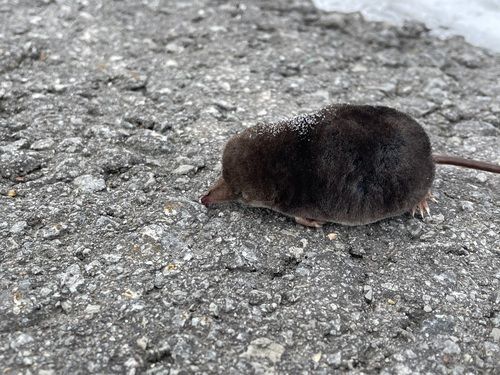
Scientists have long known that some small mammals reduce their brain size during cold months and regrow them in the spring. Long-clawed shrews from Hokkaido, Japan, seem to follow that pattern—while their noses surprisingly do the opposite August 25, 2026 11:36 a.m. A long-clawed shrew seen in northern Japan sergey_stefanov via iNaturalist under CC BY-NC 4.0 These shrews don’t grow their noses when they lie. Their snouts seem to elongate when the creatures are cold—a strange reversal of an already odd phenomenon. Scientists have long known that certain shrews, moles, weasels and other small mammals seasonally shrink their brains and other body parts, sometimes by more than 20 percent, during winter and regrow them in the spring. The adaptation, first described by Polish biologist August Dehnel in 1949 and thus called Dehnel’s phenomenon, likely helps the animals survive harsh, frigid conditions. Now, in a study published in the Proceedings of the Royal Society B on August 19, researchers report that in addition to reducing their brains, long-clawed shrews also temporarily increase the size of their schnozzes. The findings mark the first known instance of what the researchers dub a “reverse Dehnel’s phenomenon” in shrews and deepen our understanding of this curious adaptation. Northeastern Asia is a hotspot for shrew diversity, but the species there remain “strikingly understudied,” the study authors write in the paper. The seasonal size reductions have mainly been documented in small mammals in Europe.To address the knowledge gap, Yugo Ikeda, a mammalogist at Japan’s Toyo University, and colleagues examined 136 skulls of long-clawed shrews collected between 1948 and 1988 in Hokkaido, the northernmost of Japan’s main islands. All specimens were housed at the Botanic Garden of Hokkaido University. The specimens covered each month of the animal’s short, less-than-two-year lifespan since the researchers couldn’t study live shrews. “Measuring skull structures in live, wild shrews repeatedly without harming them is practically impossible,” Ikeda tells Nicola Davis at the Guardian. Examining 16 traits as the creatures aged revealed that the skulls went through the expected braincase reduction in winter and regrowth in the spring. “But as we analyzed the data, we realized something was off,” Ikeda tells Jake Buehler at Science News. The snouts of shrews collected in the winter were 7 percent taller and 6 percent wider than those collected in the spring. The findings, Ikeda tells the outlet, were “completely unexpected and caught us all off guard in the best way possible.” Why would the creatures’ features grow Pinocchio-style in winter? The team has a few ideas. A larger snout might widen dietary options in the winter by increasing bite force, allowing the animals to chow down on tougher prey. However, the jaw shape didn’t show a similar size change, the authors write, so there’s little direct evidence to support this hypothesis. Another reason might be that a bigger nose improves the shrews’ sense of smell, helping them find prey in the deep snow of Hokkaido winters. This proposal requires more research to see whether the scent-detecting tissue in their snouts enlarges in the cold, too. Based on current evidence, the most plausible hypothesis seems to be that a bigger nose would allow the animals to regulate their temperature better via blood vessels. “Expanding the nasal cavity creates more room for a rich vascular network,” Ikeda explains to the Guardian. “When the shrew inhales freezing air, this network efficiently warms it before it reaches the delicate, winter-shrunken brain—helping maintain core cognitive functions.” Overall, the study builds on work that examines how shrews can undergo these temporary transformations. Within the past year, for instance, other researchers have uncovered some genetic and molecular changes that might underlie Dehnel’s phenomenon in the Eurasian common shrew. And there’s still more to be learned. Jan R. E. Taylor, an evolutionary ecologist at the University of Białystok in Poland who wasn’t involved in the study, tells Science News that he would like to know if long-clawed shrews that live in milder climates undergo the same snout enlargement. That investigation could help explain some of the environmental factors behind the adaptation, he adds. You Might Also Like Get the latest stories in your inbox every weekday. More about: Animals Biology Ecology Evolution Japan Rodents and Shrews Wildlife
These Tiny Shrews Grow Bigger Snouts and Shrink Their Brains to Survive Harsh Winters, Study Suggests
Full Article
Original Source
Read the full article at Smithsonianmag →KhanList aggregates and links to publicly available news content. We do not host full articles from third-party sources. Always verify important information with original sources.