
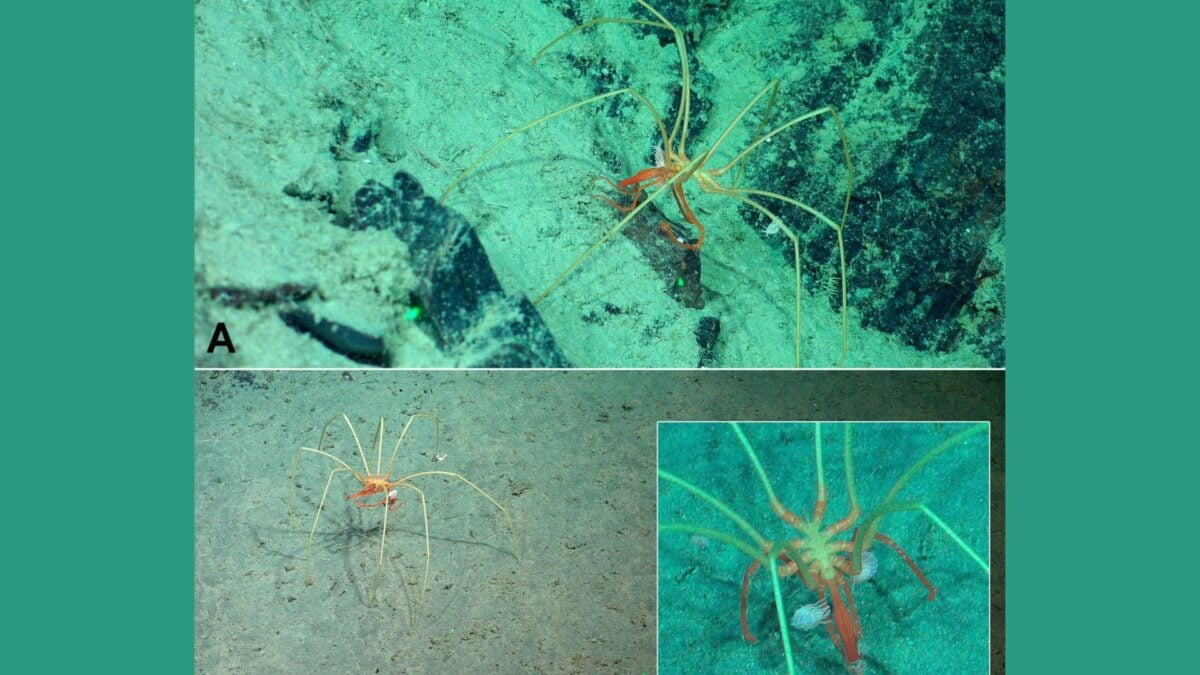
As anyone who’s stayed up well past their bedtime knows, catching a taxi or Uber home can be a godsend, and now recent research shows that even some deep sea animals appreciate the value of bumming a ride off someone else. A team of marine biologists was studying life deep in the Pacific Ocean when they came across something unexpected: shrimp-like crustaceans hitchhiking on the bodies of giant sea spiders. This behavior might be commonplace, the researchers say, and the discovery illustrates just how little we really know about the lives of our deep sea neighbors. “These observations underscore the importance of direct in situ exploration in revealing hidden ecological interactions and adaptations that take place in remote and unexplored deep-sea ecosystems,” they wrote in their paper, published earlier this month in the journal Ecology. A sea spider rideshare The research team was exploring the Chilean margin in the southeastern Pacific Ocean, a region near the western coast of South America featuring deep submarine canyons formed by the intersection of three tectonic plates. They used the robotic submersible SuBastian to visit life thousands of feet under the surface. Sometime in November 2024, at roughly 10,000 feet, the team caught an unusual sight: a sea spider (though they are arthropods, these creatures are not closely related to land spiders and other arachnids) with at least three shrimp-like animals known as amphipods on its body. Four days later, the team once again saw a sea spider with amphipod passengers, about 140 miles away from the first sighting. The team collected the odd pairing for further study on land. The marine Uber driver was identified as Colossendeis colossea, the largest known species of sea spider, while the freeloaders were members of the species Mesopleustes abyssorum. Sea spiders, like many relatively large animals, are known to have their fair share of moochers using their bodies for shelter or dispersal to new areas, but these are usually stationary organisms. Rarely, according to the researchers, have scientists documented other mobile arthropods like amphipods taking a ride on sea spiders. Interestingly enough, the team did find a rarely cited paper from nearly a century ago in 1927 where a researcher described finding a M. abyssorum attached to the same species of sea spider described here, and a study last year reported seeing a M. abyssorum stuck to a different kind of sea spider. But this current study appears to be the first instance of scientists directly observing these two species interacting in this way. What could this mean? Given how close in timing and distance the sightings were, the researchers say that it’s likely that sea spider hitchhiking among these crustaceans is a common occurrence. “Although the possibility that the interaction observed here is incidental cannot be discarded, its apparent specificity and recurrence within a relatively constrained search space suggest instead an underrecognized ecological strategy,” they wrote. But from there, the mystery only deepens. It’s definitely possible these tiny crustaceans, not known for being strong swimmers, are only using the sea spiders to travel farther than they ever could alone. But they also might use the giant creatures as a place to hook up with other potential mates, or to more easily nab a bite to eat. “Whether this interaction is accidental, a dispersal capacity for a nonmobile species, or a form of adaptation to seafloor environments with scarce food resources could be revealed with studies that involve more in situ observations, population genetic studies and trophic ecology,” the researchers wrote. Whatever the case may be, it’s certain that scientists will continue to discover all sorts of surprises about the life that calls the deep sea home, including how they behave with one another.
These Deep Sea Denizens Use Giant Sea Spiders as Ubers
Full Article
Original Source
Read the full article at Gizmodo →KhanList aggregates and links to publicly available news content. We do not host full articles from third-party sources. Always verify important information with original sources.