
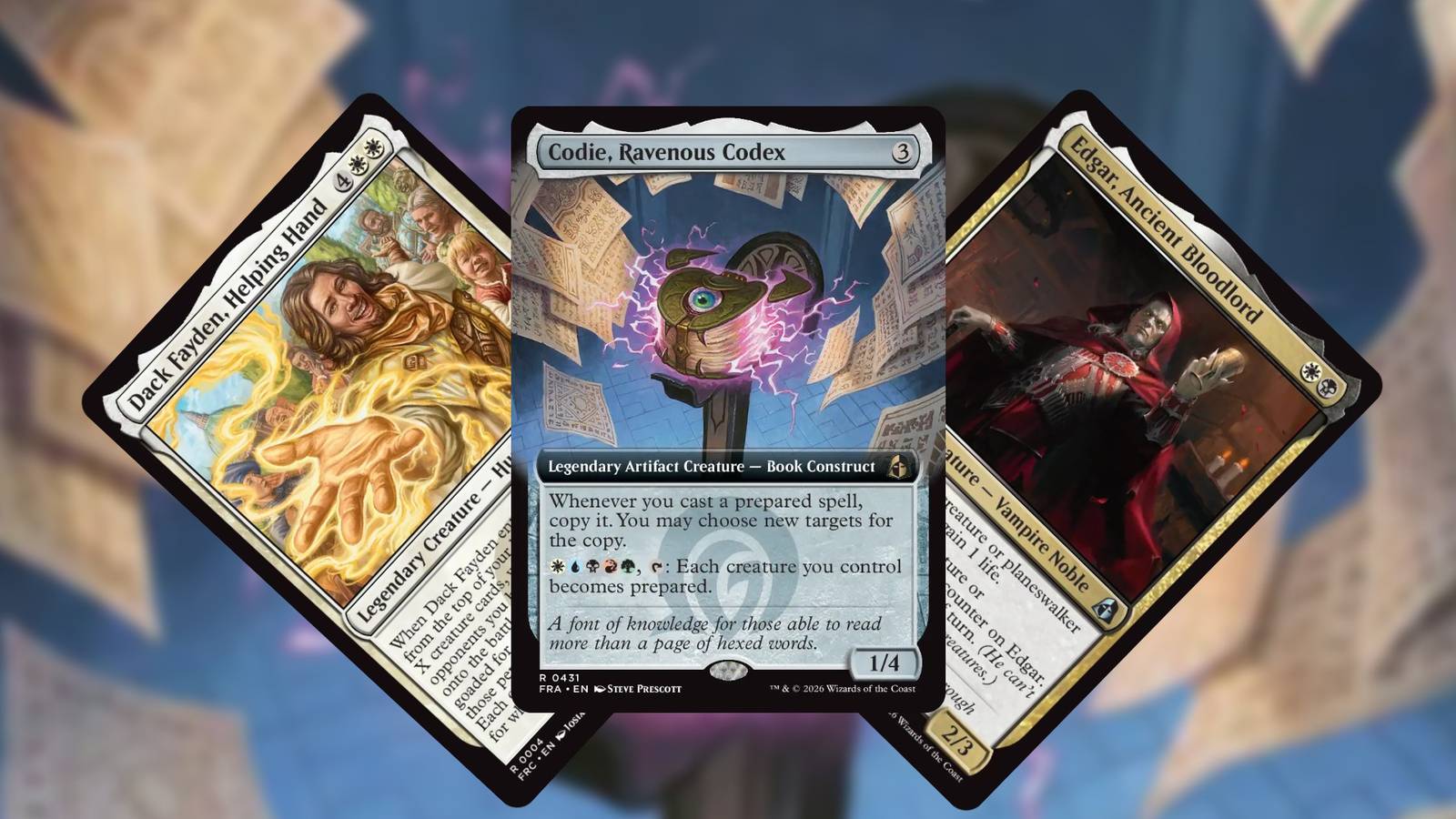
Published Oct 7, 2026, 4:01 AM EDT Niall (pronounced Ny-ul) is a UK-based writer who has been writing about Magic: The Gathering throughout his entire career, with everything from new set breakdowns and individual deck guides to offering his opinions on the state of formats and the general direction of the iconic TCG. Niall also has a rich history covering triple-A releases, sports games, and PC hardware. If you're searching for a new Magic: The Gathering Commander deckbuilding project, Reality Fracture offers plenty of brilliant options. There are over 80 cards that meet the criteria for leading a Commander deck in this set, and among them are some options we expect to see leading decks for years to come. So, whether you're leaning towards an aggressive, mono-colored deck or want to challenge yourself with a complex WUBRG strategy, there's something for everything in the Reality Fracture pool of legendary creatures. Codie, Ravenous Codex We're kicking off this list with a card that's proving hugely popular for anyone building a WUBRG deck around the Prepare mechanic introduced in Secrets of Strixhaven and continued in Reality Fracture. Codie is a three-mana colorless artifact creature that copies any Prepared spell when it is cast, letting you select new targets if needed. Then, for the cost of WUBRG and tapping Codie, you can re-prepare and re-cast Prepared spells you currently control. Because the WUBRG cost of its ability is printed in the text box, you can build a five-color deck around Codie, even though he's technically a colorless artifact creature. Commander decks can only be built using the mana colors printed anywhere on your chosen Commander. Edgar, Ancient Bloodlord While it's not quite the Edgar Markov Eminence Commander that's been incredibly popular since 2017, Edgar, Ancient Bloodlust is still a great black-and-white life-gain card with plenty of potential as a cheap but effective alternative to the elite Vampire kindred Commander. Costing just one white and one black mana, Edgar enters as a 2/3, and whenever a creature or Planeswalker you control dies, you gain one life. You can also pay two mana to willingly sacrifice a creature or Planeswalker, and this lets you put a +1/+1 counter on Edgar and gives him Menace until the end of the turn. We love the idea of building a cheaper Vampire deck around this card, while still maintaining the effectiveness of creating token creatures for the sole purpose of sacrificing them to gain life, drain life from opponents, and buff our own creatures. Dack Fayden, Helping Hand Dack Fayden is back, and this Echoverse version of our favorite thief is now handing out your creatures to other players, but with a pretty clever strategy in mind. This six-mana 4/6 creature enters play and immediately starts revealing cards from the top of your deck until you've revealed X creatures, where X is the number of opponents you have. Then, you must give one of the revealed creatures to each player. Fear not, however, as any triggered abilities of those creatures as they enter play are declared and targeted by you, and these creatures all enter play Goaded, meaning they have to attack, but cannot attack you (unless you are the only remaining player). This very much plays like a group hug Commander, with a focus on gifting opponents creatures and having them fight it out while you sit by and work toward a slightly less direct win condition, or just swoop in at he end to take care of whatever is left of your opponents. Kwia Vigorbloom We thought about taking the easy route of just adding all the Hexhaven Sphinxes to this list, but the reality is that Kwia Vigorbloom is by far the best of the bunch. This green and white Sphinx costs six mana, but enters play as a 6/6 with Flying, Vigilance, Lifelink, and Ward 2. On top of this, whenever you gain life, you create a colorless artifact Locus token, that can be sacrificed for three mana of any one color. This Commander is hell to deal with: you can cast it, and before players even have a chance to target it with removal, you can gain life multiple times to generate multiple Locus tokens and effectively cover the cost of casting it again. Life Gain is frustrating to play against at the best of times, but build in plenty of threats to take the fight to your opponents so you're not sat there endlessly gaining life without doing much to lower everyone else's totals. The Ur-Sphinx A balanced version of The Ur-Dragon? Oh, go on then! While the influence for The Ur-Sphinx is very clear, the card still has to get its rules text right, and this one does. Eminence for Sphinxes is powerful but limited, just as it should be; otherwise, cards end up too powerful and annoying to play against, like The Ur-Dragon and Edgar Markov. There are well under 100 eligible Sphinxes to build into an Ur-Sphinx deck, but there's still plenty of variety in a 100-card singleton format to keep any build exciting and varied, not to mention that a Commander impacting a game even when it's in the Command Zone is always a bonus. Vraska, Soul Of Stone If you're after a strong Jeskai Commander, look no further than Vraska, Soul of Stone. This three-mana 3/3 gives all artifact creatures you control Vigilance, and whenever you cast a noncreature spell, you create a 1/1 colorless Sculpture treasure artifact creature token that can be sacrificed for one mana of any color. We love this card because there are two main routes to can build around it. You can go down the noncreature spell route, and have the deck largely produce its own creatures while Vraska is on the board, or you can look to stack the deck full of artifact creatures, all of whom will benefit from having Vigilance while Vraska is in play. A balanced approach of both strategies is also a possibility, but why hedge your bets when you could full-send one way or the other? Tamiyo, Upriser Crowned One for the Boros crowd, Tamiyo, Upriser Crowned is a huge six-mana 3/5 with Flying, Double Strike, and Haste. In addition to just being a huge threat, when Tamiyo enters, you immediately become the Monarch, meaning you draw a card at your end step, but players can take the Monarch title from you by dealing combat damage to you. To dissuade this, when a creature deals combat damage to you, it is tapped and a stun counter is placed on it, which means that opponent won't be able to untap them on their next turn. It's a pricey card, sure, but aggressive red and white decks are fun to build and play with, and this card is more than suitable to lead the lines and force players to focus their attention elsewhere until they can find a way to deal with Tamiyo, or else they risk leaving themselves open to devastating swingbacks. Tam, The Possibility If you've ever wondered whether a Planeswalker-heavy Commander deck is a viable strategy, Tam, the Possibility is arguably the best card to test it out. She's a three-mana 2/4 who reduces the cost of all Planeswalker spells by one colorless mana. Then, you can pay WUBRG to Proliferate X times, where X is the number of Planeswalker types you control. Given the power of Proliferate, you can also build a +1/+1 counter strategy into this deck to support it, and you're not limited by mana identities thanks to Tams' ability seeing all five colors printed on the card. It makes for an interesting built concept that we're keen to try out, especially with quite a few powerful Planeswalkers having been added in Reality Fracture alone. Franchise Magic: The Gathering Original Release Date August 5, 1993 Publisher Wizards of the Coast Designer(s) Richard Garfield
These Are The Best New Commanders From MTG Reality Fracture
Full Article
Original Source
Read the full article at Thegamer →KhanList aggregates and links to publicly available news content. We do not host full articles from third-party sources. Always verify important information with original sources.