
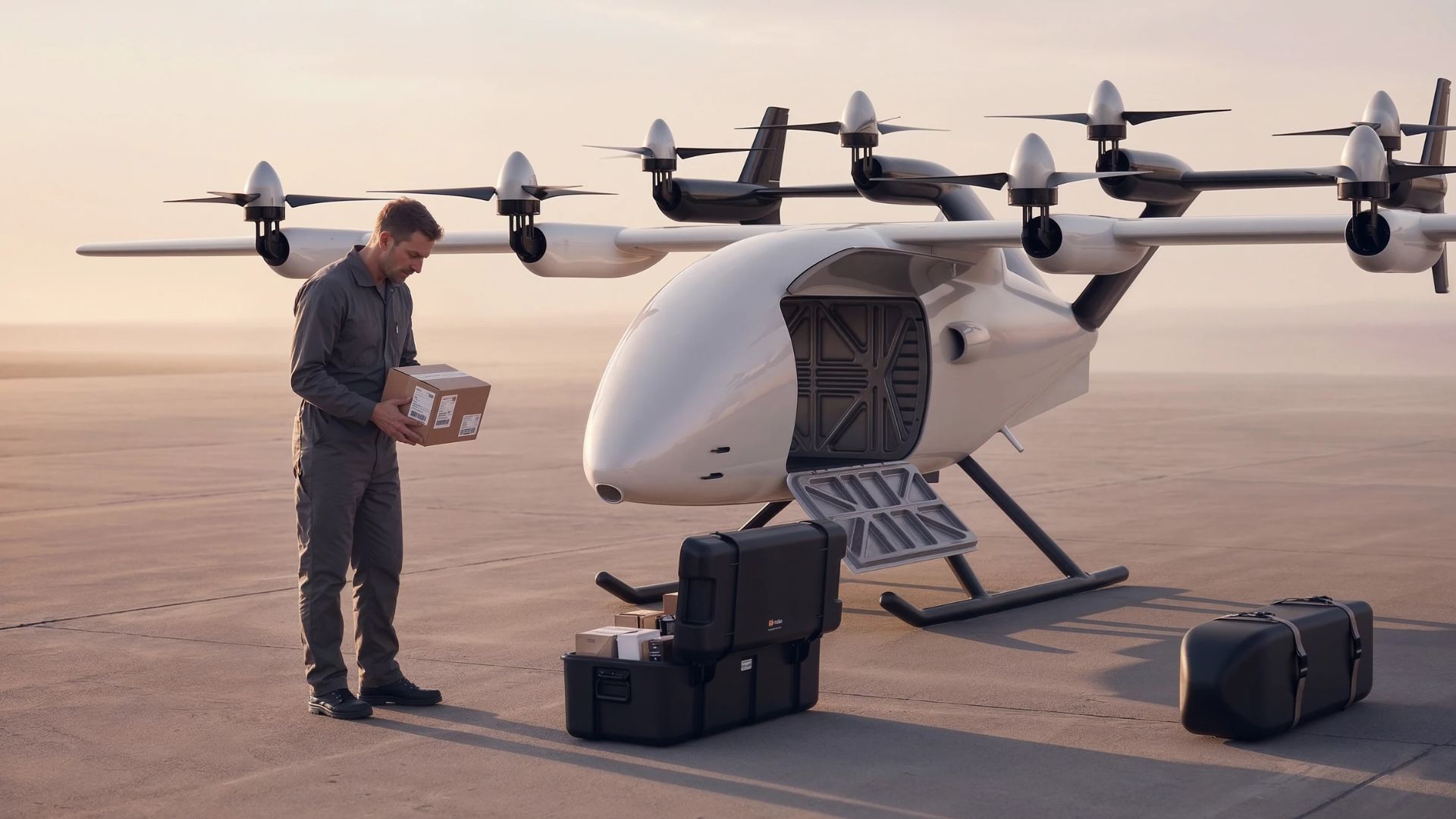
Several companies and militaries are testing uncrewed cargo aircraft that can haul supplies without a pilot onboard. From hybrid-electric cargo aircraft to heavy-lift fixed-wing planes, these planes are moving from concept toward real-world operations. They are already being used to deliver medical supplies, packages, and military cargo in remote areas. Some have already completed uncrewed flight demonstrations, while others are still in development. Let us look at the seven groundbreaking models leading the transformation. 1. Elroy Air Chaparral Hybrid-electric cargo aircraft designed for autonomous vertical takeoff and landing The US-based Elroy Air’s Chaparral is among the most advanced projects in this category. The hybrid-electric aircraft uses vertical-lift propellers to take off and land without a runway, while a separate propulsion system supports forward flight. It is designed to carry more than 500 pounds (227 kg) of cargo over distances of up to 450 miles (724 km). Its modular cargo pods can transport medical supplies, spare parts, and other deliveries without requiring ground infrastructure at the destination. In September 2026, Chaparral completed a series of autonomous, uncrewed cargo flights in Louisiana under the Federal Aviation Administration’s eVTOL Integration Pilot Program. The aircraft transported packages, medical supplies, tools, food, and water under air traffic control oversight, without a pilot on board. The demonstration brings the project closer to commercial operations. 2. Skyways Skyreach Long-range hybrid-powered autonomous VTOL aircraft Skyways unveiled its Skyreach autonomous cargo aircraft in November 2026, with customer flights scheduled to begin in December. Developed from the company’s V3 Block 2 platform, it combines eight electric motors for vertical takeoff and landing with fuel-powered propulsion for forward flight. The aircraft is designed for more than 18 hours of flight and an operational range exceeding 1,300 miles (2,092 km) under its maximum-fuel configuration. Its seven-cubic-foot (0.2 cubic meters) cargo bay can accommodate different payloads, including temperature-controlled cargo. Skyreach has a combined fuel-and-payload capacity of 100 pounds (45 kg), so its maximum range depends on how much cargo it carries. The project is backed by a $37 million US Air Force AFWERX STRATFI award intended to support full-rate production. Skyways says production has started in Austin, Texas, following the completion of its production design and progress in flight qualification testing. 3. Poseidon Aerospace Egret Large uncrewed fixed-wing cargo aircraft Poseidon Aerospace is developing Egret as a larger alternative to small cargo drones. The aircraft has a planned wingspan of approximately 50 feet ( about 15 meters) and is designed to transport up to 4,000 pounds (1,814 kg) of cargo over more than 1,000 nautical miles (1,151 miles). Unlike vertical-takeoff aircraft, Egret uses conventional runways, including paved and unpaved airstrips. Its design includes both front and rear cargo doors to simplify loading and unloading. Poseidon raised $60 million in Series A funding in September 2026 to advance flight testing and establish its first production line. The company expects the full-scale aircraft to conduct its first uncrewed flight by the end of 2026. Its earlier quarter-scale Seagull demonstrator has already flown, helping validate elements of the aircraft’s design and control architecture. Egret is designed for autonomous operation or remote control, rather than carrying a pilot onboard. 4. Zuri uncrewed cargo VTOL Hybrid-electric tiltrotor designed for offshore and remote deliveries Czech aerospace company Zuri unveiled its uncrewed cargo VTOL in August 2026. The hybrid-electric tiltrotor is designed to combine the vertical takeoff capability of a helicopter with the efficiency of fixed-wing flight. Its planned useful load is 165 kg (364 pounds), including fuel and cargo. Zuri estimates a design range of 679 km (422 miles), or 569 km (354 miles) with a 30-minute fuel reserve, at a cruising speed of approximately 220 km/h (137 mph). The aircraft is based on Technology Demonstrator 2.0, a full-scale platform undergoing ground testing and systems integration in Prague. Zuri plans to begin flight testing in early 2027, supported by a €6 million (about $6.9 million) first tranche of Series A financing. Unlike some fully autonomous designs, Zuri’s aircraft will be remotely piloted, with automation handling flight tasks under ground-based supervision. 5. Bell 505 uncrewed logistics aircraft Autonomous helicopter being developed for US Marine Corps resupply Bell and Near Earth Autonomy are adapting the Bell 505 helicopter into an uncrewed logistics aircraft for the US Marine Corps’ Medium Aerial Resupply Vehicle – Expeditionary Logistics (MARV-EL) Increment 2 program. The project aims to give Marines a mid-weight cargo aircraft capable of delivering supplies to dispersed units in contested environments. Using an existing helicopter platform could provide access to established manufacturing and maintenance infrastructure while allowing the aircraft to operate without an onboard pilot. Bell announced its selection for the program in April 2026. The development team is integrating Near Earth’s Captain autonomy system and modifying the helicopter’s cargo-handling capabilities. The program is intended to produce a prototype that meets or exceeds the Marine Corps’ performance requirements. The aircraft is still in development, but its military backing gives the project a defined customer and operational requirement. 6. Reliable Robotics’ autonomous Cessna Grand Caravan Conventional cargo airplane adapted for autonomous flight Rather than developing an entirely new aircraft, US company Reliable Robotics is working to automate the Cessna 208B Grand Caravan, a widely used single-engine turboprop. The system uses onboard computers, sensors, and automated flight controls to manage operations such as taxiing, takeoff, navigation, and landing. A remote operator can supervise the aircraft from a ground control station, reducing the need for a pilot in the cockpit. In October 2026, Reliable Robotics completed cargo-flight demonstrations at Albuquerque International Sunport as part of the FAA’s eVTOL Integration Pilot Program. The trials used a safety pilot onboard, with the aircraft remotely piloted from the company’s California base. They therefore demonstrated automated and remote operations, rather than routine pilotless commercial service. The project is significant because adapting an existing certified aircraft could offer a more direct route toward autonomous cargo operations than developing a completely new airframe. 7. Cessna SkyCourier UX Autonomous medium-payload cargo aircraft concept from Textron and Merlin Textron Aviation and autonomy developer Merlin introduced the Cessna SkyCourier UX concept in September 2026. It combines the existing twin-engine SkyCourier aircraft with Merlin’s Pilot autonomous flight software to explore cargo operations without an onboard crew. The proposed aircraft is intended to carry approximately 6,000 pounds (2,722 kg) of cargo, with space for up to three LD3 containers. It could operate from unimproved runways and support deliveries to remote military bases, expeditionary locations, and other destinations where traditional airlift is difficult to arrange. The concept also explores a more fundamental redesign of the aircraft. Removing the cockpit could free additional space for cargo, with a forward-loading arrangement and integrated loading equipment under consideration. However, SkyCourier UX remains a concept undergoing engineering studies and evaluations. Textron and Merlin have not announced a completed autonomous prototype or a production schedule. Get the latest in engineering, tech, space & science - delivered daily to your inbox.Kaif Shaikh is a journalist and writer passionate about turning complex information into clear, impactful stories. His writing covers technology, sustainability, geopolitics, and occasionally fiction. A graduate in Journalism and Mass Communication, his work has appeared in the Times of India and beyond. After a near-fatal experience, Kaif began seeing both stories and silences differently. Outside work, he juggles far too many projects and passions, but always makes time to read, reflect, and hold onto the thread of wonder.
These 7 aircraft could reshape the future of pilotless cargo flights
Full Article
Original Source
Read the full article at Interestingengineering →KhanList aggregates and links to publicly available news content. We do not host full articles from third-party sources. Always verify important information with original sources.