
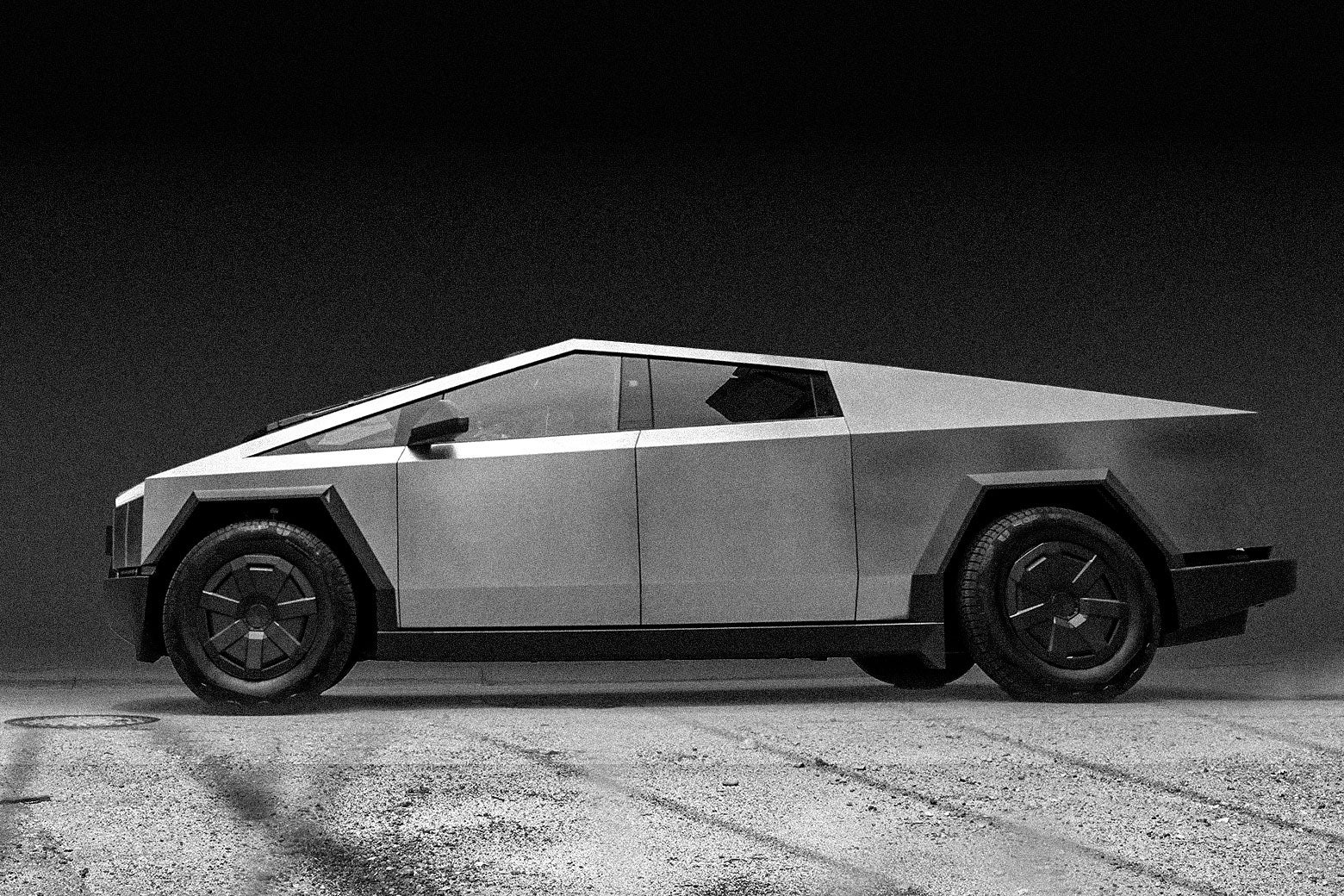
The Industry There’s a Reason Elon Musk’s Cybertruck Never Took Off Actually, there are a few. Photo illustration by Slate. Photo by Patrick T. Fallon/Getty Images Plus and Joe Raedle/Getty Images. Sign up for the Slatest to get the most insightful analysis, criticism, and advice out there, delivered to your inbox daily. Few vehicles have been more widely unloved and often ridiculed than Elon Musk’s attempt to radically redefine the venerable all-American pickup truck. Now it appears that the wedge-shaped stainless-steel monstrosity that is the Tesla Cybertruck is headed for that great scrapyard in the sky. On Friday, fresh off a shellacking of the candidates he bankrolled in the midterms, Elon Musk posted to X that Cybertruck production would wind down in mid-2027 to free up manufacturing capacity at Tesla’s factory in Austin, Texas, for the new Cybercab, a gold-colored self-driving car that has no pedals or steering wheel. Many will likely say good riddance to the Cybertruck. With a road presence that strives for futuristic but comes off as obnoxious, it came to symbolize Musk’s transformation from a climate-conscious champion of the left—the Cybertruck was, at least, an electric vehicle—to a MAGA-addled, chain saw–wielding, Trump-boosting agent of the right. Unveiled in 2019, the Cybertruck sought to reimagine the pickup segment with a combination of jaw-dropping technical audacity and arrogance. The brutally angular design was rumored to have sprung directly from the mind of Musk himself, with the mandate to the Tesla design team to make it so. The story I heard was that the ever-childlike Musk drew it with a ruler on a piece of paper, then handed it to head designer Franz von Holzhausen and Tesla’s beleaguered engineers to figure out the details. True or apocryphal, that scenario captures Musk’s penchant for pursuing self-evidently dumb ideas, which he somehow thinks he can translate into world-changing demands. But this time, the world didn’t want to change. I covered the reveal of the Cybertruck with a colleague whose spit-take reaction when the Cybertruck rolled out was unforgettable: Is this for real? The vehicle, which does, underneath all those angles, feature a truck bed with a motorized cover, was almost immediately labeled a colossal blunder. The pickup segment is extremely profitable in the U.S. for automakers, and it’s where the country’s perennial top seller, the Ford F-Series, has ruled since the Reagan administration. The goal with the Cybertruck, it seemed, wasn’t to join the pickup-truck segment but to shock it into submission. But as of now, fewer than 75,000 of Musk’s pickups have been sold, a number that is all the more disappointing when you consider that Tesla’s Austin factory was set up to produce 250,000 trucks a year. That might have something to do with the fact that the originally promised price tag was $40,000, also an undershoot of reality: Currently, the base truck is $82,490 (although it appears that Tesla has stopped taking orders for it), the middle level is $92,490, and the top-trim, immaturely named “Cyberbeast” is $102,490. It was hard to see who the Cybertruck was for. Your average pickup buyer, even if they could afford the Cybertruck, didn’t have much incentive to entertain Musk’s vision. Customers who might have been attracted to an electric truck had the much more functional Rivian R1T to consider. Apart from a polarizing headlight design, the Rivian actually looked like a pickup, while the Cybertruck was auditioning for a part in a Mad Max movie. (Rivian fans could also buy an R1T several years before the Cybertruck eventually arrived; the Tesla didn’t begin being delivered until 2024.) Contractors and farmers in the market for a pickup don’t care about the ability to go from 0 to 60 in under five seconds so much as they need towing capacity and durability. The truck’s windows were supposed to be bulletproof, lending the thing a postapocalyptic vibe, but they embarrassingly cracked during the Cybertruck’s livestreamed launch event at its design studio near Los Angeles. It’s hard to imagine your average farmer being shot at, but it wasn’t a good sign, quality-wise. And potential owners for whom the pickup lifestyle is more aspirational—i.e., they don’t need to haul stuff—could opt for a Ford F-150 King Ranch, a luxurious dream truck with a 14-speaker audio system and real wood interior accents, to make their lives complete. The death of the Cybertruck isn’t all the Cybertruck’s fault. Tesla is in a massive shift in its business strategy away from electric vehicles and toward self-driving robotaxis, Optimus humanoid robots, and artificial intelligence. The company discontinued both the Model S sedan and Model X SUV earlier this year. The Model 3 four-door and Model Y crossover remain in the lineup—for the moment at least; these are the Teslas that well-to-do liberals are now slapping “I Bought This Before Elon Went Crazy” stickers on, and Tesla hasn’t meaningfully updated either in years. The Semi (an electric semitruck with a massive wraparound windshield) is also sticking around, and of course Tesla just showcased its new Roadster, a supercar that can “fly” (really, it more elevates for very short distances). The sheer impracticality of the car is a signal of where Musk wants to take the company: Human-piloted EVs are in their way out, replaced by Cybercabs summoned on demand. Embracing that transformation, including the production of any army of robots, means that there isn’t room for continued Cybertruck manufacturing at Tesla’s factories. I like to characterize the Cybertruck as an “exotic” vehicle—a fever-dream hypertruck meant to appeal to crypto bros who had played a lot of Halo and measure success in terms of Lamborghinis in the driveway. To its credit, it was impossible to mistake the Cybertruck for anything else. You were supposed to imagine a fleet of the vehicles rolling off SpaceX Starships that had landed on Mars, possibly driven by androids quoting The Hitchhiker’s Guide to the Galaxy. In the end, the Cybertruck has probably succeeded in delighting its fairly limited core audience—at least the members of that audience who have stuck with it through numerous recalls for stuff like trim pieces that were literally falling off. The Cybertruck certainly provided some sizzle in 2019 when Tesla’s stock price was sliding and Musk appeared to be losing some of his ability to dominate the conversation inside and outside the auto industry. It put stainless steel back into the picture when nobody had given it a second thought since John DeLorean’s cocaine bust or Back to the Future’s flux capacitor. SpaceX reportedly wound up buying thousands of Cybertrucks when sales disappointed and inventory accumulated, providing some valuable insight into how Musk uses his portfolio of companies to prop each other up. Cybertruck fans—whoever they are out there—can rest assured that it won’t completely disappear from America’s highways anytime soon. It could evolve into something of a collectible: Tesla’s swaggering pre-COVID middle finger to the truck world, an artifact of the company’s do-anything period, an emblem of its triumphant assent to the pinnacle of the EV world. That will reward aficionados who rightly see the Cybertruck as a bold-yet-doomed attempt to break out of the established pickup paradigm and try something wildly different. It’s true: The Cybertruck was a swing for the fences. It was also more than a little stupid. Self-Driving Cars Transportation Elon Musk Cars
There’s Maybe One Good Thing to Say About the Now-Dead Cybertruck
Full Article
Original Source
Read the full article at Slate →KhanList aggregates and links to publicly available news content. We do not host full articles from third-party sources. Always verify important information with original sources.