
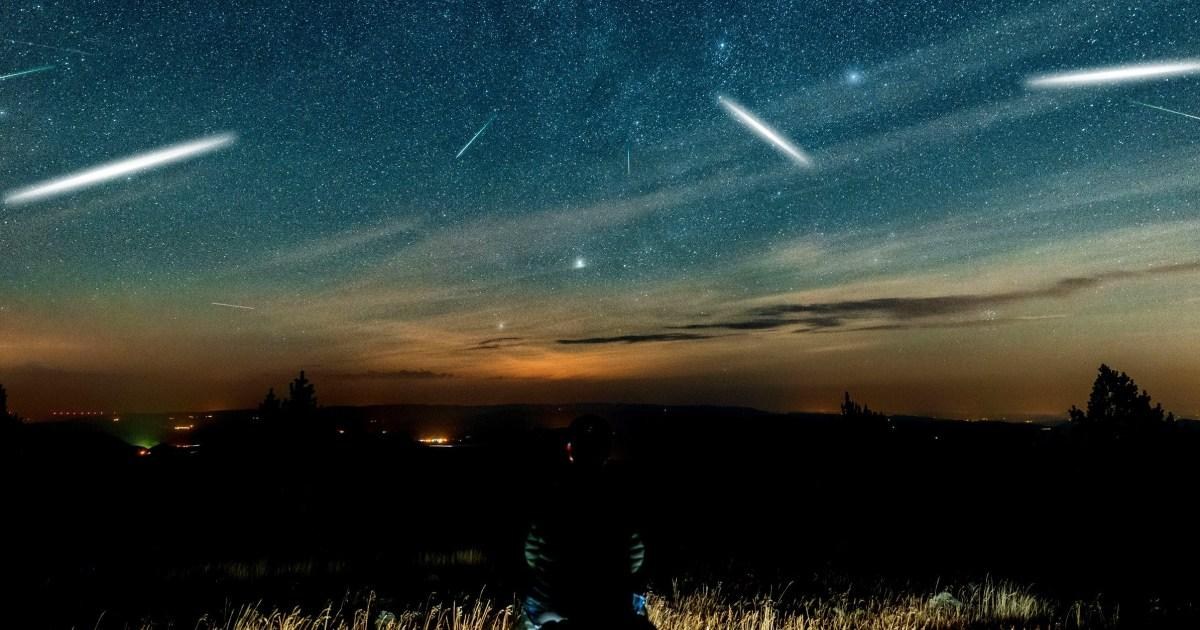
Satellites reflect sunlight, making them visible at night (Picture: Getty/Metro) The next time you light a campfire and look up at the night sky, those thousands of pinpricks of light might not be stars – but satellites. The Royal Astronomical Society has warned that the starry night sky could disappear if private companies keep blasting spacecraft into space. On a clear night far away from city lights, you can see 4,500 or so stars. But if every planned satellite was launched today, there would be 70,000 illuminated orbiting devices, 15 times as many stars speckling the sky. ‘It would mean the complete transformation of the sky we’re familiar with,’ Dr Robert Massey, the charity’s deputy executive director, tells Metro. ‘And nowhere on Earth would escape this change.’ Elon Musk tech company ‘threatens human heritage’, says expert According to the RAC, this view could be replaced by moving white dots (Picture: Getty Images) Satellites keep life running smoothly. They help us watch TV, forecast the weather and ensure phone map apps don’t send you the wrong way. Nearly 15,000 satellites orbit Earth, including those that have stopped working and drift in ‘graveyard orbit’, according to the UN. Elon Musk’s SpaceX has launched around two-thirds of them, which power its Starlink internet service. And the company plans to launch one million more to form a ‘megaconstellation’, a sprawling network of 500ft-wide AI data centres. ‘That number would mean thousands of satellites visible at any one time, so they could easily outnumber the stars we see with the naked eye,’ says Massey. The servers, called Starmind, would hover in low Earth orbit, between roughly 250 and 620 miles above the planet. A mock-up of Musk’s orbital data centres (Picture: SpaceX) Other tech giants, like Google’s Project Suncatcher and Amazon’s space company Blue Origin, are also plotting AI-computing spacecraft. But megaconstellations aren’t astronomers’ only concern – a start-up company wants to light up the night with 50,000 orbiting mirrors. Reflect Orbital would bounce sunlight to power solar farms and illuminate city streets. Each of these space mirrors would be brighter than the Full Moon, smearing even countryside skies with the glow of the suburbs. ‘So with hundreds visible at once it would be akin to a sky full of moving bright dots,’ says Massey. ‘Personally, I’d say that the two proposals threaten a core part of human heritage, the night sky humanity has looked at for our entire existence.’ An image of the cosmos taken by the Vera Rubin Observatory (Picture: AP) This would be bad news for astronomers, who point telescopes to the heavens to discover more about the universe we call home. Some observatories would struggle to operate, such as the Vera Rubin Observatory in Chile, which maps the sky every three days. Olivier Hainaut, an astronomer at the European Southern Observatory, has previously estimated that astronomers would have to have their telescopes make exposures three times as long to overcome this. ‘If we cut off the sky in optical and radio, we are killing off much of astronomy,’ adds Massey. ‘It means we can’t even try to answer the big questions about our origins and whether we are alone in the universe.’ These new satellites are adding to the cosmic rubbish dump above our heads. There is currently no way to remove the large amounts of space junk zipping along at 17,000 miles per hour. A big fear among scientists is that just a single piece of rubbish smacking into another, shattering them, could cause a chain reaction. This worst-case scenario, Kessler syndrome, would end with Earth surrounded by fast-moving shrapnel too perilous for people and satellites. To view this video please enable JavaScript, and consider upgrading to a web browser that supports HTML5 video Researchers say that climate change is making Earth’s in-demand lower atmosphere thinner, leaving less room for satellites. For Massey, the final frontier for the corporate world needs to be better regulated by governments and independent bodies to ‘protect astronomy’. He suggests limiting the number of orbiting devices private companies can launch and requiring ‘At the moment it’s very much the case that astronomers and environmentalists, with our relatively meagre resources,’ Massey says, ‘are being outpaced by the world’s richest companies and men, who appear to be almost entirely unconstrained.’ SpaceX has been approached for comment. Get in touch with our news team by emailing us at webnews@metro.co.uk. For more stories like this, check our news page. Arrow MORE: Solar storm fears as ‘modest’ flare soaks plane with 1.5 times more radiation than normal Arrow MORE: A new star has been discovered – one scientists thought was ‘impossible’ Arrow MORE: Invisible jet of radioactive goo is heading for Earth – should we be worried? News Updates Stay on top of the headlines with daily email updates.
There could soon be more satellites than stars in the sky – thanks to billionaires
Full Article
Original Source
Read the full article at Metro →KhanList aggregates and links to publicly available news content. We do not host full articles from third-party sources. Always verify important information with original sources.