
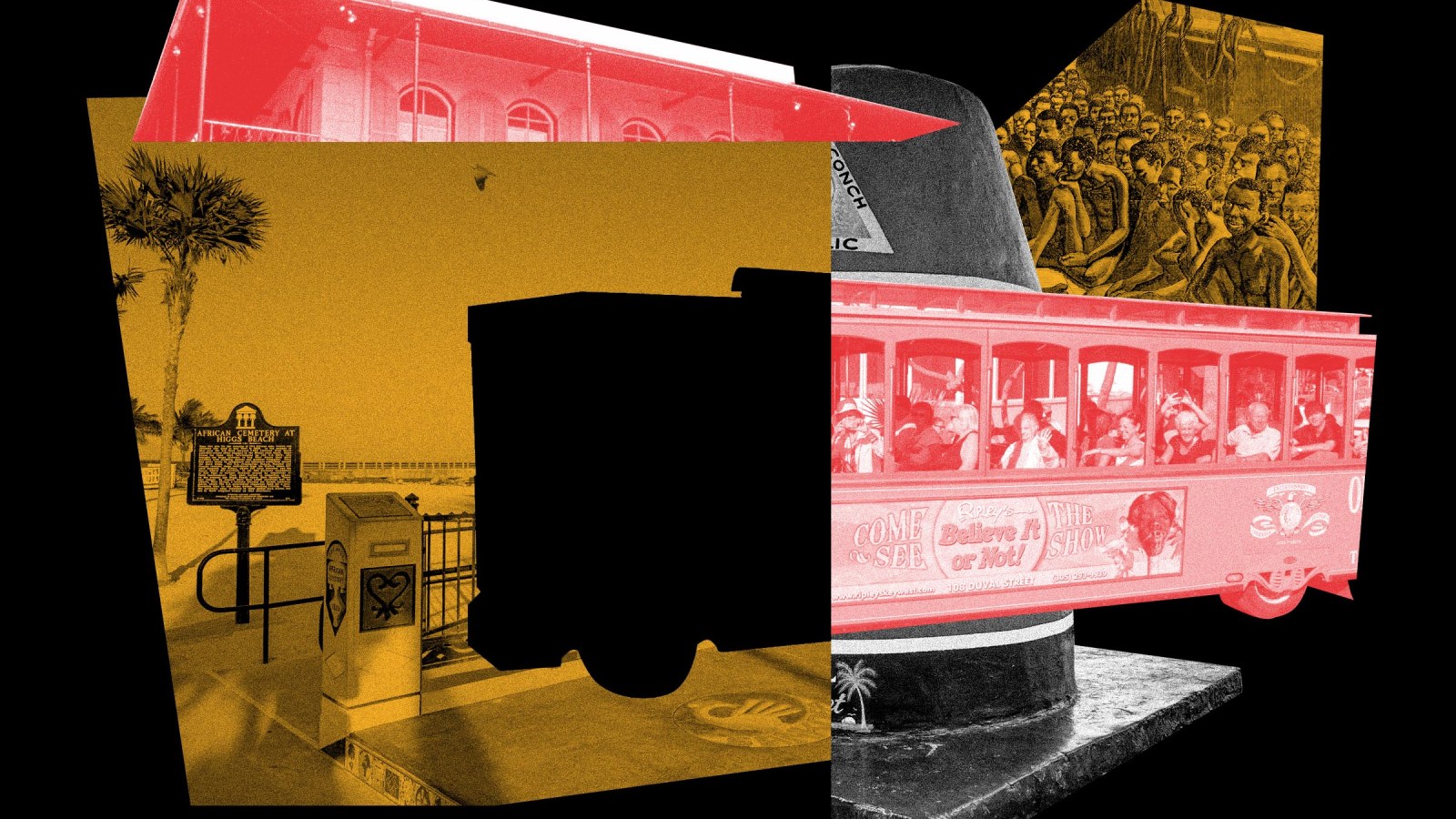
Editor’s note: This story is part of a special series by Princeton University journalism students reporting on the discovery of an African burial ground in Key West, Florida, and how the legacy of slavery still reverberates through the island community and beyond. O n a sizzling Sunday in March, tourists cool themselves with miniature fans at the curb while waiting for the hop-on-hop-off trolleys that trail down Duval Street in Key West. The cheerful voice of a guide on a mic booms through the open-air cab of each old-timey bus. “Welcome ladies and gentlemen…” Moments later, a rental van pulls up. The diver, dressed in a multicolored African-print dress with a matching headwrap, rolls down the window. Her Long Island accent is thick as she says, “Sorry, y’all, I took so long, there was traffic from Stock Island.” She’s an hour late to the tour and she wipes the sweat dripping down her cheeks. This tour is unlike anything else in Key West. “I’ll have to do y’all in the shadows,” she tells the group of six tourists climbing into the van. On the lamppost next to the van reads a sticker: “One Human Family,” the official motto of Key West. “The AC is broken, so windows down, everybody,” she says while peeling away from the curb en route to the first stop: Bahama Village. Arida Wright’s Island Cultural Tours is a one-woman operation, the only guided tour about Black history in Key West. Wright’s small business is a part of her larger mission as a social activist: to spread cultural understanding and awareness of Black life in Key West. Earlier this year, she was named the city’s poet laureate, yet for the past three years Wright, 65, has been running her tours essentially off the books. Due to a tangle of local regulations and the dominance of one tour company, she is unable to secure a proper tourist-vehicle license. That company, which currently controls all such licenses in Key West, is Historic Tours of America (HTA). According to co-founder Chris Belland, HTA hosts approximately 3 million guests each year across the U.S., operating more than 36 brands in nine cities and declaring themselves “storytellers of American history.” In some places, HTA offers the only history tours available. Editor’s picks But what other stories are missing from the narrative? All over the country, local guides like Wright are fighting to keep their communities’ history alive through specialized tours, only without corporate backing. “I would love to say, ‘Take my tour, everybody knows about it,’” Wright says. “No, I have to be in the shadows. I can’t let it be known that I’m doing these tours.” DRIVING DOWN OLIVIA STREET, palm trees stud the sky and warm wind blows through the van. Bahama Village is a historically Black neighborhood of approximately 1,800 residents, with a storied history. Wright points out the Navy Yard in the distance. “Bahamians migrated to this area in the 1800s for economic opportunity as boat builders and spongers,” she says as a chromatic mural comes into view. The mural shows individuals who made Bahama Village what it is, like Coffee Butler, a musician who dedicated the song “The Beautiful Isle of Key West” to his beloved hometown. “This is the Douglass Community Center,” Wright says as she parks the van in front of a low-slung off-white building. “It used to be the high school for Black students in Key West before integration.” Back in 1870, the Frederick Douglass High School opened and recruited Black teachers from all over the mainland. Related Content “That’s my alma mater!” Carolyn Brown shouts out, full of pride. Brown, 75, a Bahama Village native and best friend of Wright, joins on the tours to give an insider’s perspective on Key West history. Suddenly, a man with an aquamarine shirt walks up to the side of the van. John Wilson Smith, 69, another friend of Wright’s and native to Bahama Village, slips into the passenger seat. A local historian, Smith tells stories about the major figures of Bahama Village, like the vaudeville artist turned actor Stepin Fetchit. “He was the first Black millionaire in Hollywood, and he started here in Bahama Village,” Smith says, as Wright pulls up to Fetchit’s famous “Pink House” with columns and a wide porch. “He was frowned at by the Black community and the NAACP, because he did blackface. It was an insult to the Black people.” A classic trolley tour rolls through Key West. Jeffrey Greenberg/Universal Images Group/Getty Images OVER ON ONE OF THE HTA-RUN trolleys, customers are getting a very different lesson about the area’s Black history. “You’re DOOMED!” yells the guide on the “Ghosts & Gravestones” tour as the bus rolls down Duval Street. “Yes, we are DOOMED!” responds the group on board. The ghost story-themed tour, which centers the paranormal tales of Key West, includes a stop at Higgs Beach. There, a public park partially rests on a burial ground for 295 African refugees who’d been rescued from intercepted slave ships in 1860 and died ashore weeks later of illnesses acquired on board. The tour guide, a man dressed up as a friar, walks over to the small memorial site. Violet lights illuminate the faces of tourists as they sit on the big bus overlooking the beach and the man begins giving a history of the cemetery. “Now, if you look at this platform you’ll see ovals etched into the cement,” he says, pointing to a concrete patch of ground, which has been painted to show a map of the kidnapped Africans’ journey to Key West. He continues, “The white podiums will tell you stories about the African children and the black sign in the corner will tell you about their story.” Only a minute has passed and the guide heads back toward the bus, but not before dropping one last tidbit of information: “Across the street over here by the dog park, a man wanting to start a hotel put his shovel in the ground and found… bones. He never got his hotel.” The tourists mutter in disbelief before the driver of the bus heads down the street to the next haunted stop. Asked about the tale of found bones in the Ghosts & Gravestones tour, Sam Kaufman, a former city commissioner of Key West’s District Two and, as of Aug. 24, the city’s new mayor, says, “A lot of those tours are not factually correct.” He offers, by way of evidence, “My daughter worked for one of the tour companies. She would say she made things up because it was entertaining.” HTA marketing manager Steve Burress says the accuracy of any one tour varies, but they’re at least rooted in fact. “If you’re a believer in ghosts and ghost stories, a lot of them are fabricated around historical events… The fact that there are bones there at Higgs Beach is the little bit of history that ghost stories developed from.” HTA is the backbone of Key West tourism. The company started in 1973, after the Navy left town and the shop owners were struggling to get tourists in the door. Ed Swift III, a Key West native, along with Chris Belland, rebuilt the Duval Street area downtown. To attract business, they began giving tourists rides in a converted bread truck and trailer. “We were up against the Conch Tour train, which had been in business since 1948,” says Belland. HTA eventually bought the Conch Tour trains, and from there, the company skyrocketed. Whether tourists ride on their trolleys, visit the Key West Aquarium, or shop at Mallory Square, they’re patronizing HTA: The company owns almost every attraction in Key West — and it seems like the city is eager to help it stay that way. Heather Carruthers, a former Monroe County mayor and commissioner for District Three, recalls an attempt 15 years ago by a duck tour company — which use large amphibious vehicles — to set up shop in Key West. “The city commission prevented them from doing that,” Carruthers says. “I think their rationale was, these vehicles are too big for our narrow streets, but the real reason, a lot of people believe, is because HTA pretty much has a monopoly [on the tour industry]. The city can only give so many licenses.” Key West offers an unlimited number of franchise vehicle licenses to tour operators, but they require a substantial amount of capital to obtain: For the application itself, a business must submit a $5,000 check. Non-franchise vehicle licenses — the kind that a small operator like Arida Wright would need — are considerably less expensive, with a $375 annual fee. However a city ordinance caps the number of available non-franchise licenses at seven. Currently, HTA, which most of the time uses franchises licenses, owns all seven non-franchise licenses as well. Kaufman says that’s an unfair advantage. “Yes, it’s anti-American for a company to control all of the tours and to hold hostage seven licenses without even using them,” Kaufman explains. “You shouldn’t be able to hold all of the resources in. That’s called a monopoly.” Kaufman says he at one point proposed expanding the number of licenses by two and creating a bidding process for new businesses to obtain them. “My colleagues voted it down, in my opinion, to protect the same company.” ARIDA WRIGHT WAS BORN in Hempstead, Long Island, but vacationed in Key West before she took the leap to move to the continental United States’ southernmost city 30 years ago. The island community’s strong ties to the literary world — it’s been home to generations of writers, including luminaries like Ernest Hemingway, Tennessee Williams, and Elizabeth Bishop — drew her in. “I had manuscripts at home that were going nowhere, so I came to Key West so I could be published,” Wright says. Arida Wright celebrates being named Poet Laureate for the City of Key West this year. Having no family in town, she went straight to where the Black people were: the Douglass Community Center in Bahama Village. There, she found her family in folks like Brown and Smith, who welcomed her into their fold while she became a community activist and pursued her writing dreams. Writing, particularly poetry, for Wright is a form of channeling the spiritual realm and connecting with her inner self. Wright found comfort in poetry in the face of obstacles like overcoming addiction and healing from incest, but also joy in poems about love and pleasure. “I wrote my first poem when I was in sixth grade, about a boy I liked in church who didn’t know I existed,” Wright says. Her poetry evolved as she published two books and she began winning awards in town, but it took her a while to get comfortable with sharing her work. “I don’t like acknowledgement,” she says. “That’s not something that’s in my culture.” Even so, Wright became an ever more public fixture in Key West over time. She engaged with Black culture in the area by taking part in events like Goombay, a Bahamian celebration, and helping to establish the African Cemetery Memorial. She currently serves as president of R.O.S.E. Diversity, a group founded in 2019 that organizes and supports community engagement like the Day of Remembrance ceremony at Higgs Beach. Occurring annually in August, Key West’s version of this global celebration honors the African burial ground by having poetry readings by Wright and performers like African dancers. “My purpose is to always keep the community on notice that we are here, and we are representing our ancestors, our culture, and our god,” Wright says. “We will not let our culture disappear.” Wright’s understanding of narrative and dedication to preserving culture inspired the start of her tour business. A close friend, Shamele Jenkins, told Wright, “You’re the one to do tours in Key West about the African cemetery. You’re the one who needs to let people know, because you’re a good storyteller.” On every Island Cultural Tours outing, Wright brings visitors to Higgs Beach, where she found — and built — community so many years ago. On that Sunday in March, Wright’s tour group exits her van and moves to the beachside memorial site. The crash of waves plays out as Wright delivers her poem, “Ancestors on the Beach,” an ode to those buried underneath the tourists’ feet. “Yes, ancestors, we gather at the beach to remember your struggle, your strength, your African pride…” She guides a tourist to pour water as a libation to the ancestors. Wright details the journey of those kidnapped from Africa to Key West and those who survived, who eventually were sent to Liberia. The pillars surrounding the memorial, she explains, share messages of African spirituality, like sankofa, meaning “return and get it.” Trending Stories Wright has persisted in returning to her roots and bringing that message forward with tours for her community. But if only the well-off can afford a license, how can small operators like her find opportunity? That’s the question Wright has been struggling to answer for three years. In the meantime, Wright is doing her best to keep her storytelling mission alive. She reflects on the support she found in writing workshops here in Key West, especially one run by a previous poet laureate, Flower Conroy. “When I was writing with Flower in her class, [my classmates] all helped me,” Wright says. “They said I had a voice.”
There Are No Guided Black-History Tours in Key West. One Woman Is Trying to Change That
Full Article
Original Source
Read the full article at Rollingstone →KhanList aggregates and links to publicly available news content. We do not host full articles from third-party sources. Always verify important information with original sources.