
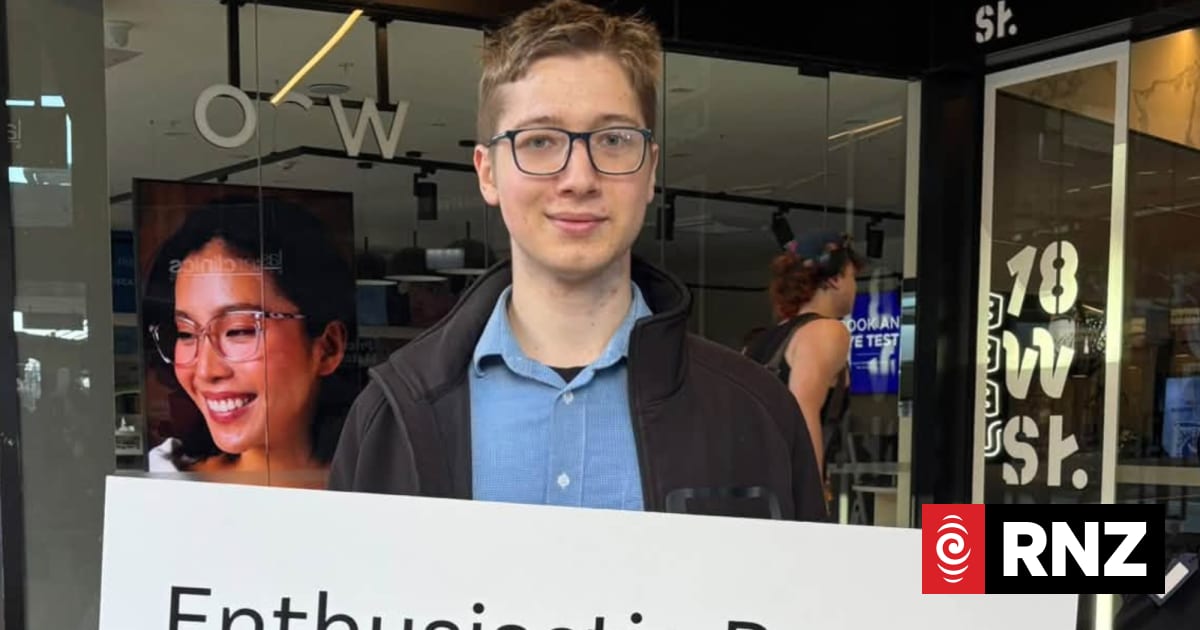
"Enthusiastic Person Looking For A Job" - Valera Bonyushkin held a sign with these words as he walked around Wellington's city centre.He added his phone number and email as well so employers could reach out."I'm trying to connect person to person because nowadays, because it's so digital, it's very hard to come off as someone with a personality or someone who has X, Y, and Z trait," the 19-year-old explained.He said the stunt was partly in reaction to the increased use of AI in an impersonal hiring system.And it worked: within a couple of days he had interviews and trial dates scheduled.He recently accepted an offer to work as an administrator for a local tradie company.It wasn't even his first time using the sign to get a job, he said.While looking for a sales role, Bonyushkin recorded himself jumping into rivers and oceans in the middle of winter holding the sign."It was absolutely glorious."I posted on Facebook and Reddit. I ended up getting a sales job within a week pretty much."Bonyushkin said the tactic worked because he believed vacancies weren't always posted on online job boards, saying employers preferred to look within their networks to hire someone they trusted.To build trust with employers, he said he never simply filled out applications, he tried to set up meetings and calls to showcase his personality and skills."Everyone can say they're a quick learner, creative, hardworking, but this just goes out of its way to prove it."According to Seek's employment reports for August, there were 300 percent more applications per job advertisement than a decade earlier - with 10 percent fewer jobs over the same period.The unemployment rate sat at 5.6 percent in the last three months to June, the highest in more than a decade, according to Stats NZ, described as "crisis-level" among young people in particular.Scott Ussher, Manager Labour Market Analysis at MBIE, said finding a job was difficult as businesses limited hiring and hours in response to ongoing economic pressures and uncertainty."At the same time, more people are looking for work, and job growth has not kept pace with population growth over the past three years. This means there is more competition for the jobs that are available," he added.But Ussher said there were signs of improvement, with a growth in filled jobs and advertised roles.According to Stats NZ, the working age population had grown by almost half a million in the past decade - and the rate of participation of this population had hit more than 80 percent.And higher unemployment rates translated to worsening mental health issues across the world, said Dr Hiran Thabrew Chair of the New Zealand Office of the Royal and Australian New Zealand College of Psychiatrists."The longer people remain unemployed, the greater the risk of mental health problems developing or worsening for them."And for some people, this can mean contributions to social isolation, relationship strains, housing insecurity and difficulty accessing services."But he said the impact of unemployment affected people differently, especially depending on the strength of existing social support systems."So mental health impacts on unemployment can be especially significant for young people entering the workforce, people in regional areas and those already facing systematic disadvantage, especially Māori and Pasifika."He described a "spiral" in which unemployment worsened mental health, which in turn made it harder to find employment.He recommended seeing a GP to be referred to appropriate mental health services as soon as symptoms - feelings of anxiety, depression, hopelessness or overwhelm - appeared.
The young Wellingtonian finding inventive ways to get employed
Full Article
Original Source
Read the full article at Rnz →KhanList aggregates and links to publicly available news content. We do not host full articles from third-party sources. Always verify important information with original sources.