
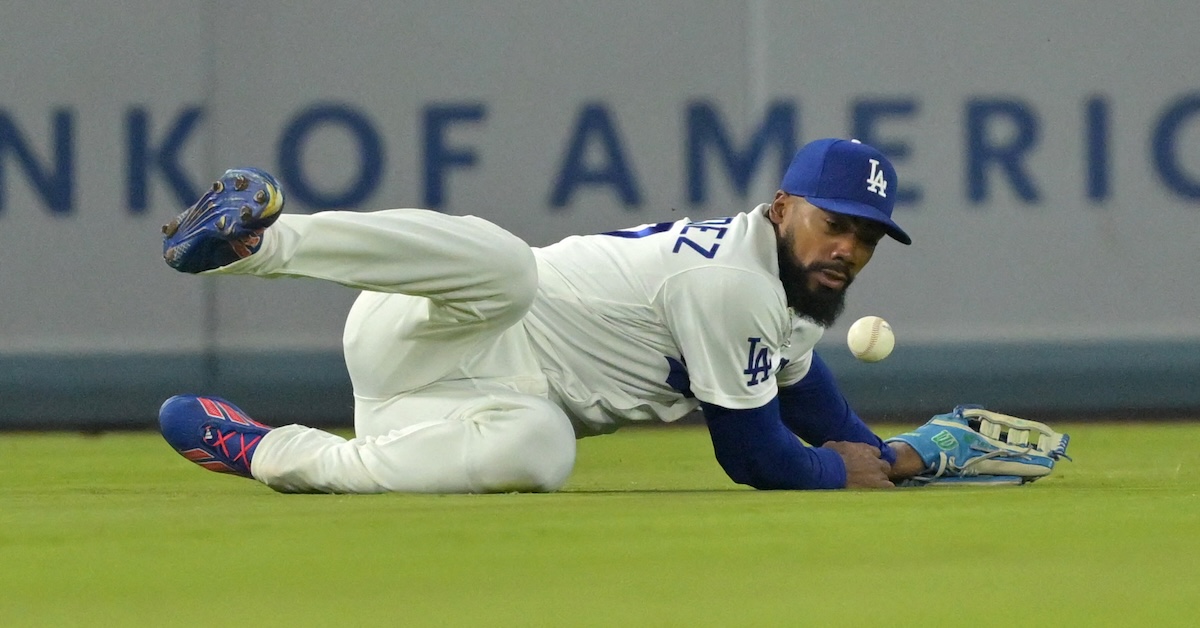
Jayne Kamin-Oncea-Imagn Images Julio Rodríguez only made one five-star catch this year. Well, that’s not entirely true. Rodríguez is indeed credited with making only one five-star play this year, but as you can see, it wasn’t a catch. With one out and runners on the corners, Detroit’s Dillon Dingler lifted a popup into shallow center field. Either because he knew he wouldn’t get there in time or he knew that the runner on first would have to wait to see whether the ball was caught, Rodríguez pulled up, fielded the ball on the hop, and fired to second for a force out. I happen to love this kind of play. I love it when the outfielder gets to turn into an infielder for a moment, trying to pick a good hop, snapping the ball up and making a quick transfer, and trying their best to whip the ball to second with the short stroke of a second baseman in time to catch the runner. I’ve had my eye on these outfield force outs ever since Rodríguez made a similar play in 2024. I noticed that particular play because I was surfing around the defense section of Rodríguez’s Statcast page, and I couldn’t help clicking on that one lonesome dot that indicated he’d made a play that wasn’t just difficult, but quite possibly impossible. You Aren't a FanGraphs MemberIt looks like you aren't yet a FanGraphs Member (or aren't logged in). We aren't mad, just disappointed. We get it. You want to read this article. But before we let you get back to it, we'd like to point out a few of the good reasons why you should become a Member. 1. Ad Free viewing! We won't bug you with this ad, or any other. 2. Unlimited articles! Non-Members only get to read 10 free articles a month. Members never get cut off. 3. Dark mode and Classic mode! 4. Custom player page dashboards! Choose the player cards you want, in the order you want them. 5. One-click data exports! Export our projections and leaderboards for your personal projects. 6. Remove the photos on the home page! (Honestly, this doesn't sound so great to us, but some people wanted it, and we like to give our Members what they want.) 7. Even more Steamer projections! We have handedness, percentile, and context neutral projections available for Members only. 8. Get FanGraphs Walk-Off, a customized year end review! Find out exactly how you used FanGraphs this year, and how that compares to other Members. Don't be a victim of FOMO. 9. A weekly mailbag column, exclusively for Members. 10. Help support FanGraphs and our entire staff! Our Members provide us with critical resources to improve the site and deliver new features! We hope you'll consider a Membership today, for yourself or as a gift! And we realize this has been an awfully long sales pitch, so we've also removed all the other ads in this article. We didn't want to overdo it. In case you didn't read all that, here's the short version. Membership includes:✓Ad-free browsing✓Unlimited FanGraphs & RotoGraphs articles✓Historical & platoon projections✓Leaderboard & player-page stat heatmaps✓One-click data exports✓Customizable player-page dashboards✓Dark & Classic site modes✓Weekly Members-only mailbag✓FanGraphs Walk-Off, your year in review✓Optional homepage photo removal✓Gift articles to non-Members✓Full postseason coverage It turned out that catching it in the air was impossible, but in the right situation with the right baserunner, recording the out could still be done. I had intended, over the winter, to write a roundup of that season’s outfield force outs. “Fun video article,” I wrote in my list of article ideas, “outfielders making force plays.” But as is so often the case, other, more pressing matters kept coming up. Now here we are two years later, and the roundup’s time has finally come, though you could argue that it’s coming too late. The 2026 season saw 17 outfield force outs. Not counting 2020, that’s tied for the lowest total in the pitch tracking era. In fact, the numbers seem to be trending downward very slightly. Over the first nine years of that graph, the league averaged 25.4 outfield force outs per year. Over the last nine years (again, excluding 2020), the average is 22.6. I suspect that this is because outfielders are playing deeper than ever. I think it might also be about the fact that offense is harder to come by. You can understand my thinking: Outfield force outs are almost always at second base, which means you need a runner on first base. If runners are getting to first less often, then you’d expect to see a dip. However, the numbers don’t bear that out. Runners are on first base roughly as often, even if you limit your sample to fly balls and line drives hit to the outfield. Let’s not let the data spoil a good time. We’re here to watch some runners get paralyzed with indecision as they try to decide whether the outfielder is actually going to make the catch. We’re here to watch outfielders make snap throws and hose those vacillating runners at second base. We’re here to watch them rack up five-star catches on non-catches. We’re here for tweeners. By starting the discussion with Rodríguez, I may have set you up for disappointment. Most outfield force outs don’t come on savvy plays where the outfielder gets a good jump on a tough ball, dekes the runner, and makes a quick, on-target throw. I’ve split the other 16 plays into categories, and only two of them got filed under Excellent Defense. We’ll save those for last. Four plays got filed under Horrendous Reads. We’ve got Kerry Carpenter and Cam Smith breaking back on balls that landed well in front of them. We’ve got Esmerlyn Valdez not getting any jump whatsoever, then deciding to just let the second baseman try an over-the-shoulder catch. And lastly, we’ve got Jung Hoo Lee somehow not even realizing that he might be called upon to catch the ball, then swooping in and making a smooth throw to first as if that was his plan all along. It was not his plan. He was napping out there. Those four Horrendous Reads were tied with four non-catches of a much less ugly variety: Dropped Dives. These were good defensive plays where the outfielder just couldn’t close the deal because they he couldn’t close the glove. Jerar Encarnacion was closing hard on a shallow liner that made for an extremely tough read. Weston Wilson didn’t get a great jump on his, but he was also dealing with a tricky sinking liner. As you’ll see from a very long video featuring lots of umpires either discussing the play or starting some kind of a cappella jam session, Ian Happ actually did complete his catch. He dropped the ball on the transfer, but the call just didn’t go his way. By rights, it should have been a fly out, not a force out. Lastly, Esteury Ruiz had a very shallow popup that required him to use every bit of his fantastic speed. All four of these outfielders had the ball in their gloves, but just couldn’t complete the play by making a football move before it popped out. (In case you’re wondering why this play is separate from the first three plays, it’s because the Reels function on the MLB.com Film Room is broken. A huge swatch of videos can’t be added to Reels for no discernible reason. If someone who works at MLB.com is reading this, please fix it!) The next category is Ugly Plays, and it should also contain four plays. The symmetry would be beautiful. However, I have split it into two subcategories. The first is Ugly Plays: Standard Division. In this division, we can see Matt Wallner doing just about everything wrong. He gets a bad jump. He doesn’t hustle at all. Instead of taking charge of the play as the outfielder, he lets the second baseman try a much more difficult catch. When he finally picks up the ball, it appears that he does so with a changeup grip, so maybe it shouldn’t be surprising that he fires it into the dirt and gets the out because shortstop Brooks Lee makes a sweet pick. On the second play, Riley Greene just kind of drops it. He doesn’t seem to have any trouble with the sun or wind. The ball just falls out of his glove. Because the play is so routine and the ball falls out of the line of sight of the baserunner at first base, it’s the easiest out you’ll see in this whole article. The next subcategory is one that you might well have seen coming if you watched a lot of Dodgers games in the last couple years. Welcome to Ugly Plays: Teoscar Hernández Division. Now, the first one is not an easy play. Statcast, factoring in the difficulty of fielding a ball near the wall, rated it a three-star play. But as is all too familiar, Hernández gets absolutely no jump whatsoever. He looks like he’s in quicksand as he slowly ramps up to a top speed you could generously describe as a saunter. His route isn’t great, so he has to adjust it at the last minute. He lunges for the ball awkwardly and has it in his glove for a moment before it falls out. This second play is also difficult, but in a different way. It’s a short, sinking liner hit much closer to Hernández. If you’re a connoisseur of outfield defense, you’ll know that this is the kind of play where bad defenders can rack up value. It doesn’t require much speed or effort, just a jump that takes them in the right direction, and even the worst outfielders guess right every once in a while. Once again, by the time the broadcast cuts from the center field camera angle (which, it’s important to note, runs on a slight delay due to the K-Zone overlay) to the high home camera, Hernández has not moved at all yet. He ends up making a nice sliding pick, and once again, the runner is easy to nab because he figured this ball would definitely be caught. But I have to tell you that this was also a three-star play, one of four that Hernández made all season. Hernández didn’t make any five-star catches in 2026. He didn’t make any four-star catches either, and we now know that half of his three-star plays were on balls that he didn’t actually catch. If there hadn’t been runners on first base, these two plays alone would likely have dropped him from FRV’s 23rd-worst outfielder in baseball to somewhere around the 10th-worst. We saw one other trap, this one on a nice play from Bryan Reynolds. Reynolds made a diving stop on this sinking liner and came up firing to catch the runner at home plate. The runner was safe at the plate, but confusion about whether Reynolds had actually caught the ball allowed the Pirates to get an easy force out at second. If you hadn’t noticed by now, we’re slowly working our way down into the great plays. This odd popup off the bat of José Ramírez didn’t earn that distinction. It’s not hard to see why. Atlanta center fielder Mauricio Dubón lost the ball in the lights, then let it pop right out of his glove. All the same, Dubón also showed off a lot of the skills that have made him a two-time Gold Glover. Finding a fly ball after you’ve lost it is no easy feat. And once the ball was down, he knew exactly how much time he had to retrieve it and fire to second base to catch the runner. You’d rather catch this ball, but it was pretty slick, as recoveries go. And with that, we’re down to our final category of outfield force outs: Excellent Defense. Here’s Rockies right fielder Tyler Freeman playing baserunner Brandon Lowe beautifully. In a fun bit of symmetry, Reynolds was the batter who got robbed of a hit here. Freeman charged this ball hard, but even when he realized he wasn’t going to get it, he didn’t slow down. He waited until the last possible moment, but still set himself up to receive a perfect hop, then he came up firing with a quick transfer and an accurate throw. The play went to review, which made it clear that every part of that process – the deke, the clean hop, the quick transfer, the 88th-percentile arm strength, and the accuracy that allowed the shortstop to stretch for the ball – was necessary in order to nab Lowe at second. According to Statcast, this was Freeman’s only five-star play of the season. We’re now down to the most impressive outfield force out of the lot, and it was a play with a lot of moving pieces. First of all, the stakes were high. The Red Sox were up on the Royals, 1-0, in the top of the seventh inning. Kansas City had runners on first and second with no outs. Tyler Tolbert sent a line drive into straightaway center field off the end of his bat. That kind of ball can be particularly difficult to read, especially when you don’t have much center field experience. But Nate Eaton read the ball perfectly. He was already charging in by the time the broadcast switched to the high home camera. Like Freeman, he didn’t slam on the brakes until the last moment. Unlike Freeman, this earned him an awkward hop, which he trapped against his belly. Also unlike Freeman, this didn’t seem to be subterfuge. Eaton is one of the most intense dudes you’ll see on a baseball field. I genuinely think the way he approached this baseball is the way he approaches everything: He went all-out on catching the ball until he was sure he couldn’t get there, then he instantly transitioned to going all-out on his next plan. If you watch Eaton’s eyes, you can see that his instinct was to go to second base, but he saw that catching the lead runner was actually the easier play, and he unleashed a laser. Here I should stop and remind you that Eaton has one of the strongest arms in baseball. His throw wasn’t perfectly on line, but he gave Caleb Durbin enough time to catch the ball and find a way to touch the bag in time for the force out. And that’s it, the cream of the outfield force out crop for 2026. Check back in next year for the 2027 roundup.
The Year in Outfield Force Outs
Full Article
Original Source
Read the full article at Blogs →KhanList aggregates and links to publicly available news content. We do not host full articles from third-party sources. Always verify important information with original sources.