
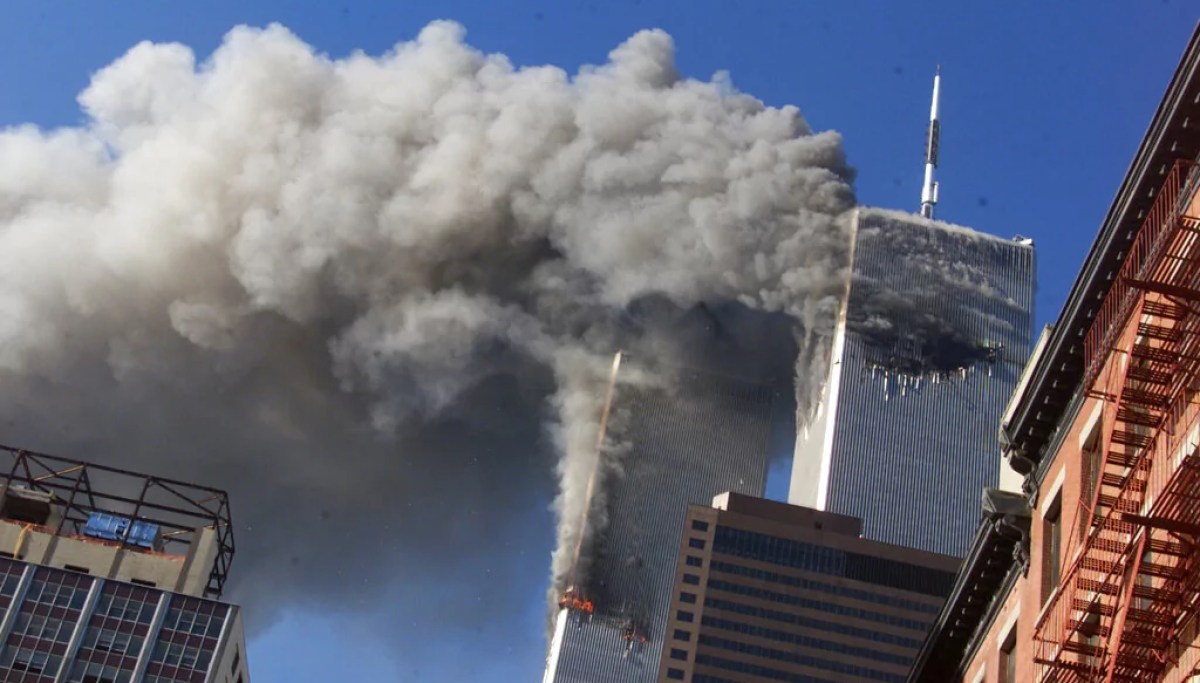
It was a Tuesday. A brilliant blue sky sparkled overhead as an unseasonably early chill hung in the air. My mother dropped me off half a block from my high school in suburban New Jersey. I was just months away from getting my driver’s license, an exhilarating prospect for any teenager. Everything felt ordinary. We were shaking off the summer cobwebs and settling back into a normal routine. The first indication that something out of the ordinary was happening arrived during a free period, mid-morning. I went down to the athletic office to pick up a roster for the following weekend’s football game and encountered the secretary hunched over her radio. Typically unfailingly warm and friendly, her face wore a look of concern as she held up a finger as I began to speak. There had been some sort of accident at the World Trade Center in lower Manhattan, not far from our town. A small plane crashed into one of the towers, she relayed via the news bulletin.“That was odd,” I thought, “given how clear the day was. How would a pilot make that sort of mistake?” I collected the document I’d come for and left, not thinking much more of it. I marched back to the other side of the school to the television studio, where I turned on one of the monitors. A local station was showing live images of the twin towers, one of which was on fire. It looked like a very serious accident. My mind wandered briefly to my father, who worked nearby and passed through that complex’s subterranean train station each morning.Then it happened, right around 9 a.m. In the first split second, my sports-fan brain told me it was a replay of the initial impact that had been queued up for the broadcast. “That explosion was huge. That plane wasn’t small. Wait, now both buildings are on fire. So that was a second blast. Oh my God, this is on purpose. Oh my God, we are under attack.”And then, “Where is Dad?”The rest of that horrific day was a blur, punctuated by crystallized, visceral memories. We had some trouble contacting Dad for a while, amid agonizingly spotty cell service. There was one tense call with Mom as we tried to figure out what was happening and if he was safe. There were no social media feeds to obsessively consult for updates, but rumors, both true and false, proliferated, sweeping through our school.One of the false rumors was that my own father had been killed. This developed through a misinterpretation of a moment that occurred in our student center. I’d taken a seat at a table alone, to try to clear my head, and started to try to reckon with what was inevitably going to be a catastrophic death toll. A wave of panic swept over me after it was confirmed that another plane had hit the Pentagon outside Washington, a blow against our military headquarters. I wept openly as I sat there. Someone must have witnessed that scene and wondered, perhaps aloud, if I had some sort of connection to a victim.This thought managed to be transmitted through a chaotic game of telephone, eventually morphing into “Guy lost his dad.” This whisper got back to me, of course, which caused enormous distress, even though I was almost certain it was untrue. After all, nothing seemed certain at all that day. And nothing would, for weeks. I remember a burst of relief when I was able to confirm it wasn’t true. It faded quickly, with worry and powerlessness reasserting themselves.In this Sept. 11, 2001, photo, smoke rises from the burning twin towers of the World Trade Center after hijacked planes crashed into the towers in New York. (AP Photo/Richard Drew) Another rumor turned out, very sadly, to be true. A student had been urgently pulled out of class and called to the main office. The reason: His father, trapped above one of the impact points, had phoned the school to speak with his son for the final time. They both knew, in that moment, that it was goodbye. Unimaginable.This nightmare suddenly became reality for that young kid, who was just days into his high school career. He was on the football team. The game for which I’d picked up that roster was never played. His father was one of 12 men and women whose lives were stolen that morning. A few months ago, when I finally summoned the courage to go visit the memorial site and museum at ground zero, I looked him up in the facility’s impressive yet haunting digital archive of victims. Seeing his face brought everything back. Tears welled up, as a lump gathered in my throat. I couldn’t help it, even almost a quarter-century later.After the towers collapsed, curses and vengeful vows echoed through the hallways. Grief was fresh. Fear was omnipresent. Anger was set ablaze. For many of us, those embers still burn. It was a defining, shattering moment. Some of my classmates subsequently enlisted in the military. Others became politically active. Still others refocused on normalcy as soon as humanly possible.But we were all scarred, and all processed those wounds, in some way. That afternoon, a few of us went up to a scenic overlook in town with a beautiful view of New York. It was packed. The southern tip of Manhattan Island was shrouded in a giant plume of dark smoke. It was, in every sense of the word, surreal. A makeshift memorial sprouted up in that space. Photos. Placards. Rosary beads. Prayer cards. Flowers. Candles. It was eerily quiet, even with all the people crowded together.The house of one of the victims was nearby, its driveway overflowing with cars. A broken family was inside that house. I remember feeling thankful that it wasn’t mine, then feeling guilty about it.Fighter jets suddenly streaked overhead, very loudly, heading straight toward the site of the atrocity. It was deeply unsettling. “What is happening? Is there more coming?” The creeping anxiety induced by low-flying planes of any sort lasted for years. I distinctly recall lying in my bed within a few days of the attacks, wondering if the distant rolling thunder was indeed exactly what it sounded like, or if it might be explosions or bombs of some sort.Dad was fine, thank God, though he still talks about the startling spectacle of police officers shouting instructions at suit-clad businesspeople to run as fast as they could uptown, away from the area. He also tells the story of going to a nearby hospital to try to donate blood for the victims. But the victims didn’t need blood — those hundreds upon hundreds of humans had been obliterated. Our next-door neighbor, a gregarious woman and an excellent cook, worked in one of the towers. Hours later, she sat in our backyard after she and Dad were able to escape the island and make their way home, despite all the transit disruptions. The dazed look on her face is still with me. Her spirit lost something that day. Many others who worked in those buildings never came home, of course. Some were forced to choose between being devoured by flames or leaping to their deaths. Torture, then execution.THE CASE AGAINST AI HYSTERIAThe famous “falling man” image was one I long wished I’d never seen, but now I believe more Americans need to really look at it and think about what it represents. It’s not “cringe” to be traumatized by such evil. Dealing with the gruesome reality of what Sept. 11 was, who did it, and what it looked, felt, and even smelled like, is essential. The evil must be stared down, which entails looking directly at it. “Never forget” is an active project that demands action. One duty many of us feel we have is to tell our unsanitized stories from that day.This is my small contribution. It was the worst day. The day that changed everything for several generations of Americans. The day we must never forget.
The worst day
Full Article
Original Source
Read the full article at Washingtonexaminer →KhanList aggregates and links to publicly available news content. We do not host full articles from third-party sources. Always verify important information with original sources.