
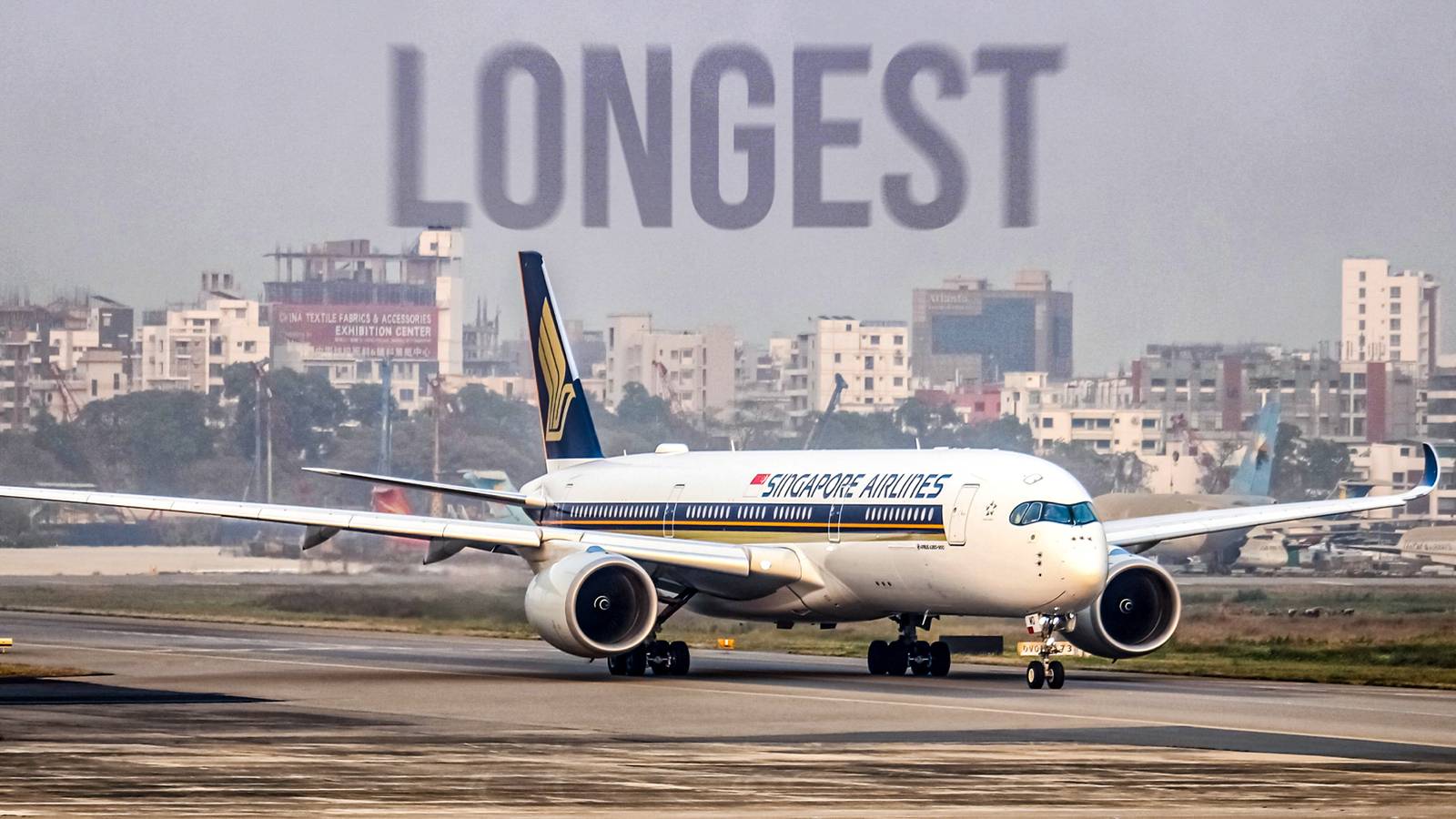
Published Oct 1, 2026, 7:00 PM EDT Brandon's passion for aviation started at a young age. He became involved in the flight simulator and VATSIM communities, which sparked his interest in aviation and eventually led him to earn his private pilot license. Outside of work, he continues to build flight hours, explore new airports, and stay involved in the aviation community. Singapore Airlines flight 24 from New York John F. Kennedy International Airport (JFK) to Singapore Changi (SIN) covers approximately 9,537 statute miles (15,349 km) and takes between 18 hours 30 minutes and 19 hours depending on direction and season. The service was launched on November 9, 2020, and has held the title of the world's longest nonstop commercial flight since. Flying it requires an aircraft built specifically for the job: the Airbus A350-900ULR, a variant with a reconfigured fuel system that only Singapore Airlines operates. Making the route work required decisions in both the cockpit and the cabin. The A350-900ULR carries 43,588 gallons (165,000 liters) of fuel against 37,248 gallons (141,000 liters) on a standard A350-900, achieved without adding a single physical fuel tank. The cabin holds 161 passengers in two classes with no economy section, roughly 92 fewer seats than the standard configuration. The route consumes approximately 85% of the aircraft's certified range, and the record has a known expiry date: Qantas launches Sydney to London Heathrow in October 2027 on a route roughly 1,000 miles (1,609 km) longer. The Route, The Distance, And The Record Credit: The Global Guy I Shutterstock Singapore Airlines flight SQ24 departs New York John F. Kennedy International Airport (JFK) and lands at Singapore Changi Airport (SIN) after covering approximately 9,537 statute miles (15,349 km) on the great-circle route. The service launched on November 9, 2020, and has held the title of the world's longest nonstop commercial flight since. Block times run between approximately 18 hours 30 minutes and 19 hours depending on direction and seasonal wind patterns, with the westbound leg from Singapore to New York typically running longer than the eastbound return. The JFK route is not Singapore Airlines' only ultra-long-haul service to the New York area. The airline launched Newark Liberty International Airport (EWR) to Singapore in October 2018 using the same aircraft type, a route that held the record until the JFK service began. Newark sits approximately two miles closer to Singapore on the great-circle path, which makes the JFK service marginally longer and gives it the record. The Newark route was suspended during the pandemic and relaunched in March 2022. Both services operate daily, and both use the Airbus A350-900ULR. The distances involved put the route in a category shared by only a handful of city pairs worldwide. The second-longest commercial flight, Qantas' Perth (PER) to London Heathrow (LHR) service, covers approximately 9,010 miles (14,500 km). Emirates' Dubai (DXB) to Auckland (AKL) route runs approximately 8,824 miles (14,200 km). Singapore Airlines' New York routes exceed both by several hundred miles. Flying nonstop between the two cities requires an aircraft that can carry enough fuel for 19 hours of flight while still generating enough revenue from a payload that has been deliberately restricted to make the range possible. The A350-900ULR: A Variant Built For One Customer Credit: The Global Guy | Shutterstock The A350-900ULR is not a different airframe from the standard A350-900. The wings, fuselage, engines, landing gear, and structure are identical. What Airbus changed was the fuel system. On a standard A350-900, usable fuel capacity is approximately 37,248 gallons (141,000 liters). On the ULR, that figure rises to approximately 43,588 gallons (165,000 liters), an increase of 6,340 gallons (24,000 liters). Airbus achieved the increase without installing additional fuel tanks or adding a rear center tank of the kind fitted to the A321XLR and the A350-1000ULR. The modification is to the fuel system rather than the airframe structure, which is what distinguishes the ULR from other ultra-long-range variants that require physical tank installation. The result is a range increase to approximately 9,700 nautical miles (17,964 km) with no change to the aircraft's external dimensions. The ULR can also be converted back to standard A350-900 configuration if the airline's route requirements change, an option that a structurally integrated tank would not permit. Singapore Airlines is the only operator of the A350-900ULR and holds seven in its fleet. Airbus built the variant specifically for the airline's ultra-long-haul requirements and has not sold it to any other customer. The aircraft is not a marketing exercise. Singapore Airlines had operated the Newark route previously with the Airbus A340-500, another purpose-built ultra-long-range variant, and suspended the service in 2013 when rising fuel prices made the four-engine aircraft uneconomic. The A350-900ULR gave the airline a way to restore the route with a twin-engine aircraft whose fuel burn made the economics work. Why There Is No Economy Cabin Credit: Nate Hovee | Shutterstock The A350-900ULR carries 161 passengers in two cabin classes: 67 business class seats and 94 premium economy seats. A standard Singapore Airlines A350-900 carries 253 passengers across three classes, including an economy cabin. The ULR has no economy section. The decision removed approximately 92 seats from the aircraft relative to the standard configuration, and it was made for two reasons that reinforce each other. The first is weight. Every passenger adds body weight, baggage weight, catering weight, and the structural weight of the seat, the in-flight entertainment unit, and the associated cabin hardware. On a route using approximately 85% of the aircraft's certified range, payload weight directly reduces the fuel the aircraft can carry. Removing 92 seats and the passengers who would occupy them frees several tonnes of payload capacity that becomes available for fuel. The trade is direct: fewer passengers means more fuel, meaning the aircraft reaches Singapore from New York without a stop. The second reason is commercial. Singapore Airlines concluded that selling an economy seat on a 19-hour flight was not a product it wanted to offer. The airline kept premium economy as the entry cabin, with 94 seats representing 58% of total capacity. Premium economy passengers get a wider seat, additional pitch, a calf rest, and an upgraded meal service, but not a lie-flat bed. The airline's judgment was that premium economy is viable at 19 hours and economy is not. The revenue math supports the configuration: 161 passengers paying premium economy or business class fares on a route with no nonstop competition generates more revenue per departure than 253 passengers paying a mix that includes 150 economy fares. The aircraft carries fewer people at higher yields, which is what makes the route profitable at the range limit. Why The Flown Distance Exceeds The Published Distance Credit: Airbus The published 9,537-mile (15,349 km) figure is the great-circle distance, the shortest path between JFK and Singapore across the curved surface of the Earth. Aircraft do not fly great-circle routes. The actual track depends on wind, weather, airspace availability, and the flight planning system's calculation of the fastest and most fuel-efficient path for that specific day. On the New York to Singapore routes, the flown distance regularly exceeds the great-circle figure by a significant margin. The reason is the jet stream. At cruise altitudes between 35,000 and 43,000 feet (10,668 and 13,100 meters), bands of high-velocity wind flow generally west to east at speeds that can exceed 200 knots. An aircraft flying eastbound can gain substantial ground speed by routing into the core of a favorable jet stream, even if doing so adds distance to the track. An aircraft flying westbound faces the opposite problem and routes to avoid the strongest headwinds, which also adds distance. The flight planning system calculates whether the time and fuel saved by riding a tailwind or avoiding a headwind exceeds the cost of the additional miles flown. The routing varies considerably from day to day depending on where the jet stream sits and how strong it is, which means the actual distance flown between New York and Singapore is rarely the same on consecutive days. The route uses approximately 85% of the A350-900ULR's certified range under normal conditions. The remaining 15% is not spare capacity. It covers the regulatory fuel reserves every commercial flight must carry, including contingency fuel for route deviations, alternate airport fuel to reach a diversion field, and final reserve fuel for 30 minutes of holding at the alternate. It also provides margin for the additional distance that wind routing adds and for unexpected headwinds that increase fuel burn beyond the flight plan. The 85% figure is what makes the route operationally sustainable rather than a demonstration flight. Singapore Airlines can dispatch the flight daily in any season with confidence that the aircraft will arrive with legal reserves intact. The Record Has An Expiry Date Credit: Qantas Singapore Airlines will lose the record in October 2027. Qantas is scheduled to launch nonstop service from Sydney Kingsford Smith Airport (SYD) to London Heathrow (LHR) using the Airbus A350-1000ULR, covering approximately 10,570 miles (17,000 km) with a block time approaching 20 hours. The route exceeds the JFK to Singapore distance by roughly 1,000 miles (1,609 km) and takes the title immediately on launch. Qantas has been working toward the route under the internal designation Project Sunrise since 2017, delayed first by the pandemic and then by the aircraft development timeline. The A350-1000ULR is a different engineering approach from Singapore Airlines' A350-900ULR. Rather than reconfiguring the existing fuel system to access unused tank volume, Airbus integrated a 5,283-gallon (20,000-liter) rear center tank into the fuselage structure behind the main landing gear well. The additional fuel brings total capacity to approximately 288,142 lb (130,700 kg) and extends range to approximately 9,700 nautical miles (17,964 km). The aircraft also received a higher maximum takeoff weight, reinforced landing gear, taller wingtips, and a redesigned galley cooling system built for flights lasting up to 22 hours. Qantas configured the aircraft with 238 seats across four classes: 6 first, 52 business, 40 premium economy, and 140 economy. The seat count is roughly 100 fewer than a standard A350-1000 carries, with the difference accounted for by the fuel tank, additional crew rest facilities, and a dedicated Wellbeing Zone positioned between premium economy and economy. The zone includes stretch handles, guided movement screens, and a hydration station. Unlike Singapore Airlines, Qantas kept economy on the aircraft, betting that the wellness features and cabin environment can make a 20-hour flight in economy tolerable enough to sell.
The World's Longest Flight, Explained
Full Article
Original Source
Read the full article at Simpleflying →KhanList aggregates and links to publicly available news content. We do not host full articles from third-party sources. Always verify important information with original sources.