
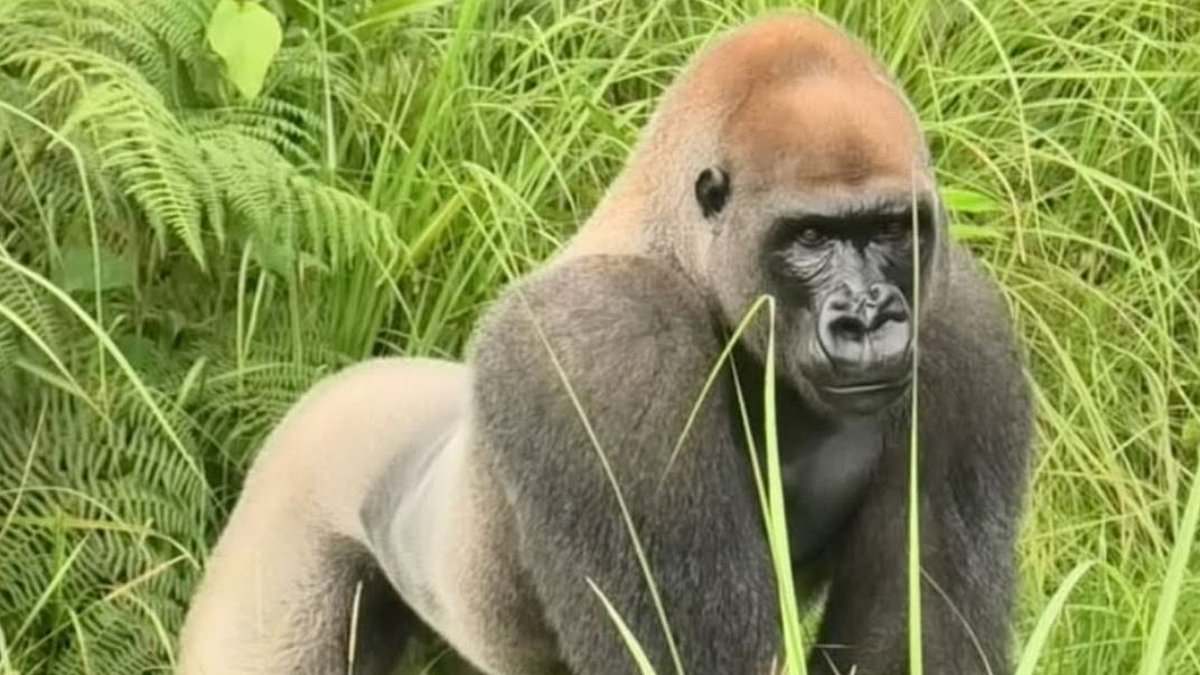
Jojo has lived his whole life without another of his kind.The gorilla was just an infant when he was cruelly snatched from his mother's arms in Gabon as poachers brutally killed his family.He was then sold to a private zoo where he spent years confined to a tiny cage and put on display to the public.In 2015, aged 11, he finally took his first tentative steps on grass after being moved to a sanctuary.But more than a decade later, Jojo is still alone – and has never had the chance to form a friendship with another gorilla.Now aged 22, he is middle-aged, as the species typically live to age 40 in the wild.An emotional appeal has now been launched to find a companion for Jojo - with the help of a British professor. Jojo has spent his whole life alone and is now looking for a companionHis carers at the Lekedi Foundation in Gabon are hoping to find him a suitable companion, potentially another rescued or zoo-bred ape, who could help him experience the social bonds he has been denied for most of his life. Professor Gillian Forrester, from the University of Sussex, who is studying Jojo's psychology and recovery from trauma, believes his case is among the most extreme she has encountered.'He's probably the most extreme case of isolation I've ever seen in a great ape,' she said.Jojo was less than a year old when he was captured, having been taken from his mother while clinging to her.Most gorillas spend their first 14 to 19 years within a close-knit family group, but Jojo was kept entirely alone.His behaviour now suggests just how much he craves companionship.Maxe Anaclet Makaba, head keeper at Lekedi, said the gorilla actively seeks out interaction with his human carers.'He will even go to the trouble of gathering leaves for us to hold, so that we trade them for a treat – to interact with us,' he said.Jojo also calls out to female keepers who visit his enclosure, making sounds normally used by wild silverback males to summon females.Éric Willaume, who runs the sanctuary, said: 'He definitely feels lonely.'Professor Forrester has been using thermal imaging technology to study Jojo's stress levels, filming his face to monitor changes in blood flow.The research has revealed what appears to be a chronically cold nose – a possible indication that his stress response is malfunctioning.When primates experience stress, blood flow increases around their eyes and ears as their bodies prepare for potential danger, temporarily leaving their noses colder.In Jojo's case, this response does not appear to recover normally.Professor Forrester believes the chance to share his life with another gorilla could make a profound difference.'Being connected to others is incredibly important to our psychology as great apes,' she said.'Having another individual to share his life with would be so healing for him.'I would assume other gorillas would help him process this grief and trauma.'Experts say socialisation is also vital if Jojo is ever to have a chance of returning to the wild – the ultimate ambition for his keepers. Professor Gillian Forrester, from the University of Sussex, believes Jojo's case is among the most extreme she has encounteredDr Katie Fawcett, from the Gorilla Rehabilitation and Conservation Education Center, said forming social relationships was essential for an animal to be considered for release.The centre uses what it calls 'gorilla-led' rehabilitation, introducing rescued youngsters to other gorillas as soon as possible so they can learn how to behave within a group.But Jojo's situation is particularly challenging because he is already fully mature.Dr Robin Morrison, from the University of Zurich, who studies mountain gorillas, says relationships and familiarity are central to their social lives.Research has shown that female mountain gorillas will seek out females they previously knew, even after years apart.She said much of a gorilla's social life involved simply spending time together.A companion for Jojo would not necessarily need to involve constant interaction – even quietly sharing the same space could be beneficial.But introducing another gorilla would require careful planning.Any potential match would need to be assessed for genetics, health, personality and compatibility, with international approval required if an animal was transferred from an accredited zoo.The introduction itself would be gradual, potentially beginning with the animals becoming familiar with each other's scent before meeting face to face.Professor Forrester has contacted several accredited zoos to explore the possibility, but discussions have so far failed to make progress.She believes there are no clear procedures for arranging such transfers when the purpose is to find companionship rather than support breeding programmes.'There's not clear processes in place to do these kinds of trans-locations,' she said.The international systems governing the movement of captive gorillas are largely designed around breeding programmes, rather than finding companions for isolated animals or preparing them for eventual release.Not everyone is convinced introducing another gorilla would necessarily be the answer.Conservationist Tony King, from the Aspinall Foundation, who specialises in rehabilitating rescued great apes, believes Jojo's age could make it difficult for him to form a new bond.'Jojo's situation is unique, but he is probably best where he is,' he said.He also warned that introducing another animal could potentially create further stress.While adult male gorillas can naturally spend periods alone – around a third are solitary – experts believe Jojo's experience is very different.In the wild, males typically disperse from their family groups during adolescence, whereas Jojo was deprived of those relationships almost from birth.Dr Morrison believes he is likely to be both traumatised and lonely.'In the wild gorillas move together, find food together, sleep together,' she said.'So much of their lives is just being with this group.'And for Jojo's keepers, the hope remains that he might finally have another gorilla to share his world with.Makaba said: 'It would be good for him to have a companion.'Because being alone is like being cut off from the world – it's like being in prison.'Having another gorilla there would be a good thing for him.'
The 'world's loneliest gorilla' needs a friend - and a British professor is trying to help
Full Article
Original Source
Read the full article at Dailymail →KhanList aggregates and links to publicly available news content. We do not host full articles from third-party sources. Always verify important information with original sources.