
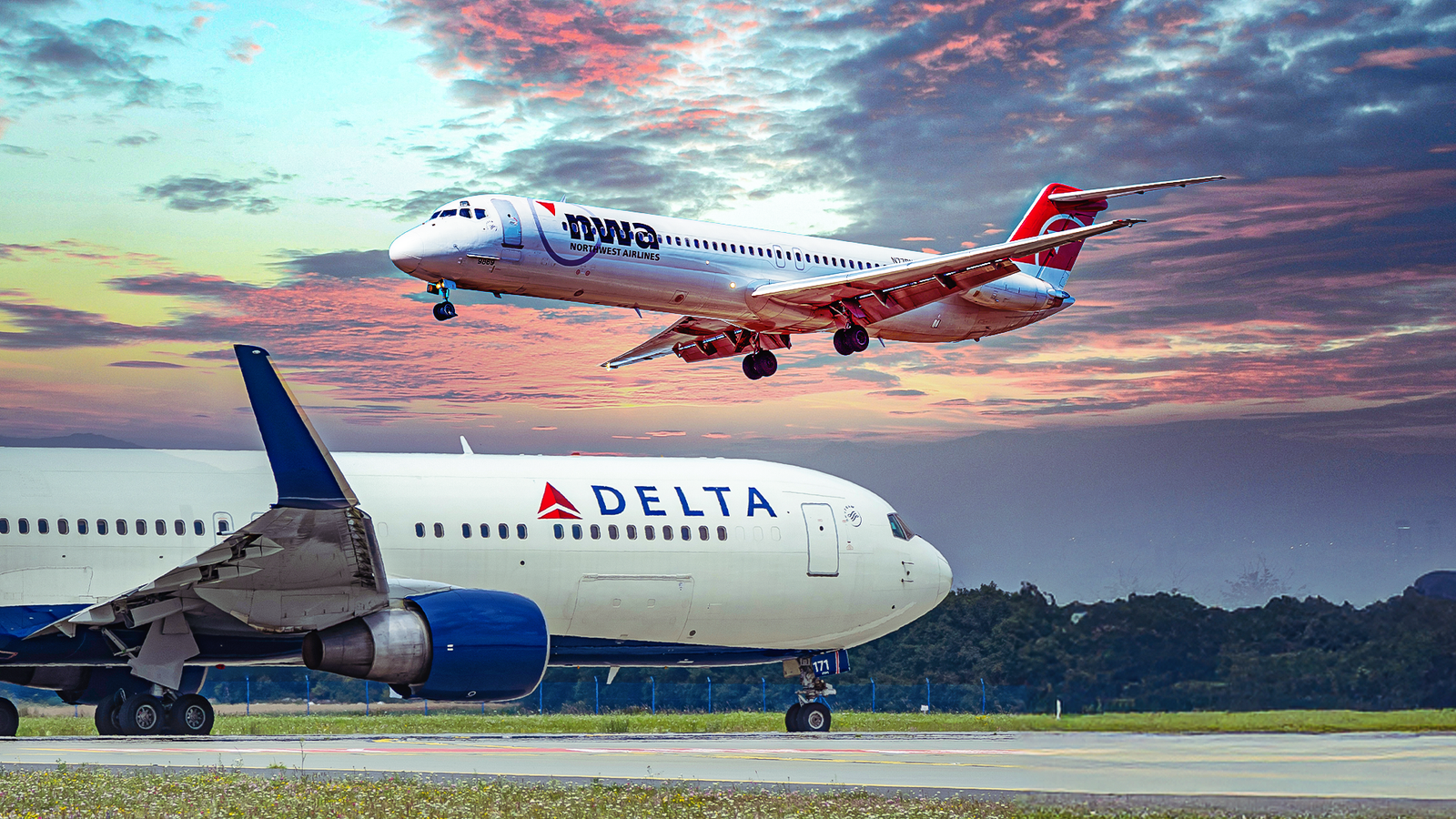
Published Nov 9, 2026, 7:01 AM EST Paul has had a career of 25+ years focused on the international technology sector, which has taken him to over 100 countries. Along the way, he developed a deep love for aviation, with a travel bucket list measured by aircraft types flown rather than destinations reached. Now he brings that avgeek passion, along with the journalism experience he accumulated early in his career, to write insightful pieces for Simple Flying. Airline mergers are almost invariably presented as opportunities to create stronger businesses, combining networks, reducing costs, and attracting more customers. Yet the results could hardly be more different. Since acquiring Northwest Airlines in 2008, Delta Air Lines has increased its market capitalization by approximately 750%, while other combinations wiped out their original shareholders. Some deals created global aviation powerhouses; others became extraordinarily expensive mistakes. To identify the best and worst aviation mergers, Simple Flying examined major airline combinations over the past 30 years, comparing the combined equity valuations at their mergers with market capitalizations on October 30, 2026. We also considered profitability, particularly operating margins and net earnings. There are some clear winners, and then there are numerous failures, divided into shareholder wipeouts and surviving businesses that have lost considerable market value. Let's take a closer look. Credit: Wileydoc | Shutterstock Among the major combinations examined, Delta–Northwest stands comfortably ahead of the pack as the most successful aviation merger of all time. The Atlanta-based carrier filed for bankruptcy in 2005, just minutes apart from its future merger partner. Two decades later, US Department Of Transportation (DOT) data shows that the airline made $6.2 billion before taxes last year, accounting for nearly 90% of the combined net profits of all of America's scheduled passenger airlines, and earning more than all its domestic competitors combined. Merger Year Initial Value Oct. 2026 Value Growth Delta–Northwest 2008 $6.2 billion $52.7 billion +$46.5 billion United–Continental 2010 $8.0 billion $33.9 billion +$25.9 billion British Airways–Iberia 2011 $9.6 billion $22.2 billion +$12.2 billion Southwest–AirTran 2011 $9.8 billion $20.8 billion +$11.0 billion easyJet–Go 2002 $2.6 billion $6.8 billion +$4.2 billion Delta's value today is more than eight times as much as it was at its merger, but it is not alone as a winner. United Airlines, after a challenging start following its 2010 merger with Continental Airlines, has more than quadrupled in value. And across the pond, British Airways and Iberia provide a compelling example of complementary networks. Their 2011 combination created IAG, and subsequent acquisitions have expanded the group further, delivering industry-leading profits and more than doubling its value. Southwest Airlines' acquisition of AirTran in 2011 strengthened its presence in the Southeast and expanded its network, while easyJet's purchase of Go accelerated its European growth. In both cases, it could be argued that much of their subsequent appreciation reflects wider business developments rather than the acquisitions alone, but at least they ended up on our winners list rather than the losers. Why Delta–Northwest Became The Gold Standard For Airline Mergers Credit: Bjoern Wylezich | Shutterstock Delta and Northwest both filed for bankruptcy protection in September 2005, emerging in 2007 with significantly reduced costs. After resisting an attempted takeover by US Airways, Delta agreed to acquire Northwest in April 2008, with the merger completing that October. Northwest brought established, profitable hubs at Detroit Metropolitan Wayne County Airport (DTW) and Minneapolis-St. Paul International Airport (MSP), and a valuable transpacific network, complementing Delta's Atlanta-centered operation. Crucially, Delta retained Northwest's strongest assets, while gradually reorganizing weaker parts of the network. Detroit and Minneapolis remain important hubs to this day, but Memphis and Cincinnati experienced substantial contractions. Meanwhile, Delta utilized its larger fleet, notably workhorses like the Airbus A330, to expand its presence at airports such as New York John F. Kennedy International Airport (JFK) and Seattle-Tacoma International Airport (SEA), increasingly targeting higher-value traffic. Delta Hub Delta Passengers 2008 Delta Passengers 2025 Change Atlanta 33.0 million 42.4 million +29% Boston 2.2 million 5.7 million +160% Cincinnati 6.3 million 1.6 million −74% Detroit 14.0 million 12.0 million −14% Los Angeles 3.5 million 7.1 million +104% Memphis 4.8 million 0.7 million −85% Minneapolis–St. Paul 13.3 million 12.9 million −3% New York JFK 5.5 million 9.3 million +70% New York LaGuardia 3.0 million 7.0 million +131% Salt Lake City 8.1 million 9.8 million +21% Seattle 2.1 million 6.4 million +208% Data based on estimated annual departing passengers carried by Delta, Northwest and affiliates in 2008, compared with Delta and affiliates in 2025. Delta also achieved an unusually orderly integration, agreeing on a joint pilot contract before closing and obtaining a single operating certificate in December 2009. It subsequently invested heavily in premium cabins, lounges, and loyalty. The financial results have been substantial: Delta generated $6.2 billion in pre-tax profits last year, more than all other airlines in North America combined. Credit: Bjoern Wylezich | Shutterstock United's 2010 merger with Continental looked equally promising, combining United's substantial Pacific network and hubs at Chicago O'Hare International Airport (ORD), Denver International Airport (DEN) and San Francisco International Airport (SFO) with Continental's dominant presence at Newark Liberty International Airport (EWR) and Houston George Bush Intercontinental Airport (IAH). The combined airline adopted United's name but kept Continental's globe logo, with Continental CEO Jeff Smisek initially leading the business. The companies valued their combined equity at approximately $8 billion and anticipated annual synergies of more than $1 billion. However, integrating United and Continental proved difficult. The transition to Continental's reservations system in 2012 produced disruption, while customer dissatisfaction and operational problems undermined confidence. However, the carrier was able to gradually distance itself from the "United Breaks Guitars" image, and the turnaround gathered momentum under Oscar Muñoz and Scott Kirby, with Polaris business class, cabin modernization, expanded networks, and renewed emphasis on premium passengers. 2025 Financial Metric Delta Air Lines United Airlines American Airlines Revenue $63.36 billion $59.07 billion $54.63 billion Operating Profit $5.82 billion $4.71 billion $1.47 billion Operating Margin 9.2% 8.0% 2.7% Net Income $5.01 billion $3.35 billion $0.11 billion By October 2026, United was worth approximately $33.9 billion, representing more than $25 billion in additional market capitalization since the merger. Its 2025 net profit of $3.35 billion was substantial, although Delta remained considerably ahead. Yet the comparison with American Airlines is especially revealing: despite similar group revenue, American generated a fraction of United's operating earnings, demonstrating that network scale alone cannot guarantee financial success. Credit: Markus Mainka | Shutterstock Some combinations delivered a far more devastating outcome: the total destruction of original shareholder equity. A top example is Japan Airlines, which acquired Japan Air System in 2002, but entered bankruptcy protection in January 2010, ultimately eliminating its previous shareholders' investment. The airline subsequently recovered and relisted in September 2012 with new equity, demonstrating that an airline can survive and eventually prosper even when the investors who previously owned it lost everything. Merger Year Crisis Shareholder Outcome JAL–Japan Air System 2002 Bankruptcy, 2010 Original equity extinguished LAN–TAM (LATAM) 2012 Chapter 11, 2020–22 Severe legacy-share dilution Air Canada–Canadian Airlines 2000 Restructuring, 2003–04 Legacy holders received 0.01% of successor equity Avianca–TACA 2010 Chapter 11, 2020–21 No distribution to original shareholders Virgin Australia–Tigerair 2013 Administration, 2020 No recovery for original shareholders LATAM Airlines' 2012 formation combined LAN and TAM, but its 2020 bankruptcy ultimately required approximately $10.3 billion in equity and convertible financing. Existing holdings were diluted by more than 99%, although shareholders could participate in certain financing arrangements. Air Canada's restructuring similarly left former investors with just 0.01% of successor equity, while Avianca's position was even more explicit when it warned shareholders during its Chapter 11 proceedings: "The value of the outstanding shares of the Company is expected to be reduced to zero." Virgin Australia's acquisition of Tigerair Australia was another attempt to increase scale and challenge a dominant competitor. Yet sustained financial pressures, followed by the pandemic, pushed Virgin into administration in April 2020. Its administrators confirmed that existing shareholders would receive nothing, and Tigerair's operations were discontinued as part of the restructuring. Credit: Markus Mainka | Shutterstock Not every disappointing combination ended in bankruptcy. American's 2013 merger with US Airways created an enormous airline, yet its combined equity value of approximately $17.05 billion compares with just $8.35 billion in October 2026. American strengthened major hubs, including Dallas/Fort Worth International Airport (DFW) and Charlotte Douglas International Airport (CLT), but has struggled with debt, commercial strategy, and profitability. Just as with its prior acquisition of TWA, American has found out the hard way that scale doesn't translate seamlessly into market value. Merger Initial Value October 2026 Value Change American–US Airways $17.05 billion $8.35 billion −$8.70 billion Alaska–Virgin America $11.89 billion $3.99 billion −$7.90 billion Air France–KLM $4.40 billion $3.06 billion −$1.34 billion Air New Zealand–Ansett $0.78 billion $0.69 billion −$0.09 billion Alaska Airlines' $2.6 billion acquisition of Virgin America in 2016 offers another cautionary example. Despite initially promising a stronger West Coast network, Alaska retired the Virgin America brand and subsequently reduced capacity at San Francisco and Los Angeles, and Alaska Air Group's market capitalization has declined substantially since the acquisition. Across the pond, Air France-KLM provides a revealing contrast with IAG. Both retained their constituent brands and major hubs, yet their profitability has diverged significantly. In 2025, both generated approximately €33 billion in revenue, but IAG's operating margin reached 15.1%, compared with 6.1% at Air France–KLM. Elsewhere, Air New Zealand's Ansett acquisition nearly destroyed the buyer, requiring an NZ$885 million government recapitalization that gave the state an 82% ownership stake. What Separates Successful Airline Mergers From Failed Ones? Credit: Minh K Tran | Shutterstock The strongest combinations generally acquire assets that would be difficult or expensive to recreate organically. Northwest gave Delta a major Pacific network; Continental strengthened United's presence at Newark and Houston; and Iberia provided British Airways with an established Latin American gateway. These were not simply exercises in becoming bigger. They allowed the buyers to develop networks and competitive positions that neither could easily have achieved independently. Successful integration also involves identifying what should be preserved and what should change. Delta retained Northwest's strongest hubs while reducing weaker operations. Southwest eliminated AirTran's brand without abandoning the strategic benefits of its network. However, research into airline consolidation also highlights the potential costs to passengers, including higher fares and reduced service quality where competition declines. Shareholder success and consumer benefits are not necessarily the same thing. Ultimately, comparing the likes of Delta and American shows that sustainable profitability and financial discipline matter more than sheer scale. Strong networks, efficient integration, premium revenue, and manageable debt are recurring characteristics of successful combinations. Which brings us to today, and Alaska's acquisition of Hawaiian Airlines, which now offers an intriguing test: unlike Virgin America, Hawaiian is retaining its identity, while its widebody fleet supports new long-haul ambitions. Whether those advantages eventually create lasting shareholder value remains uncertain, reinforcing the industry's central lesson that bigger airlines do not automatically become more valuable airlines.
The World's 5 Best & Worst Airline Mergers Based On Market Value
Full Article
Original Source
Read the full article at Simpleflying →KhanList aggregates and links to publicly available news content. We do not host full articles from third-party sources. Always verify important information with original sources.