
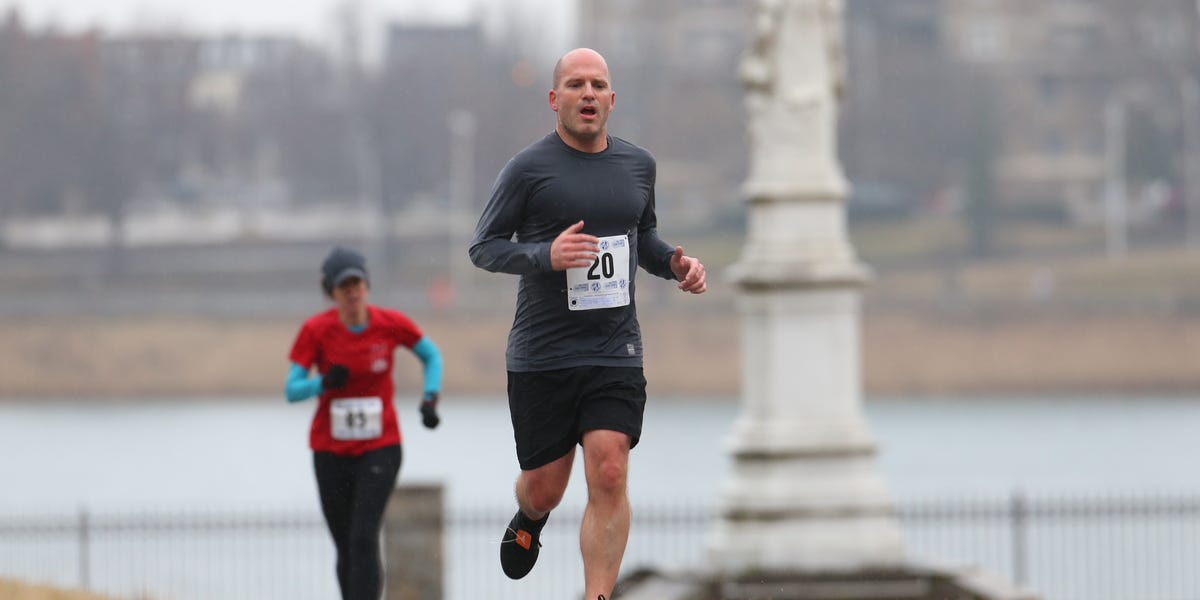
Courtesy Jonathan Basalyga//Hearst OwnedAs far back as he can remember, Jonathan Basalyga has always loved to run. The 53-year-old from Atlanta fondly recalls being one of the fastest kids in his elementary school. As he got older, pounding the pavement was his preferred way to get to and from his friends’ houses. “My childhood consisted of a lot of running and a lot of movement,” he says. “Early on, my mind associated running with a level of freedom.”But life caught up to him, and running fell by the wayside in his 20s as he prioritized starting a family and a career in sales—until a colleague asked if he wanted to train for a marathon. Basalyga was living in Maryland at the time, and ran the 2005 Baltimore Marathon—his first attempt at the distance—in 4:52. He fell in love with the distance, and over the next 10 years returned to it seven times.“For many years, I didn’t even identify as a runner, even after marathons—I ran without much structure, aside from total mileage, which was about 40 miles a week,” Basalyga says.As his three children grew older, the family started participating in a lot of activities and charity events, which included short races. In one 5K, Basalyga recalls his high-school-aged son beating him—the push he needed to rethink his running strategy. “I believe that race poked at my competitive nature and changed my perception that I could be faster if I wanted to,” he says.Basalyga figured that to become faster, he’d need to do speedwork, something he had not done consistently in the past. He started adding intervals to his marathon training, specifically Yasso 800s. “I remember the first time trying a version in a parking lot at my daughter’s soccer practice. I will never forget how much I liked the way hard running felt,” he says.He saw the improvement as he crossed the finish line of the 2015 Quebec City Marathon in 3:54, breaking 4 hours for the first time. He decided to see what dedicated training for speed could do for his time in shorter distancesTo train for a quick 5K, Basalyga knew he needed to dial in his speed workouts. At the time, he had read about the 10x400 being Sir Roger Bannister’s favorite workout.“I remember thinking, ‘What's the big deal? It’s such a short workout,’” Basalyga says. “But the first time I tried it, I vividly remember by the sixth 400-meter interval, I thought I was going to die. In the span of less than 30 minutes, I had really felt like I worked out in a way I had never felt before.” He kept returning to the feeling—and the workout, which became his favorite speedwork.After diligently incorporating the 10x400 into his training once a week, he managed to break 21 minutes in the 5K—a PR by more than 4 minutes, and a time he consistently comes in under to this day. (And yes, he beat his son’s original 5K time in the process.)“It has always been me against myself,” Basalyga says, acknowledging that how he used to structure his training plans held him back. “I would call my running ‘unstructured discipline’ in that I have run consistently now for more than 20 years, but with loosely held plans and goals. Only recently have I become more focused.”To be able to maintain a sub-21-minute 5K, these days Basalyga does one long run, two shorter runs, and one speed or hill workout per week. He also strength-trains twice a week.The 10x400 was a game changer not only for Basalyga’s speed but also his mindset: he finally began to refer to himself as a runner. “Early in my running, I would have never believed I could run a 6-minute mile,” he says. “Right now, in my 50s, I am more motivated than ever as I start to think about functional capacity as I grow older.”Basalyga’s next aspiration? To run a sub-20:30 5K next year, then a sub-20 by 55. “It will take more discipline and structure,” he says, “but it’s 100 percent achievable.”Danielle Zickl is a freelance writer who has 10 years of experience covering fitness, health, and nutrition. She's a graduate of Ithaca College. You can find her work here on Women's Health, and in many other publications including PS, SELF, Well+Good, Runner’s World, Outside RUN, Peloton, Men’s Fitness, and more.
The Workout That Took a 53-Year-Old’s 5K Time From 25 to Sub-21
Full Article
Original Source
Read the full article at Runnersworld →KhanList aggregates and links to publicly available news content. We do not host full articles from third-party sources. Always verify important information with original sources.