
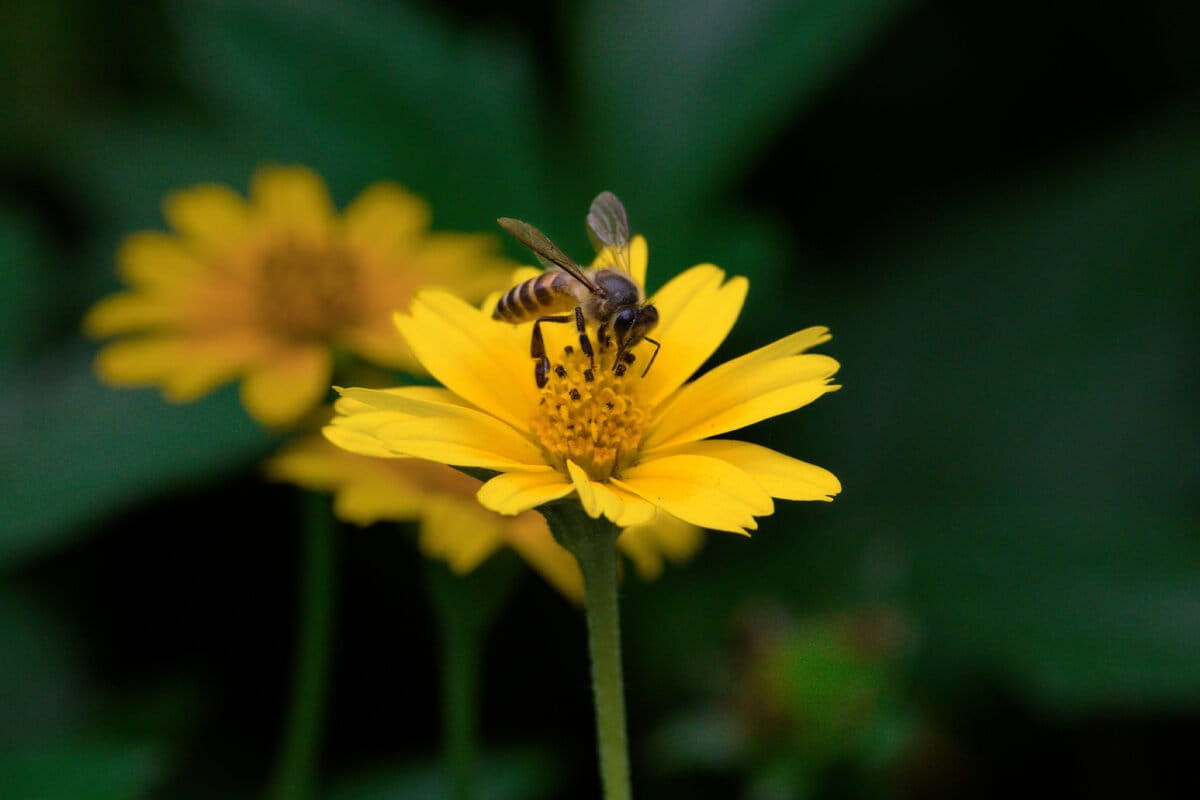
In the Himalayan region of Uttarakhand, India, traditional homes include wall hives for native bees.It’s the women of the household who typically care for the bees and hives.These indigenous bees, Apis cerana indica, face numerous threats — climate change, habitat fragmentation, pesticide exposure and even the loss of the traditional wall hives, as modern homes often do not include them.Women play a vital role in the survival of this native bee species. PITHORAGARH, Uttarakhand, India — The world comes alive during summers in Himalayan states like Uttarakhand. The forests are budding with new green leaves, and almost every trail is lined on both sides with flowers of many shapes, sizes and colors. With the flora, fauna comes to life as well. Saraswati Devi, 80, sits in her courtyard with bees buzzing in and out of the wall hive where the colony lives in her home. “Bees are considered so sacred and an important part of people’s lives that we have faag songs about them,” Saraswati says. Faag are traditional songs sung at joyous and auspicious occasions like weddings and festivals in the Kumaon region of Uttarakhand. She and her fellow women hum a melody that Saraswati sang at weddings. Bees come to those homes where children play; But at homes with no children, the bees won’t stay. For centuries here, people’s lives have been intertwined with the bees, creating a unique interdependence. In rural Uttarakhand, many households share their homes with an indigenous species, Apis cerana indica, commonly known as the Indian honey bee or Himalayan honey bee. However, factors like climate change, introduction of new bee species for more honey production, habitat fragmentation and inadequate nutrition are among the reasons for a decline in their population. As rearing bees is a natural part of household duties, women’s role becomes central in the conservation of this species. Saraswati Devi, along with her family, standing beneath the opening of the wall hive, with the back cavity opening in their bedroom wall. Image by Swati Thapa. As caring for bees is a natural part of household duties, women’s role becomes central in the conservation of this species. Image © Afsar Nayakkan via iNaturalist (CC BY 4.0). A home for all Traditional homes in Uttarakhand have wall hives, a unique feature for accommodating the Indian honey bee. A rectangular cavity is built into one of the walls during construction, with a circular opening on the outside for bees to enter. A small cabinet door is placed at the back, which is sealed shut by applying clay and cow dung. The caked window is only opened when it is time to harvest honey. A singular house can have multiple hives on different walls. Traditionally, it’s the women in a household who tend to the bees. And this is underscored in modern times, as many men have left the rural villages of Uttarakhand for job prospects in other areas in a trend called “out-migration.” But the women often stay behind, as caretakers of their traditional homes — and bees. Nagma Parveen, assistant professor of biomedical sciences, D.S.B. Campus, Kumaun University, Nainital, emphasizes that women’s role as traditional beekeepers is crucial to the conservation of the Indian honey bee. “The only reason A.Cerana indica is still surviving in Uttarakhand is the women,” Nagma says. By maintaining their wall hives, women are aiding the bees’ survival, which is increasingly at risk in the wild due to habitat loss, pesticide exposure, invasive species and climate change. Bee colony inside a wall hive of a resident in Okhalkanda, Uttarakhand. Image courtesy of Nagma Parveen. In the wild, Indian honey bees look for dark cavities to protect themselves from predators like ants and wasps, as well as from harsh climatic conditions in the hills. The wall hives offer a ready-made haven. “Rain, storms and cold also impact the well-being of the bees. Many bees die in such conditions if they don’t have shelter. Inside the wall hives, they are safe, but outside they cannot fight the natural forces,” says Shakuntala Devi, from Ramni village, where she cares for a colony of bees. Women smooth the interior of the hives with clay and cow dung. The thick mud walls insulate against cold conditions, making wall hives a superior nesting space, especially in high-altitude regions. The bees leave their hives in search of food only in suitable temperatures. “If the temperature outside is like 10-13° Celsius [50-55° Fahrenheit], only then will they be able to come out of the hive. Otherwise, they will not survive in that cold weather,” Parveen explains. Although the Indian honey bee can live in modern bee boxes, few beekeepers in Uttarakhand keep them outside of traditional hives. Parveen explains that traditional beekeeping was never meant as a means of livelihood. Rather, in traditional Kumaoni and Garhwali culture, beekeeping is considered sacred, practiced only in wall hives, wooden logs or window hives, which would typically be looked after by the women in the family. For this reason, many beekeepers also refuse to shift them to bee boxes. Traditional pahadi homes in Marhmanley village, Uttarakhand. Image by Swati Thapa. Modern houses, fewer bees However, the practice of traditional beekeeping is seeing a decline as new modern houses (without wall hives) are replacing traditional houses. A study states that the percentage of traditional houses in the Chamoli district of Uttarakhand fell from 61% before 1980 to 26% between 2001 and 2010. In that time, modern houses surged from 2% to 31%, respectively. Consequently, the number of traditional wall hives plummeted from 11.2 in houses constructed before 1980 to roughly 0.9 in houses built between 2001 and 2010, bringing the overall average down to 8.4 per house by 2010. The study looked into 10 villages with 210 observed bee colonies; of those, 81% were located in traditional wall hives, predominantly those built before 1980, and 19% were in cattle sheds; whereas modern cemented houses contained zero colonies. These numbers also suggest a need to conserve traditional beekeeping, which provides local bee populations their essential nesting structures. “Recently, we got our house renovated. We asked the mason to also add a wall hive but because he lacked the techniques used in traditional houses, he made the cavity up high. We cannot access the cavity to maintain it, and the bees cannot enter either,” says Kanta Devi, a resident from Ramni village. Traditionally, the height of the beehive opening is made in a way that the bees can glide in and out at a 70° angle. The bees cannot inhabit the hive if the opening is too high. Modern houses built with cement and brick walls are becoming more common, leading to a decline in traditional wall hives. Image by Swati Thapa. Gender’s role in beekeeping Although men share some beekeeping duties with women, like adding back panels to wall hives or harvesting honey comb, the majority of the tasks are treated as domestic labor and fall to the women of the household. For many, it isn’t seen as overly demanding, as the duties naturally overlap with routine housework. “Once the bees have taken to the wall hive, my job is to seal the back panel with red mud and cow dung,” Shakuntala Devi says. Other tasks include attracting a new swarm by leaving a trail of honey from the opening into the cavity. During winter, when forage is scarce, women feed the bees amaranth or hemp seed powder every 2-3 weeks until the weather warms up. Because bees are considered sacred, strict rules around ritual purity are followed across Uttarakhand. In some regions, anyone can harvest a hive, but in others, the task is reserved exclusively for men or menopausal women. Additionally, women are prohibited from touching the hives while menstruating, as periods are traditionally seen as an impure state. “People who are menstruating cannot even go near the area where the hive is located. Harvesting is usually done by men or older women,” explains Kanta Devi. Even households that do not observe every purity restriction still follow some strict rules. “Women can harvest, too, but you have to take a bath before touching the bees. It’s believed that bees will sting a menstruating woman more, leading to heavy swelling and sickness. The environment must be pure, and so must the woman,” Kanta Devi says. Uttarakhand homes may have multiple wall hives, which are also commonly found in cowsheds, in addition to residential buildings. Image by Swati Thapa. Even when men extract the comb, women usually manage the labor-intensive processing steps afterward. While Shakuntala Devi is not so strict about the purity restriction herself, she still prefers her husband to handle the initial removal. “My husband takes out the honeycombs and leaves them for me to extract the honey, that takes hours,” Shakuntala Devi says. Since Ramni is a high-altitude village, low temperatures make the honey much more viscous. To ease the process, honeycombs are heated in a pan in small batches and then squeezed through a clean cloth. “We do small quantities at a time, as it is easier to squeeze and we can work faster with the honey without it getting cool and thick again,” Shakuntala Devi explains. Climate change impacts Saraswati Devi has noticed fewer bees buzzing around her courtyard in recent years, an observation echoed across the region. This year, Shakuntala Devi’s wall hives sit entirely empty. “Many bees died this year due to heavy rains and storms. High winds drastically reduce their survival rate,” Shakuntala Devi explains. Along with the bee sightings, honey yields have dropped too. Women in Ramni are expecting almost no honey this year. With extreme rains and high winds, the bees do not leave the hive very often, feeding on the honey they have already collected, which means less honey to harvest. “Back in my day, we used to harvest around 3 kilograms [6.6 pounds] of honey per hive. Now, we hardly get 1 or 2 kg [2.2-4.4 lbs],” Saraswati says. Because honey reflects the local flora, shifting bloom times and declining biodiversity have altered its profile and taste, Shakuntala Devi says. “It is more bitter now,” she notes. “The honey back then was so delicious. You would lose count of how many rotis you ate with it.” Despite these challenges, the Indian honey bee remains crucial to local ecosystems. While A. cerana yields less honey than the European honeybees (A. mellifera) introduced for commercial beekeeping, indigenous bees are well adapted and acclimated to the climate and continue to forage under more extreme conditions compared with the European bees, whose foraging activity can be decreased by tropical and wet conditions. “Climate is not just affecting us on a daily basis, but it is also affecting the animals who live in that microclimate,” Nagma says. With a lack of pollinators, other animals also lose their forage. Kamla Devi stands beside the back cavity of her wall hive, sealed with a mixture of red soil and cow dung. She holds an old sack, which she burns to smoke out the bees during honeycomb harvest. Image by Swati Thapa. Irreplaceable family members “The bees that live with us have been here since my daughter was born,” says Kamla Devi of Marhmanley village, marking 21 years of coexistence. While traditional wall-hive beekeeping offers this sustainable coexistence, it is far from enough to reverse the vast destruction inflicted by human interference. Deforestation and climate change have tilted the balance of interdependence of species by destroying natural habitats on a massive scale, forcing bees to rely on human homes for shelter. “Bees only need humans because humans are devastating their natural homes. On one hand, people destroy forests and drive climate change, destroying hundreds of colonies. On the other hand, they offer shelter to just one or two hives in their walls,” Nagma says. What was once a tradition as a part of life in rhythm with nature has now become a quiet responsibility: caring for hives with utmost pride and love. “The house feels incomplete without them. Having them around brings us joy,” smiles Shakuntala Devi. Banner image: An Indian honey bee in Pune, Maharashtra state. Image by Theblendermann via Wikimedia Commons (CC BY-SA 4.0). Sickles, sarees and smoke: Women on the frontlines of Uttarakhand forest fires The Indigenous women changing the course of their communities Citations: Steinhübel, L., Wenzel, A., Hulamani, P., Von Cramon-Taubadel, S., & Mason, N. M. (2022). Effects of local farm management on wild bees through temporal and spatial spillovers: Evidence from southern India. Landscape Ecology, 37(10), 2635-2649. doi:10.1007/s10980-022-01507-8 Tiwari, P., Tiwari, J. K., & Singh, D. (2013). Changing Scenario of Traditional Beekeeping in Garhwal Himalaya: A Case Study from Gairsain Block of district Chamoli, Uttarakhand. International Journal of Life Sciences. Retrieved from https://www.researchgate.net/publication/295087027_Changing_Scenario_of_Traditional_Beekeeping_in_Garhwal_Himalaya_A_Case_Study_from_Gairsain_Block_of_district_Chamoli_Uttarakhand R. Reddy, P. V., Rashmi, T., & Verghese, A. (2013). Foraging activity of Indian honey bee, Apis cerana in relation to ambient climate variables under tropical conditions. Journal of Environmental Biology. Retrieved from https://jeb.co.in/journal_issues/201505_may15/paper_09.pdf A V, M., Pandey, R., & Mall, P. (2025). Regional variations and adaptive morphology of Apis cerana forelegs across India. International Journal of Environment and Climate Change, 15(1), 55-61. doi:10.9734/ijecc/2025/v15i14673 Montero‐Mendieta, S., Tan, K., Christmas, M. J., Olsson, A., Vilà, C., Wallberg, A., & Webster, M. T. (2019). The genomic basis of adaptation to high‐altitude habitats in the eastern honey bee ( Apis cerana ). Molecular Ecology, 28(4), 746-760. doi:10.1111/mec.14986 Credits Topics
The women keeping Uttarakhand’s native bees alive
Full Article
Original Source
Read the full article at News →KhanList aggregates and links to publicly available news content. We do not host full articles from third-party sources. Always verify important information with original sources.