
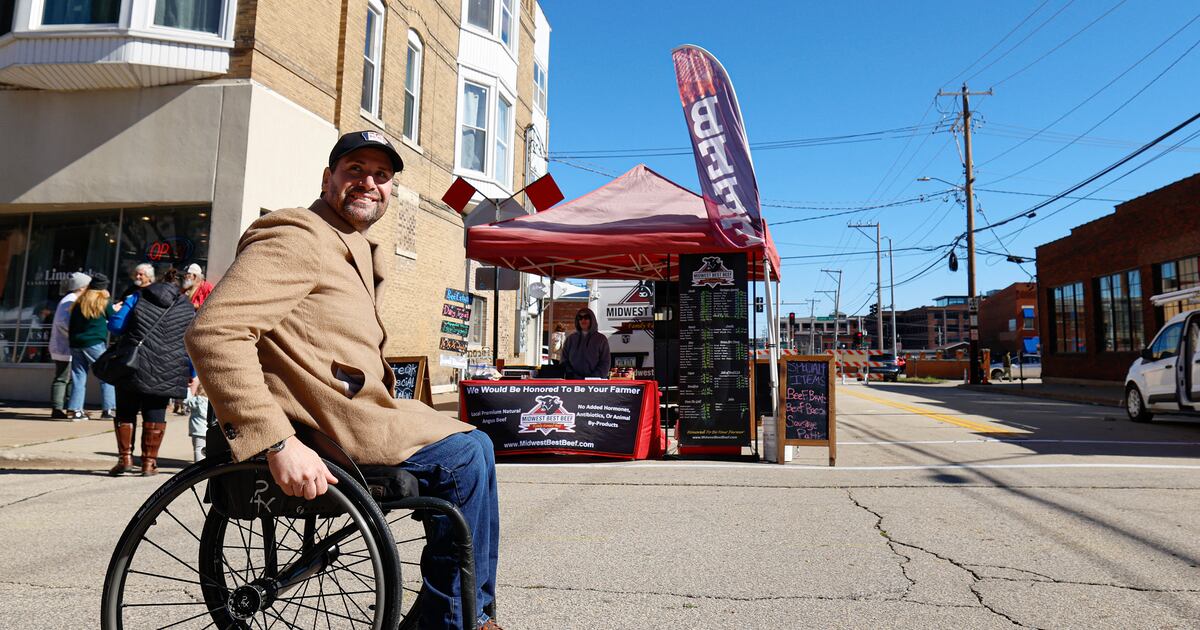
The late, great David Lynch titled his filmic ode to Iowa The Straight Story, and the local joke is that the terrain is so flat here that you can watch your dog run away for three days. But Josh Turek likes to point out that it was his good luck to be born in the Loess Hills, the gruff hills that straddle the ragged western edges of Iowa and the Nebraska border. The hills in his home city of Council Bluffs made for a gruelling workout as he ferried himself around in his wheelchair looking for votes to join Iowa’s state legislature.John Turek has occasionally described his son as “a casualty of the Vietnam War”, because the family strongly believes that the spina bifida with which Josh Turek was born in 1978 originated from his father’s exposure to Agent Orange during the 22 months he spent fighting that war. As a fledgling politician, Turek used the wheelchair, and his athletic prowess, as a weapon, physically hauling himself up porch steps, dragging the chair behind him, and then seating himself before ringing the doorbell. The effort at least earned him an open conversation.“The only way I was able to win was going out and dragging my wheelchairs upstairs and having conversations with Republicans and Independents,” he said of that initial foray into politics. Now, he is on the cusp of winning a Senate seat. Sioux County is a Republican stronghold, but Turek billboards and yard signs have begun to bloom. President Donald Trump is due in Sioux City to campaign for the Republican candidate, Ashley Hinson, on Thursday afternoon, as a series of polls suggest the race is deadlocked.READ MORETurek has termed himself “the prairie populist”, advocating a return to the Democratic Party virtues of John Kennedy and Roosevelt and his personal touchstone Tom Harkin, who served as senator to Iowa for a full 30 years from 1985. Harkin was the lead sponsor of the landmark Americans With Disabilities Act in 1990. In a fitting symmetry, Harkin, now 86, campaigned for Turek in that first election campaign for House district 20, which he won by just six votes out of the 6,800 cast.US Representative Ashley Hinson, a Republican of Iowa and candidate for the US Senate, speaks to a supporter during a campaign stop in Davenport, Iowa, on October 15th, 2026. Hinson is running to replace retiring US Senator Joni Ernst. Photograph: Kamil Krzaczynski/AFP/Getty The campaign bus for US representative Ashley Hinson, Republican of Iowa, and candidate for the US Senate in the state, arrives in Davenport, Iowa on October 15th, 2026. Photograph: Kamil Krzaczynski/AFP/Getty “We went to the west part of Council Bluffs knocking on doors, and I couldn’t believe it – this guy dragging that wheelchair up and down stairs,” Harkin said.“Now that impressed me that he was willing to do that. But what also impressed me was the way he connected with people. It wasn’t just a quick handshake and I’m moving on.”On Monday night, the upstairs room in Morningside College is full by the time Turek wheels himself in, to loud cheers. He is wearing denims, a black polo top and his customary black Hawkeyes baseball cap, and he apologises for his appearance: he’d been out on farmlands all day. If Turek is to win Iowa, then a mutiny by the state’s farming class will be the essence of the story.[ Funny, irreverent, cocky: Can Abdul El-Sayed win a vital senate seat in abandoned America?Opens in new window ]Over an hour-long question-and-answer session, and on the campaign trail, he offers a deft but bleak series of statistics which depict the ways in which life has gone wrong for Iowans. These are that the state lags in 48th place in income growth; is one of only three US states to have its economy contract; that it closed some 842 healthcare facilities in the last six years; that it is second in the national cancer rate only to Kentucky (due, he says, to a combination of nitrates in the water caused by pesticide run-offs and the fact that it is a state with an ageing population dealing with “healthcare deserts” requiring trips to the bigger cities for treatments); that it scores too highly on social problems such as binge-drinking and smoking; and that 70 of its 99 counties are losing population.Iowa State Representative Josh Turek, Democratic nominee for the US Senate, speaks to supporters in Des Moines after winning the primary election on June 2nd last. Photograph: KC McGinnis/The New York Times It’s difficult to reconcile this vision of Iowa with what you see on the four-hour drive from Kansas City to Sioux City, which runs through the Loess Hills and is a rolling vista of impeccably neat corn fields and tidy, silent towns. It feels like a place that would promote health and abundance. But the cycle of emptying small towns is the backdrop to the acute stresses visited on Iowa farmers, whose corn and soybean produce are highly vulnerable to the Trump tariff policy, as well as the obvious hike in fuel prices.Turek has the common touch and speaks in the low confiding tones of a Midwest late night radio show. But his candidacy has seen a sharp rise in his profile“We have arrived at a second farm crisis,” Turek tells the audience. “We had the first one around 40 years ago when we lost half of our small family farms. “Our farmers need open markets and free trade more than any other group. You are looking at commodities prices tanking, at a complete loss of markets for them. I had a farmer tell me today, ‘the difference between diesel prices this year and last year is $100,000. That is the difference between me making a profit and having to sell land.’ It really is a farmageddon. Our farmers do not want handouts. They do not want subsidies. They want stable markets.”John Gray, a Sioux City resident, has come along with his friend Greg Peterson. When they attended their first Turek rally, before the primary, just 12 people showed up.We talk for a while about the transformation of life in Iowa over the past three decades. Gray grew up in Rockwell City, a town of about 2,000 people an hour north of Des Moines.“Like many of our towns based on agriculture, many people who grew up there have left for college and moved on to big cities,” he says.“That’s been going on for a long time, but it has accelerated as the farms have gotten bigger. There is more of an emphasis on ‘big ag’. And then the retail stores suffer. And then there is often a consolidation of the schools. And when a town loses its school, that is kind of the end of the town. In Sioux County, a lot of the towns are still successful but the towns in the centre and south and west of the state, not so much.”Democratic US Senate candidate Josh Turek speaks to supporters during a campaign stop at the Dubuque Farmers' Market in Dubuque, Iowa, on October 17th, 2026. Photograph: Kamil Krzaczynski/AFP/Getty Democratic US Senate candidate Josh Turek speaks to a supporter during a campaign stop at the Dubuque Farmers' Market in Dubuque, Iowa. Photograph: Kamil Krzaczynski/AFP/Getty The genesis of the Iowa senate election is compelling in its own right. The exiting senator, Joni Ernst, in staunchly defending the Trump administration’s decision to remove some 1.4 million immigrants from receiving benefits at a public event in Parkersburg, was challenged by an audience member who said the policy would cause people to die.“Well, we are all going to die,” Ernst retorted. It was one of those soundbites that lit up the information channels and was held up as an example of the heartlessness of the policy. Ernst (56) announced she would not run again that September, leaving an open contest to join Chuck Grassley, the 93-year-old Iowan institution who has held the senior senate seat for the Republican Party since 1980.Turek brought four years of Iowa state house experience along with an extraordinary and classically Midwestern story. His condition meant a hospital-defined childhood: he went through 21 surgeries before the age of 12, involving painful and solitary recuperations. The family came from what he calls “modest” circumstances. In the hall, he told of a childhood defined by clothing from the Goodwill charity and free summer lunch programmes. [ The Irish Times view on US midterms: a lame duck Trump is still a dangerOpens in new window ]Like many Iowan kids, he was a basketball obsessive. He found a wheelchair team and excelled, spending eight to 10 hours a day on his way to becoming a two-time gold medallist with USA Paralympian teams before playing professionally in Europe. The wheelchair at once limited his range of movement and was his passage around the world. In Spain, in particular, he took note of the health and social systems.“I understand your struggle right now,” Turek tells the smattering of college kids in the room. “I come from humble beginnings economically. I say that my story is uniquely the American dream. In no other country on Earth could someone from my economic background, health background, ultimately win gold medals, represent their community in high legislature, or certainly run for the US Senate. Iowa Democratic candidate for the US Senate Josh Turek greets people as he participates in the University of Northern Iowa homecoming parade on October 10th, 2026 in Cedar Falls, Iowa. Photograph: Scott Olson/Getty “And I understand that for young people you may be the first generation who may not have the same standard of living as your parents. I understand apathy because you have looked at whether Republican or Democrat is not going to make any difference to your life. My promise and my pledge to every one of you is, I am fighting for this American dream. My north star is what is best for the people, and ensuring this American dream continues for the next generation of Americans.”Turek has the common touch and speaks in the low confiding tones of a Midwest late night radio show. But his candidacy has seen a sharp rise in his profile: Barack Obama has campaigned with him, and the pair shot hoops. (Turek points out that he won). Republican attack ads have branded him “America’s favourite liberal” who skipped 58 per cent of Iowa state legislature votes this year while he “schmoozed with wealthy coastal elites in Los Angeles and Washington DC”.It’s clear that if Turek is to go to Washington, he will have convinced a significant percentage of Iowan farmers to break with tradition“Despite missing hundreds of votes, Turek still collected over $20,000 in taxpayer-funded benefits,” one ad states. Trump, probably not then fully aware of Turek’s extraordinary life story, branded him as “lazy”: he is likely to choose a different attack line on Thursday.[ US midterms: how likely is a blue wave?Opens in new window ]The presidential rally will come with the usual security and media carnival. But Turek’s sitdown on Monday night illustrated the berserk way in which donor money has distorted US politics. At one stage Turek remarked, in genuine wonder, that he had stopped on his way to buy a small carton of fresh fruit to keep him going. “It cost eight dollars,” he said, to a low murmur of recognition. Iowa Democratic candidate Josh Turek poses for a picture with his team after they participated in the University of Northern Iowa homecoming parade in Cedar Falls, Iowa. Photograph: Scott Olson/Getty The Turek town hall had the look and feel of a particularly enthusiastic book club: a gathering of pleasant locals. But the Des Moines Register this week reported that $137 million (€122 million) has been spent on trying to influence Iowans in this senate race. The bulk of that figure has been spent on adverts attacking both candidates.The Iowa Farm Bureau, representing more than 150,000 Iowan farming families, has endorsed Ashley Hinson, a former local television reporter who has represented Iowa in the US House for the past six years. The smaller Iowa Farmers Union has backed Turek. It’s clear that if Turek is to go to Washington, he will have convinced a significant percentage of Iowan farmers to break with tradition.“Oh, he’s going to need to do that, yes,” Shiela Thompson, a retired union worker, tells me when the event finishes and Turek eases into a meet-and-greet.“Our farmers are traditional Republicans. I have knocked doors for 20 years, so I know. And I think that it is down to, they do what their parents did. Our farmers are very important. And our children are so important. I think we need to go in the right direction and stand up for Iowans. We have been in dire straits.”
The wheelchair warrior taking on Trump’s heartland
Full Article
Original Source
Read the full article at Irishtimes →KhanList aggregates and links to publicly available news content. We do not host full articles from third-party sources. Always verify important information with original sources.