
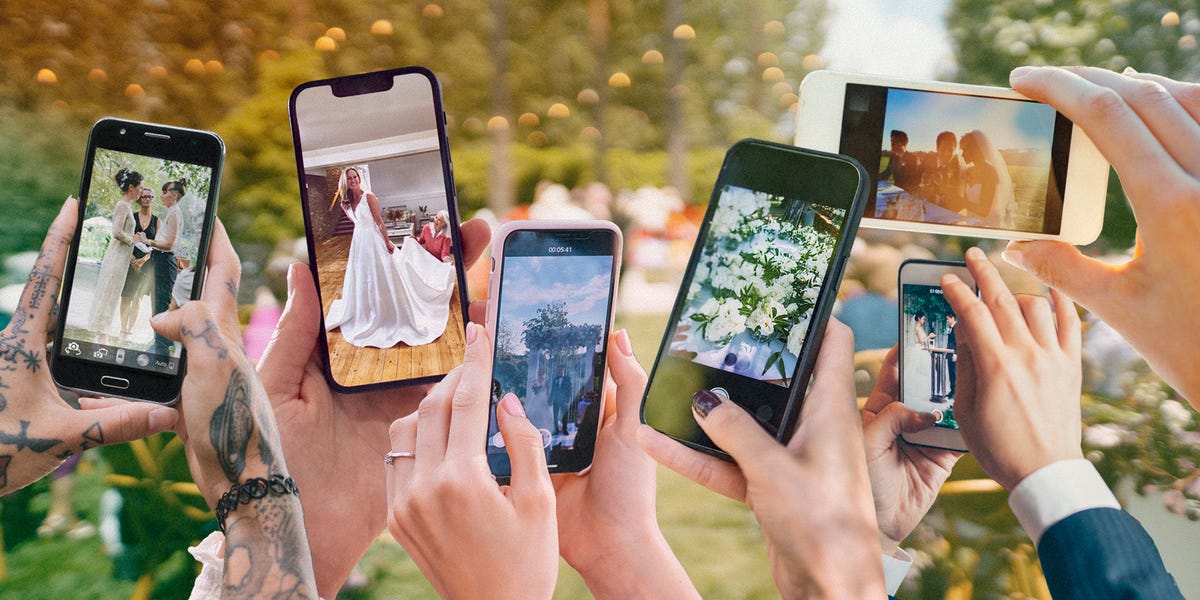
If it feels like someone you know is at a wedding every other weekend, you’re not alone. Weddings are the low-hanging fruit of the content tree, so to speak. Regular people can go viral trying to guess the type of dress the bride is wearing, or who is going to be the drunkest by the end of the night. And content creators who happen to be engaged can milk the situation for endless content from every angle, as well as brand deals and free items.Influencer Remi Bader has seen firsthand how big the wedding industrial complex has become online. With more of her friends getting married over the past two years, wedding guest dress hauls have become a lucrative staple of her content strategy.“I think brands don’t realize that those [wedding guest dress content] are my best videos, the ones I get commission from and that actually drive purchases,” Bader tells Cosmo. “A dress might not look good on me, but someone will see it and think, ‘Oh, I need that dress.’ I always link everything through LTK or ShopMy.”Bader also launched her own brand, FanGirl by Remi, which Brigette McHale of Acquired Style purchased for her bachelorette party, so Bader is getting to explore several angles of wedding content culture, and all of them are working for her.Her seemingly weekly hauls keep people coming back to her page, but so do the insiders snippets from the weddings she’s attended. “I love having that connection with my followers, especially when I meet them, and they recognize things I’ve shared,” Bader says.That connection is at the forefront of why the content works so well and reaches so far, according to Bader. “People are following these influencers as they get older. They’ve watched their relationships develop, seen their engagements, and now they’re seeing their weddings. They feel like they’re part of the story,” she says. “It’s the same thing that happens when you follow an influencer and are influenced by what they buy and do. I think the same thing is happening with weddings. I don’t know if that’s necessarily good or bad.”Influencer and author Eli Rallo saw her following grow after announcing her engagement, sparking months of anticipation from fans eager to see what her wedding dress would look like. That attention also brought a certain level of pressure. Like many creators, Rallo partnered with brands for wedding-day sponsorships, a growing part of the influencer wedding economy. Rallo took on a few sponsorships for her wedding, but was very intentional about what she said yes to, given that she still wanted her day to feel private and for herself, husband, and family.But the money, or savings, that can come from it is nothing to ignore. As The Wall Street Journal reported, depending on their follower tier, brides can secure anything from thousands of dollars in complimentary products and hundreds in cash to major cash collaborations totaling up to $150,000. Influencers like Halley Kate and Jaz Smith, Brigette McHale, and even everyday creators, incorporated branded content into their weddings or the surrounding week’s festivities.“The algorithm loves a wedding. I’ve never seen anything like a wedding to get the algorithm going,” Rallo says. “I didn’t get married for the internet, and I’m so glad the internet liked it as much as it did. But I’m just as glad that people have allowed me to move on, too.”In between the warm, fuzzy feelings of love and the taste commentary of all the aesthetic choices, there is something brewing that gives people, including the content creators themselves, pause. “I think we’ve gone in this direction with Gen Z where everyone is becoming more traditional,” Rallo continues. “Weddings are part of that. We’re seeing a lot of wedding imagery in media and music. I did get married, so in that sense, I did the traditional thing. But I’m not a traditional person. I got married because I met someone I wanted to spend the rest of my life with, not because I was trying to get married.”Rallo sees wedding content as part of a larger cultural conversation about traditionalism, but she also believes weddings give the internet another excuse to critique women.“People love to talk about women on the internet,” she says. “We all want to talk shit about influencers, women in the public eye, female journalists, and female celebrities. It’s just how it goes, and it’s so much harder for people who aren’t in a privileged position. What they face is so much worse. But it’s universally true that people love to talk about women. Weddings give people an easy opportunity to critique women because they feel like they have a barrier: ‘I’m critiquing her wedding. I disagree with her stylistic choices.’ But at the end of the day, we love to snark on women. I don’t think the wedding is that much of a shield.”Wedding expert Kennedy Bingham, who was a bride herself in 2021, has watched the industry evolve and says it isn’t always welcoming to creators who aren’t thin and white. And that thread of traditionalism breeds other types of echo chambers.“What I’ve noticed is that things have gotten a lot more traditional, with people really leaning into a specific, church-appropriate look,” Bingham says. “I wouldn’t even call it traditional in the historical sense. It’s more of an early-2000s-to-2012, clean silk ball gown look. People call it classic and traditional, but it’s really tied to a very specific period of American culture.”Bingham muses in particular on the broader political and cultural shifts that might be influencing which wedding content gets promoted online. “It’s hard to say whether people genuinely care about this aesthetic or whether they’re being pushed to care,” she says. “A big part of Project 2025 emphasized weddings and the importance of returning to traditional values. With TikTok transitioning to American ownership, I wonder whether the algorithm is heavily pushing content that aligns with a more traditional bridal style.”Bingham says her wedding content has completely shifted over the years. She noticed the algorithm moving away from her because her content focused on nontraditional weddings.“If I’m going to put my tinfoil hat on for a second, I do think there’s a behind-the-scenes push toward traditional American, Anglo-Saxon, and evangelical values,” Bingham says. “Creators who fit that image are being promoted. Most of the creators who have gone really viral, or whose dresses people are loving, are white creators or creators of color who have married white people or are surrounded by other white creators.”For Bingham, the existential question of making such a personal day into a branded moment feels like it blurs lines. “Yes, it’s your wedding, but you’re also trying to use it for marketing. And to make it marketable, you may feel pressured to embrace more traditional values. You’re no longer a person; you’re a brand. Whether you think that’s good or bad, you’re saying you can take any personal day and use it as a billboard,” she says. “Nothing is off-limits. If your wedding isn’t off-limits for a brand deal, what is? I wouldn’t be surprised if we eventually start seeing brand deals for funerals.”The stakes go beyond the pressure to monetize personal milestones, too. They also involve who gets represented in an industry she sees as overwhelmingly white and conservative. For her, if the algo is pushing this type of content in a certain way, it’s important for other perspectives to try to push through too. “It doesn’t matter if you’re not getting millions and millions of views,” Bingham says about nontraditional creators tapping into this ever-growing wedding market. “If the wedding space keeps soaring, everyone should get involved. It doesn’t matter how far your reach is.”In the current landscape we are facing calls to roll back marriage equality and women’s rights. It’s no mistake that there’s a rise in traditionalism with an undercurrent of white supremacist, conservative values. It’s hard not to wonder if this rise in wedding content is subconsciously attached to the political climate we’re in, or just another form of escapism online, like reading fiction or playing video games. The wedding bells are everywhere, online, in-person, and hanging over our heads. Is this natural push a means for new opportunity for women entrepreneurs and creatives or simply repackaged patriarchy sneaking its way back in? One thing is for sure: Weddings have transformed drastically. It’s not just about getting married, there’s a bigger picture at play. One where the most important vow might just be the one made to the algorithm.Aiyana Ishmael is the style editor at Cosmopolitan magazine. In her work, Aiyana focuses on the culture of fashion and how it intertwines and shapes the zeitgeist. She is an award-winning journalist from Miami, Florida, and a graduate of the historically Black university, Florida A&M. She is a 2024 Forbes 30 Under 30: Media honoree, and her debut romance novella PASSING GAME is set to release March of 2027 (831 Stories/Simon & Schuster).
The Wedding Industrial Complex Has Taken Over Influencer Culture
Full Article
Original Source
Read the full article at Cosmopolitan →KhanList aggregates and links to publicly available news content. We do not host full articles from third-party sources. Always verify important information with original sources.