
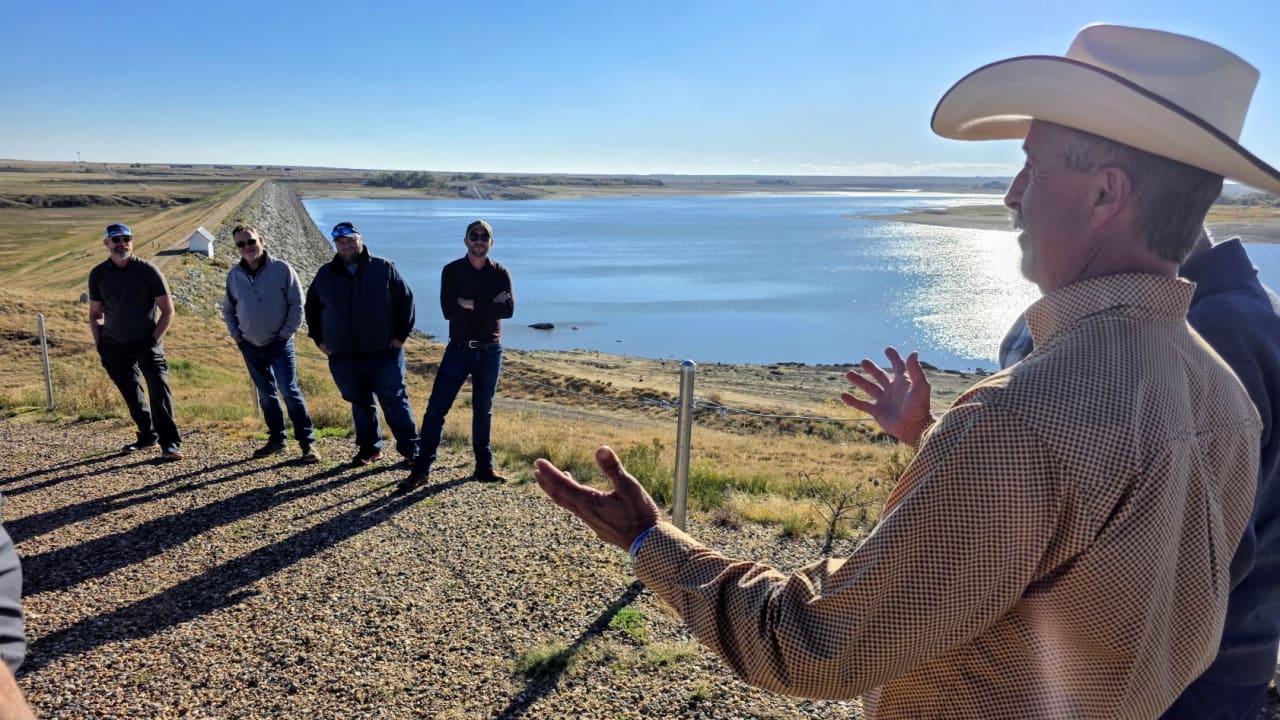
NOVEMBER 1, 2026 10:13At Schell Farms outside Sterling, Colorado, the smartest machine on the property never leaves the field. Cameras and ground-penetrating radar, designed in Israel, are bolted to a center pivot and scan the corn and soil on every pass."When corn is 10 feet tall in July, you can't see what's happening in the middle of the circle," said Daniel Schell, a fourth-generation grower. "Having the pivot tell my phone, 'Hey, nozzle 14 on span 3 is clogged,' before the crop shows stress, that's huge."I came to northeastern Colorado as director of Innovation Diplomacy at HaMitbah, the Western Negev Innovation Authority, representing our region's full innovation coalition: Ofakim Municipality, the Eshkol Regional Council , Sapir Academic College's Tech and Innovation Departments, and 17 AgTech and WaterTech companies in our deal flow.Logan County Commissioner Jim Yahn, who ran the North Sterling Irrigation District for 34 years, explains at a South Platte River headgate how the same water is reused up to seven times as it flows back to the river and on to farmers downstream. (credit: NOAM BEDEIN)Two food-security enginesLogan County sits in one of the top agricultural regions in the United States, a farm economy worth more than $6 billion, with 1.38 million head of cattle. The Western Negev is Israel's food-security engine, growing 65% of the country's field crops in a desert that gets even less rain. Our challenges are the same: extreme climate, water scarcity, and labor shortages. The connection began with the BIRD Foundation, the US-Israel Binational Industrial Research and Development Foundation. Trae Miller, executive director of the Logan County Economic Development Corporation (LCEDC), read that Nutrien Ag Solutions had won a BIRD grant with the Israeli smart-spraying start-up GreenEye Technology."When I first read the article about Nutrien Ag and their BIRD grant, I was excited to get connected and learn more," Miller said. "After BIRD referred me to Jordan and CO-IL, we began conversations on potential opportunities. That chain of events led to this exploration visit."The Colorado-Israel Chamber of Commerce (CO-IL), led by co-directors Jordan Kastrinsky and Jeremiah Baronberg, brought in HaMitbah and hosted our delegation.Noam Bedein of HaMitbah, the Western Negev Innovation Authority, in the field with Trae Miller, Executive Director of the Logan County Economic Development Corporation, and Daniel Bridges, U.S. representative of the Israeli company Autonomous Pivot. (credit: NOAM BEDEIN)Autonomous Pivot turns irrigation hardware into a data platform. Its cameras catch clogged nozzles and leaf browning, and its radar reads moisture through the root zone, so growers know whether to irrigate when water allocations run short. The company sells an annual membership instead of a $50,000 hardware package and now runs more than 800 systems across the High Plains."His pivot's always there," said Daniel Bridges, the company's US representative, who lived on Kibbutz Kinneret before moving to Kansas. "It doesn't need the weekend off. It doesn't get sick."Innovation that fits the farmerIsraeli drip irrigation is famous worldwide, yet row-crop farmers here run center pivots and refuse to lay and pull up plastic lines every season."They're basically telling you: 'No, I'm not going to put all this in my ground when I'm going to have to pull it up every year,'" Kastrinsky said. "But if I could do something with my pivot where I'm dropping water... that's the thing that works."Our deal flow fits that reality. Aqueduct Agrotech runs drip at ultra-low gravity pressure, cutting pumping costs. Ness Fertigation plugs into existing irrigation lines to dose fertilizer at the roots.At NA Timmerman, general manager Ryan Timmerman oversees about 50,000 head of cattle at one of the company's multiple locations.Asked about his biggest challenge, he pointed to labor with one word: "Help." We presented Cattle Measurement's 3D cameras, which weigh animals without a chute, and RumaFeed, which turns potato and tomato foliage into high-protein feed.Near Denver, Lioz Aharon of BACCARA USA, a valve maker founded on Kibbutz Geva, offered the hardware backbone young Israeli start-ups need. "Software is great, but at the end of the day, water has to flow through a physical valve that won't fail when hard water or sand gets into the line," he said.The water diplomatsLogan County Commissioner Jim Yahn, who ran the North Sterling Irrigation District for 34 years, showed us South Platte water rights dating to 1873."We use the water seven times," he said. "My return flow, somebody else picks it up downstream."Colorado's regional basin roundtables bring farmers, cities and state engineers together to settle water disputes before they reach court. Kastrinsky called it social water technology, an innovation Israel can learn from.The same grassroots ingenuity runs through Graham Electric Planter, where six employees build their own circuit boards to turn old planters into precision machines, and through Northeastern Junior College, whose president, Mike White, welcomed a "twin college" bridge with Sapir College.What we are buildingLCEDC is taking over management of 170 acres beside Sterling's historic 1905 Sugar Factory as a test field for AgTech and WaterTech."My game plan as of right now is that the 2027 growing season is really a kickoff," Miller said. "We might have four different water management technologies on one field and be able to compare them."Bridges committed Autonomous Pivot hardware to the site, and Ofakim set aside land as a reciprocal test site. Lance Gloss of the Colorado Office of Economic Development and International Trade outlined state grant opportunities of up to $500,000.In March 2027, we will bring Western Negev start-ups to Idea Farming 2.0 in Sterling, and we are exploring a county-to-county partnership."County to county," I mentioned to Kastrinsky. "Nobody's done that before in Israel."At the CO-IL gala in Denver, I told the room: "We come presenting 'Ecosystem as a Service,' exporting field-tested resilience and technologies developed under severe climate and operational stress to help feed a changing world.”Before I left Sterling, I gave Miller a desert flower from Kibbutz Sa’ad in the Western Negev, sealed in wax, the kind that blooms without water. Next season, on 170 acres of Colorado farmland, we will see what Western Negev innovation can grow.Noam Bedein, director of Innovation Diplomacy and Strategic Partnerships, HaMitbah, the Western Negev Innovation AuthorityFollow us on Google
The water diplomats: How western Negev AgTech and WaterTech are taking root in Colorado
Full Article
Original Source
Read the full article at Jpost →KhanList aggregates and links to publicly available news content. We do not host full articles from third-party sources. Always verify important information with original sources.