
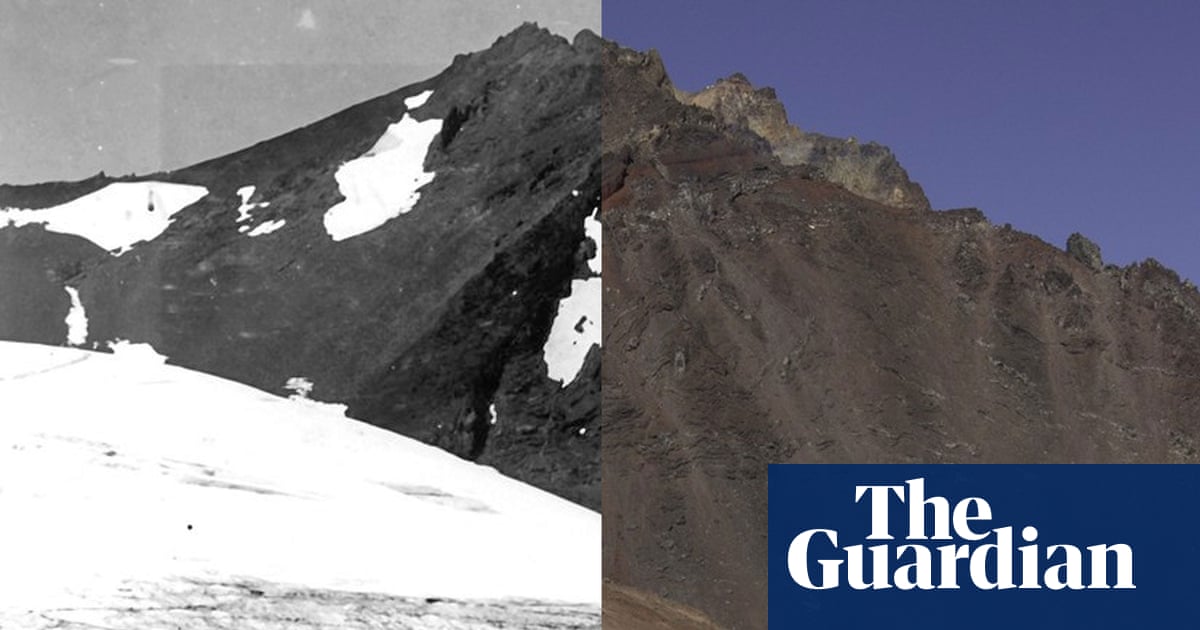
Across the US west, rising temperatures are causing glaciers to retreat to the point of vanishing. About 300 glaciers have disappeared since the 1960s, with almost all of the rest set to drastically shrink as the climate crisis continues to escalate, a new study has found.At the midpoint of the last century more than 1,450 glaciers – large tongues of ice, snow and rock that move under their own weight and gravity – were threaded throughout the mountains of the American west, providing cool water for ecosystems and agriculture as they gradually melted.Some, in the Sierra Nevada of California, were formed a few thousand years ago while others, such as those in the Pacific north-west, are remnants from even further back in the last ice age, which ended about 11,700 years ago.The long stories of these perennial masses of ice are coming to a rapid end, however, due to global heating caused by the burning of fossil fuels. The total area of glaciers in the US west has shrunk by a third since the 1960s, the new research found, with evidence this loss is speeding up as temperatures continue to rise.About 300 of these glaciers have functionally disappeared, meaning they have reduced to the size of about two football fields and no longer move. After dominating mountaintops for thousands of years, hundreds of once regal glaciers have been reduced to tiny, sad scraps of ice just within the span of time since the Beatles released their first record.“When I realized this it was like, ‘Yikes – that’s a lot more than I thought,’” said Andrew Fountain, a geographer at Portland State University and lead author of the new study.Map of glacier loss in the western US Photograph: The GuardianThe US’s largest glaciers are still found in Alaska but Fountain said he wanted to conduct the first proper inventory of the “unloved” glaciers that sit closest to where people live, in the lower 48 states. The new research, published in Proceedings of the National Academy of Sciences, used satellite data and aerial photography to chart how glaciers across six western US states have receded.Smaller, south-facing glaciers have experienced the greatest rates of shrinkage, particularly those at lower elevations of below 9,000ft in the Sierra Nevada and under 6,000ft in the Cascade range, which runs along the Pacific north-west.But even many of the larger glaciers are set to disappear in the next half century, previous work by Fountain has found, with the end of the century likely to see them only existing, in a diminished state, atop the tallest mountains in the west such as Mount Hood and Mount Rainier. Coleman glacier, located on Mount Baker in Washington. Photographs: James Wilbur Sandison/National Snow and Ice Data Center; Hassan Basagic/The Glacier RePhoto Project Composite: James Wilbur Sandison/National Snow and Ice Data Center; Hassan Basagic/“The sad conclusion is that we are seeing signs glacier change is accelerating and I’d say a lot of them will be gone by 2100,” Fountain said. “In the summertime they are melting more because it’s hotter and in winter they are getting rain instead of snow, which isn’t nourishing them. It’s a double whammy. There’s no good news on this.”Glaciers are important components of alpine ecosystems and provide some water for agriculture and hydroelectric power in the US west, even if they are remote from where most people live. Still, their retreat has been fast enough to cause a sense of angst among locals, according to Fountain.“People like knowing glaciers are around, they are close to their hearts and it’s worrying to see the mountains look bare,” he said. “The loss of glaciers is also tangible evidence of a shrinking snowpack, where a lot of drinking water is sourced from, so that is a concern when it comes to drought too.”This problem is not confined to North America. In places such as Europe and the Himalayas, scientists have documented the decline of glaciers as global heating has intensified, imperiling crops and wildlife.“We are turning up the heat in the refrigerator, so the ice is melting everywhere,” Fountain said. The loss of glaciers can be slowed by action to cut planet-heating emissions, he said, but the process of halting or even restoring them could take centuries, if at all.Until then, glaciers will be at increasing risk of destabilizing in sudden, potentially disastrous ways, such as when a catastrophic glacier and bedrock collapse along the Tibet and Nepal border in August killed at least 1,400 people, with thousands more still missing. Mazama glacier, located on Mount Adams in Washington. Photographs: Harry F Reid/National Snow and Ice Data Center; Hassan Basagic/The Glacier RePhoto Project Composite: Harry F Reid/National Snow and Ice Data Center; Hassan Basagic/The Glacier RePhoto Project“There is a whole suite of dangers we haven’t quite prepared for which is not just that the ice has gone but that the terrain isn’t stable any more,” said Eric Rignot, a glaciologist at the University of California, Irvine. “We have seen that in Nepal but also in the Alps, where the climbing season is getting shorter because it’s too dangerous. That is something I’m worried about.”The rampant melting of glaciers at the great polar ice caps, meanwhile, is directly causing sea levels to rise. About 12.5tn tons of ice from glaciers in Greenland and Antarctica have melted away since 1979, a major study found last month.This enormous amount of lost ice, enough that it could cover the entire continental US 5ft deep, has melted into three quadrillion gallons of water and raised global sea levels by about an inch over the past four decades.Even a small sea level rise is enough to severely worsen the effect of storms and flooding on shores, with most of the world’s coastal cities now at risk of some level of inundation as the ice sheets lose mass.“People have been shocked about the flooding in southern California but we have been telling you about this for 40 years, clearly no one is listening until their basement is flooded,” said Rignot, a co-author of the paper on the ice that has been lost at the poles.“You get creeping sea level rise but then you have events like storms or king tides on top of that and then you are in trouble. It’s getting worse all the time but it’s not too late, any step in the right direction matters. People shouldn’t be overwhelmed by the task, we should think we want to change and we should change.”Main photos of Hayden Glacier in Oregon. Photographs: IC Russel/US Geological Survey Photographic Library; Hassan Basagic/The Glacier RePhoto Project
The US west has lost nearly 300 glaciers since the 1960s. Climate crisis is drastically shrinking what’s left
Full Article
Original Source
Read the full article at Theguardian →KhanList aggregates and links to publicly available news content. We do not host full articles from third-party sources. Always verify important information with original sources.