
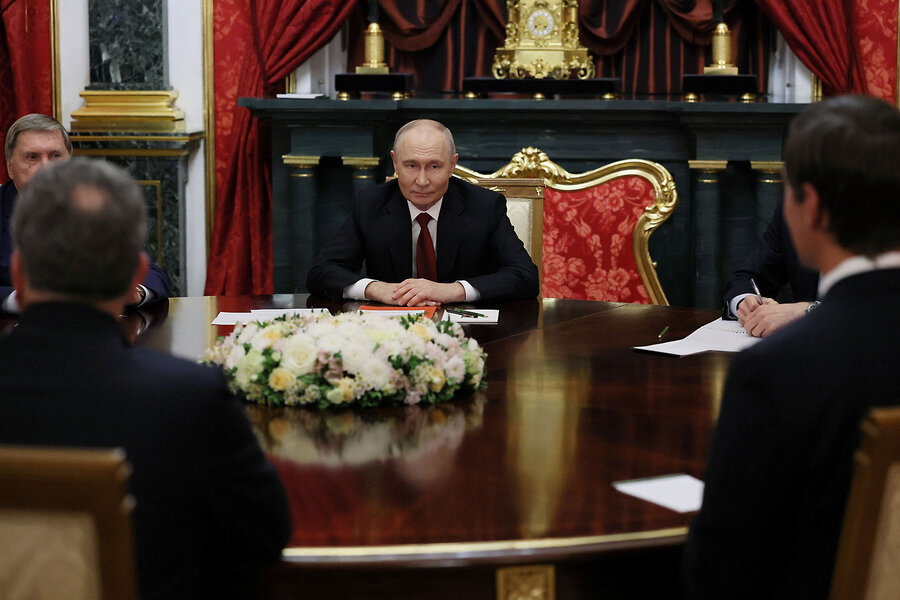
After a long hiatus, the idea of peace talks between Russia and Ukraine, mediated by the United States, appears to be back on the agenda.But that’s not a sign the Kremlin is concerned that its war in Ukraine is going badly. They appear to feel just the opposite, in fact.Russian analysts insist that the war is increasingly tilting in Russia’s favor and that the terms of the current U.S.-backed plan are the best that Ukraine can hope for. The plan carried by White House envoys Jared Kushner and Steve Witkoff to Moscow and Kyiv in early September reflected long-standing Russian terms for ending the war, as had previous ones. (They were rejected by Ukrainian President Volodymyr Zelenskyy.) Though Ukraine has escalated its drone war in recent months, bringing the war closer to home for millions of Russians – and many Western commentators believe that Ukraine still has a path to victory – Russian military specialists don’t appear to have gotten that memo. It suggests that any peace talks down the line could prove difficult for Ukraine and its supporters, particularly in Europe, to digest.“The strategic initiative is in Russia’s hands. Russian forces are moving forward and taking towns” on the front line, says Igor Korotchenko, editor of National Defense magazine, whose main readership is military officers and defense officials. “Peace talks depend on Russian terms being met.” Sputnik/Mikhail Metzel/APRussian President Vladimir Putin shakes hands with Trump son-in-law Jared Kushner during a meeting at the Kremlin, Sept. 5, 2026. At center is U.S. special envoy Steve Witkoff. Difficult terms for peaceRussia’s core terms have hardened since they were first spelled out in a draft peace deal negotiated directly between Russian and Ukrainian representatives just weeks after the war started, but was never signed.Moscow demanded guarantees that Ukraine would never join NATO, would accept substantial demilitarization but receive security guarantees from outside states, and would legislate language rights for Russian speakers. Under that unrealized deal, Russian territorial demands were limited to the small “peoples’ republics” of the Donbas and Crimea. Moscow even agreed that postwar Ukraine could join the European Union. Though there is no official text of the current U.S.-backed proposal, it is reportedly very similar to the “understanding” that the Russians say emerged from the Anchorage summit a year ago. However, the new proposal adds that Russia will keep all the territories it has occupied, and Ukraine must withdraw not only from the entire Donbas region but also from parts of Zaporizhzhia, also annexed by Moscow.Russian analysts argue that gaining territory was never Moscow’s main goal; the priority was always a neutral Ukraine at least partly anchored in the Russian sphere of influence. But after nearly five years of fighting and heavy sacrifices, President Vladimir Putin needs to show the Russian people some tangible results.The Kremlin claims that U.S. President Donald Trump dropped the ball after Anchorage and allowed Ukraine and its European backers to water down the terms, leading to an eventual breakdown of talks. Mr. Zelenskyy greeted Mr. Trump’s emissaries in Kyiv in early September with national security advisers from Germany, France, and Britain present. The Ukrainians rejected the deal.“The Europeans want to draw Trump back into fully supporting Ukraine” because they cannot accept the idea of Ukraine’s defeat, says Dmitry Suslov, an expert with the Higher School of Economics in Moscow. “As for Zelenskyy, it’s obvious that agreeing to these terms would be the end for him.”Mr. Suslov says the main reason previous attempts by the Trump administration to broker a peace fell short was because there was a belief that Russia could be convinced to make concessions. It was hoped that Moscow would agree to a general ceasefire before the final settlement had been decided. “But Russia needs its key terms to be agreed [to] before it stops fighting,” says Mr. Suslov. “The main thing that has changed now is the situation on the battlefield, in which Russia increasingly has the upper hand.”“We have lots of leverage”The fog surrounding the 700-mile-long front line is thick, but there is little doubt that the Russian pace of advance is glacially slow. Russian experts say the prevalence of drones on the battlefield has made any kind of rapid maneuver-in-force suicidal, and Russian troops now move forward in small groups of five or 10 men, often penetrating into Ukrainian-held towns without being able to take full control. Francisco Seco/APUkrainian President Volodymyr Zelenskyy (right) discusses the war against Russia with U.S. envoys Jared Kushner (left) and Steve Witkoff, during a joint news conference in Kyiv, Ukraine, Sept. 6, 2026. Though the Russians appear to have taken major Donbas towns such as Pokrovsk and Siversk this year, their claims to have seized the key fortress city of Kostiantynivka are still hotly disputed. Russian experts admit that a Ukrainian offensive near the northern Donetsk city of Lyman has erased months of previous Russian gains and blocked an attempt to surround the remaining Ukrainian-held Donbas fortress cities.“With the battles going on, we sometimes receive contradictory information. Commanders sometimes report that they’ve taken a place when, in fact, they have not,” says Viktor Baranets, a military columnist for the Moscow daily Komsomolskaya Pravda. “But we are on the offensive across the entire line of contact. In some areas, we’re moving forward, and in others, it’s static trench warfare. It’s hard, stubborn, sacrificial combat.”The main bright spot from the Russian point of view appears to be the air war, which Russia claims has turned decisively in its favor in recent weeks. Though Ukraine is still able to strike deep inside Russia, daily Defense Ministry statistics claim the majority of Ukrainian drones are being downed before reaching their targets.Mr. Korotchenko, the editor of National Defense magazine, admits that Ukraine’s stepped-up drone assault has done significant damage to Russian refineries and consumer warehouses. But he says that Russian retaliation – with ballistic missiles and new jet-powered attack drones – has devastated Ukraine’s logistics, arms industry, and rail transport, and has virtually shut down all its Black Sea ports.In the next phase, he says, Russia is preparing to destroy what is left of Ukraine’s electricity grid and power-generating stations. “We have lots of leverage to bring to bear,” he says. Western reports indicate that Russia is now outproducing Ukraine and the West in attack drones. At a time when Ukraine is running out of anti-missile defenses, Russia has greatly increased its production of ballistic missiles that can hit Ukrainian targets with virtual impunity.“I think the chance of success in these peace talks is virtually zero,” says Viktor Litovkin, an independent Moscow-based military expert. “Still, I think this operation is getting closer to the end. One big factor is the massive blows Russia is striking at the Ukrainian rear, hitting transportation, cutting off Ukraine from Western aid.” Deepen your worldviewwith Monitor Highlights.Politics with respectGet political stories with respectful analysis.There‘s a world of new ideas in everyBooks newsletter.There‘s more to life, enrich yours withCulture & Learning weekly.Follow humanity‘s discoveries withScience & Nature stories in your inbox.Gain a spiritual perspectivefrom the stories in your inbox.Want to understand the deeper impact of critical events? Learn the Monitor‘s insight.Already a subscriber? Log in to hide ads. The Russians are also demanding de facto recognition of their territorial gains, which appears to be the biggest remaining stumbling block.“Russia is looking for a legal settlement to end the war for good,” says Mr. Suslov. “If there is a ceasefire without legal force, Ukraine, Europe and even a new U.S. administration might be tempted to reopen the issue at any time. Russia wants to see this through to a sustainable conclusion.” ALREADY A SUBSCRIBER? LoginReal news can be honest, hopeful, credible, constructive.The Christian Science Monitor was founded in 1908 to lift the standard of journalism and uplift humanity. We aim to “speak the truth in love.” Our goal is not to tell you what to think, but to give you the essential knowledge and understanding to come to your own intelligent conclusions. Join us in this mission by subscribing.
The US wants a Ukraine peace deal. Here’s why Russia isn’t biting.
Full Article
Original Source
Read the full article at Csmonitor →KhanList aggregates and links to publicly available news content. We do not host full articles from third-party sources. Always verify important information with original sources.