
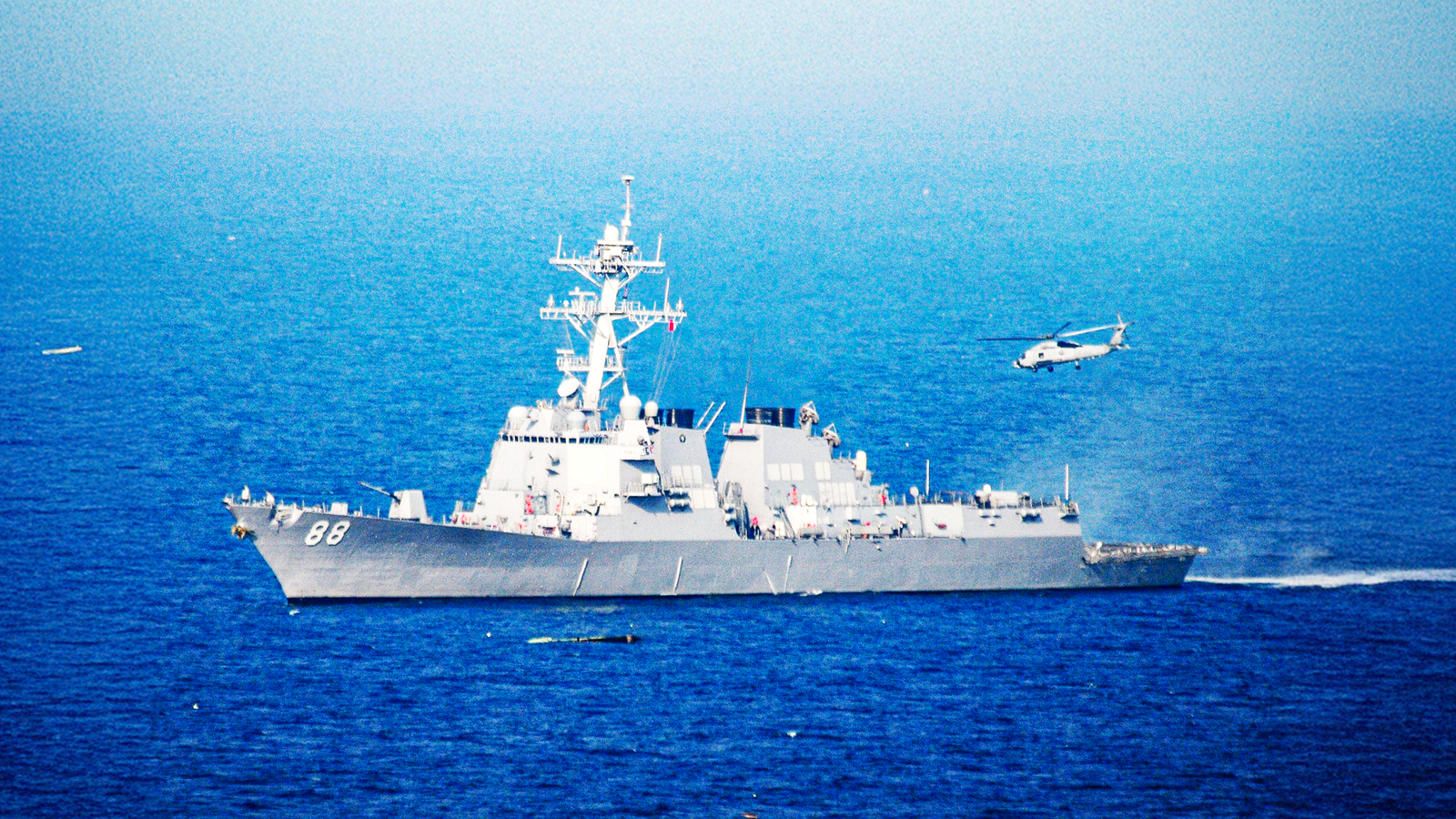
Published Sep 18, 2026, 10:00 AM EDT Luke Diaz is a freelance military writer with experience with active duty experience in the US Navy as well as defense and industrial engineering. He is a former Naval Flight Officer who performed tactical air control on the carrier-based E-2 Hawkeye. In January, the US Navy destroyer USS Preble made history as the first warship to use a laser and shoot down a wave of multiple drones in a single salvo. The demonstration came two years after the new directed-energy system knocked out its first target in trials at sea. Lockheed Martin's chief executive touted the milestone on an earnings call as proof that HELIOS is on track to replace interceptor missiles as the primary close-in defense weapon for America's Navy. What went unsaid in the optimistic projection is important to understand the magnitude of the technological and industrial ramp-up to achieve full-scale deployment. Preble is still the only destroyer in the fleet carrying a laser powerful enough to destroy a drone outright. The weapon is also limited to a single target engagement at a time. The kind of attacks the Navy has actually faced in the Red Sea have been waves of a dozen or more drones using swarm tactics. The destruction of a four-drone formation is real progress. At the same time, it also exposes exactly how far the technology still has to go before it changes the math of a drone saturation attack on an actual ship of the line in a real-world combat scenario. A Decade In The Making, One Ship Deep Credit: US Navy HELIOS stands for the High Energy Laser with Integrated Optical-dazzler and Surveillance. It is also formally designated Mk 5 Mod 0, which has been in development since 2018 under a contract Lockheed Martin won. The parameters of that contract aim to build a 60-kilowatt-class laser combining a hard-kill weapon with a dazzler to blind electro optical sensors, all tied into a destroyer's Aegis Combat System. The Navy took delivery of the system in 2021 and integrated it aboard the Arleigh Burke-class destroyer USS Preble the following year, as The War Zone documented. Task & Purpose reported at the time that the Navy had also received several lower-powered Optical Dazzling Interdictor (ODIN) systems. Navy officials described the roll-out as a rapid push to get lasers onto the surface fleet. Nearly four years later, that acceleration has produced only one operational HELIOS. Preble, now forward-deployed to Yokosuka, Japan, remains the sole ship carrying it. That leaves a substantial gap between ambition and hardware. So, what has the Navy actually gotten for a decade of laser development, and how capable is it? What HELIOS Can Actually Do Credit: US Navy HELIOS is rated in the 60-kilowatt class. That power level is enough to destroy or seriously damage a small drone. It also claims to be able to disable a fast attack craft. Lockheed has also proposed scaling the power to 150 kilowatts, a power level the company and Navy officials have floated repeatedly without a firm fielding date. The January demo marked the system's most demanding test yet. TWZ noted that no technical details were disclosed about the test results, including how quickly HELIOS re-slewed from one target to the next, how long each drone had to sit on the beam before it was disabled, and how close the drones were flying, which would enhance the meaning of those four 'kills' were the metrics also impressive. This slow march forward has been a recurring topic among the Navy's top brass for years. Breaking Defense quoted Rear Admiral Fred Pyle at the 2024 Surface Navy Association's symposium: “I can go back to the Arabian Gulf and probably 15 years ago, we had a ship called the Ponce that had a laser on it. … We’re still working on that technology.” “Sometimes we have a tendency to overpromise and under deliver. We need to flip that to where, when we’re intellectually honest, when we’re honest with ourselves about a technology capability, we have an agreed-upon sight picture of what it’s going to look like to deliver that capability.” Vice Admiral Brendan Mclane also expressed frustration with the crawling speed of iterative improvements at the same event, remarking: “I am not content with the pace of directed energy weapons. We must deliver on this promise that this technology gives us.” The limitations of directed energy weapons are well known and clearly defined, yet the advantages of a weapon with a functionally unlimited magazine remain extremely valuable to the surface Navy. That tactical urgency has only increased with the rise of low-cost, attritable, remote-piloted aircraft becoming a dramatically more prolific weapon in today's battlefield, with virtually every military on the planet ramping up to increase future drone arsenals. The Physics The Navy Can't Engineer Around Credit: US Navy Among the key technical problems is that a laser weapon is fundamentally a one-target-at-a-time system. The beam has to dwell on an aim point long enough to burn through or disable it before the mount can slew to the next threat, and that dwell time only lengthens as range increases or the target maneuvers. Beam power also degrades with distance and atmospheric interference, humidity, dust, smoke, and especially the salt haze and rough sea states of naval operations. That keeps HELIOS confined to relatively short engagement ranges. Targeting distance is measured in single miles at best. Advanced optics can partially compensate for atmospheric distortion, but they cannot eliminate the underlying tradeoff between range, weather, and lethality. Although that is not so different from the guns and missiles currently in use, laser reliability compounds the problem. Directed energy systems depend on delicate, precisely aligned optics that have historically proven finicky in the controlled environment of a test range. Once deployed across the fleet, vulnerabilities to vibration, salt exposure, and heat-and-cooling demands of sustained shipboard operations will only become more problematic. Making HELIOS lethal enough is one problem, but ensuring that these systems can achieve readiness levels that make them useful on a nine-month or longer deployment is a major engineering hurdle as well. Power Is A Deeper Bottleneck Than The Beam Credit: US Navy Even if HELIOS's engagement logic were faster, the Navy faces a more basic constraint in simply putting more lasers on more ships. Electrical power. Arleigh Burke Flight IIA destroyers, the variant Preble belongs to, have enough spare generating capacity to run a single HELIOS-class laser, which is precisely why the Navy chose that hull for the installation rather than a newer Flight III ship. The Flight III design, built around the AN/SPY-6 Air and Missile Defense Radar, consumes so much of the ship's electrical output that, as then-Rear Adm. Ron Boxall memorably put it in 2019, the fleet was effectively "out of Schlitz", out of spare power, for additional systems like a high-energy laser. That tradeoff has not disappeared with newer hulls. It has simply been deferred to the next-generation DDG(X) destroyer program, which Navy officials have said is being designed from the outset with dual 600-kilowatt lasers and a smaller 150-kilowatt system in mind, rather than retrofitted onto an existing electrical architecture never built for them. In the meantime, fielding HELIOS or a similar laser more broadly across the Flight III fleet would mean either stripping out other equipment to free up generating capacity or accepting aggressive, mission-limiting power management, an unappealing tradeoff for a capability that, even at its best, defeats one target at a time. That power ceiling is exactly why the Navy's near-term answer to scaling up directed energy has shifted away from bigger single installations and toward smaller, movable ones. The Payoff Is Real, But It's Years Away Credit: US Navy None of this diminishes the genuine appeal of what a mature laser weapon would offer. The two headline advantages are its virtually unlimited magazine depth and a cost-per-shot measured in cents rather than the millions of dollars like the missiles the Navy currently relies on for point defense. That arithmetic is precisely why Navy leaders, like Admiral Caudle, have said the long-term goal is for directed energy to become the first response to any close-in threat within a ship's line of sight. Yet, today, there is a huge gap between the Navy's grand vision for lasers and what the USS Preble actually proved by shooting down four drones in a controlled test. While the recent test was a successful proof of concept, it is a far cry from being ready for real war. In actual combat, ships face overwhelming raids of dozens of drones at once or complex strikes using missiles to enhance the onslaught. For context, in the past two years, American warships had to fire nearly 400 expensive interceptor missiles in defense against such raids. The Red Sea Set The Bar HELIOS Hasn't Cleared Credit: US Navy Going back three years, Houthi attacks in and around the Red Sea have repeatedly presented American destroyers with exactly the saturation scenario current lasers cannot solve. The US Central Command reported a December 2023 attack on USS Carney by a swarm of 18 one-way attack drones, two anti-ship cruise missiles, and one anti-ship ballistic missile. Then, in November 2024, the destroyers USS Stockdale and USS Spruance together defeated eight drones and eight anti-ship ballistic and cruise missiles. All of which were launched during a single transit of the strait. During the same operation, the destroyer USS Laboon, with carrier-based fighters, fended off a dozen drones as well as three anti-ship ballistic and two land-attack cruise missiles. As of early 2025, the Navy disclosed that its ships had fired roughly 220 interceptor missiles and 160 five-inch shells during the course of 380 separate Red Sea engagements. That tally would be updated a year later to nearly 400, including an estimated 120 SM-2s and 80 SM-6 multimillion-dollar Interceptor missiles. Set against recent combat action, a laser that has downed four drones in its best single demonstrated engagement is not yet a credible substitute, but the case for its development is clearly urgent.
The US Navy Just Bolted A Laser Weapon Onto Its Newest Destroyer, But It's Still Not Enough To Stop Drone Swarms
Full Article
Original Source
Read the full article at Simpleflying →KhanList aggregates and links to publicly available news content. We do not host full articles from third-party sources. Always verify important information with original sources.