
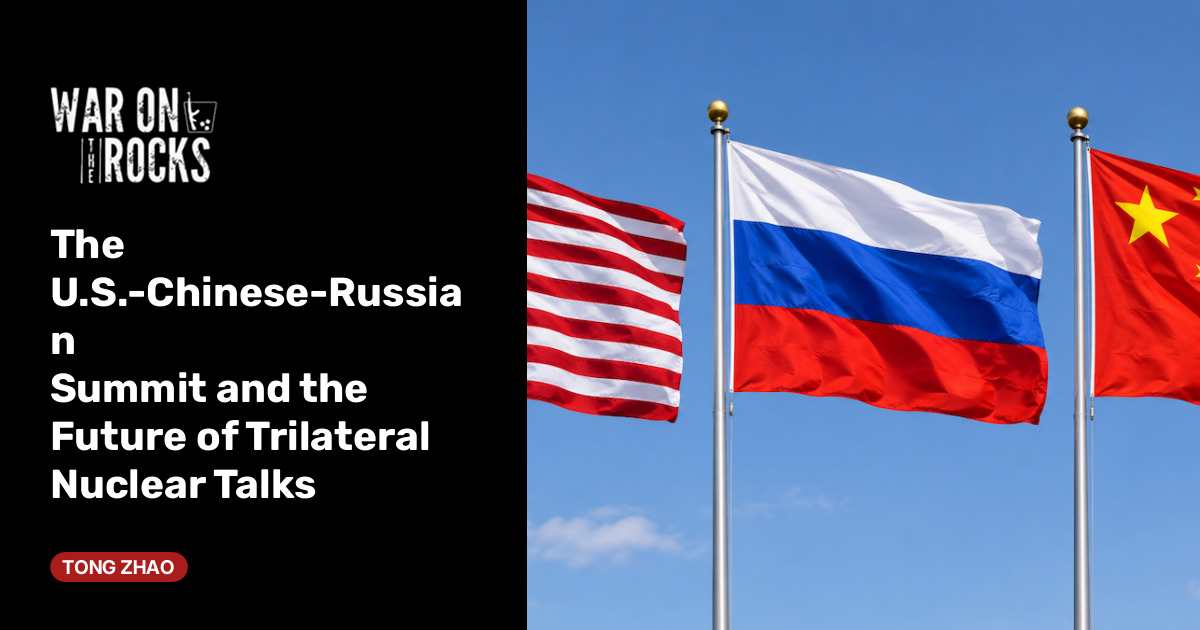
U.S. President Donald Trump, who has sought nuclear arms control with Russia and China since his first term, may finally have his chance. The first-ever U.S.-Chinese-Russian leaders’ summit is set to take place in Shenzhen, with nuclear issues potentially on the agenda. Regardless of whether the summit yields substantive progress, it could make the prospect of trilateral nuclear arms control seem somewhat less remote than before. For Beijing, however, the summit’s symbolism matters most: Washington is finally treating its geopolitical and ideological adversaries as equals in addressing issues of global governance. Discussions among Chinese experts suggest a widespread belief that China’s rapidly growing strategic power, including its military and nuclear capabilities, has compelled Washington to acknowledge reality and show Beijing due respect. With Russian President Vladimir Putin relying on General Secretary Xi Jinping to help stage Russia’s return to the center of global affairs, Beijing can use the summit to underscore its pivotal role in bringing together rival powers, each mired in protracted wars, and bolster China’s image as a capable and indispensable global leader. Trump’s repeated push to put nuclear arms control on the leaders’ agenda reflects a common-sense appeal to reduce global nuclear arsenals. Xi and Putin, however, are hard-nosed realists who regard nuclear weapons as essential to safeguarding their visions of history and justice. While Russia faces significant resource constraints on nuclear expansion, China has emerged as the pivotal player with the potential to reshape the global nuclear balance. Nonetheless, Beijing is unlikely to reverse its historic nuclear expansion soon, which includes significant expansion of infrastructure that can support long-term production of fissile materials and the research, testing, and manufacturing of nuclear warheads. This is especially true as Beijing appears convinced that its growing military strength and increasingly visible displays of strategic power have helped steer Washington toward a more conciliatory approach to Beijing. China’s 15th Five-Year Plan, released in early 2026 and covering the period between 2026 and 2030, reaffirmed its commitment to “strengthen and enlarge” strategic deterrence capabilities. In recent months, Beijing has reportedly shown slightly greater openness to nuclear engagement with Washington. Trump’s personal push on the nuclear issue may have helped draw Xi’s attention. At a practical level, Beijing likely sees carefully managed and limited engagement as a way to discourage Washington from publicly highlighting China’s nuclear expansion and related activities, including allegations of nuclear testing in violation of its international commitments. By keeping Washington publicly quiet and focused on private diplomacy, Beijing could face significantly less international scrutiny and pressure from other countries. Beijing has been particularly resistant to trilateral nuclear talks with Washington and Moscow, insisting that the two bear primary responsibility for nuclear arms control while avoiding any suggestion, as implied by a trilateral format, that China should assume comparable responsibility for preserving the international arms control regime. Substantive arms control breakthroughs at a trilateral summit, such as agreeing on limits to nuclear arsenals or greater transparency regarding nuclear capabilities, are highly unlikely, despite Trump’s previously expressed desire for a new arms control agreement that includes China. That said, Trump could make a more lasting impact by pressing Xi and Putin to explicitly commit to regular, institutionalized nuclear dialogues among their governments, insulated from broader political tensions and subject to transparency requirements about progress. Nuclear talks have too often served as diplomatic leverage, suspended over unrelated disputes such as U.S. arms sales to Taiwan and resumed as a reward for more “stabilizing” U.S. behavior. A durable mechanism could help prevent nuclear talks from being used as bargaining chips to advance other, higher-stakes objectives. War on the Rocks Membership Newsletters. Podcasts. Analysis. Exclusive members-only dispatches, premium shows like The Russia Contingency with Michael Kofman, and expert analysis of the conflicts shaping national security. Military, government, and students 33% off with a .mil or .gov email50% off with a .edu email Choose annual, then sign up with that email address. No code needed. A near-term topic attracting growing international attention is the integration of AI into nuclear weapons and related systems. A joint statement explicitly ruling out AI control over nuclear-use decisions should be a no-brainer, as the American and Chinese leaders already endorsed this principle in 2024. A trilateral statement to this effect could offer modest added value by bringing Russia on board, given Moscow’s weaker declaratory policy on this issue compared with other nuclear powers. More valuable, though far harder, would be working-level talks on implementing this broad principle. The main obstacle, however, is the extraordinary secrecy surrounding nuclear and military AI systems, which makes substantive working-level talks difficult and even complicates efforts to bring together officials with the necessary operational expertise. A trilateral missile pre-launch notification agreement would be a substantive step forward, building on existing bilateral notification arrangements between Washington and Moscow and between Moscow and Beijing. Such an agreement could close the Washington-Beijing gap in the existing framework, although agreeing on its scope, particularly which types of missile launches to cover, could require difficult and time-consuming negotiations given geographic asymmetries and the potential need to consider allied interests. Reaffirming the Reagan-Gorbachev declaration that “a nuclear war cannot be won and must never be fought” would also be welcome, provided it is not the summit’s main deliverable. The P5’s January 2022 joint statement reaffirming this principle appeared to do little to influence Russia’s subsequent invasion of Ukraine or its nuclear saber-rattling during the war. More meaningful, though also more challenging, would be joint discussions to explore a shared understanding of what constitutes a nuclear threat and how to avoid such behavior, making it harder for countries to use nuclear signaling as a tool of coercion. Two more urgent threats to the global nuclear order warrant greater attention: the placement or detonation of nuclear weapons in outer space and the resumption of nuclear explosive testing. Russia, China, and the United States wield decisive influence over the future of these foundational nuclear norms. On nuclear testing, U.S. suspicions that Russia and China have conducted nuclear tests producing nuclear yields prompted Trump to threaten to resume U.S. nuclear testing on a comparable basis. Intrusive on-site inspections are likely too sensitive to be feasible in the near term. However, the three countries could consider sharing data from civilian earthquake-monitoring stations outside the Comprehensive Nuclear-Test-Ban Treaty Organization’s International Monitoring System, including those near nuclear test sites, to help clarify disputed seismic events without compromising military secrets. Because of their divergent interests in near-term nuclear arms control, nonproliferation may offer slightly more promise. A joint statement by the three leaders reaffirming their commitment to nuclear nonproliferation and a nuclear-weapon-free Iran may be achievable. Given Trump’s interest in recruiting Russian and Chinese help with the stalemated Iran war, Beijing could potentially work with Moscow to deliver more tangible results, such as curtailing supplies of dual-use materials and technologies critical to rebuilding Iran’s conventional missile forces and limiting its access to satellite intelligence used for military targeting. These would be important to Tehran’s capability to deter future U.S. and Israeli strikes on its nuclear facilities, the curtailment of which could influence its negotiating position on a diplomatic settlement. Putin and Xi might be willing to recalibrate their Iran policies if they believed Trump would reciprocate with subsequent concessions on issues more important to them, such as Ukraine or Taiwan. Such trade-offs, however, would likely raise concerns across Europe and the Asia-Pacific, compromise broader U.S. interests and credibility, and potentially outweigh any near-term gains. North Korea’s nuclear program would be a more challenging issue for the three leaders to address without North Korean leader Kim Jong Un at the table. Having consolidated its nuclear capabilities, North Korea has gained greater strategic autonomy and is better positioned to resist major powers making decisions about its nuclear future without its involvement. None of the three powers has shown much incentive to antagonize Kim, who appears to favor direct engagement with the U.S. leader to secure tacit acceptance of North Korea’s nuclear status and relief from economic sanctions. Crucially, China may also push to include “strategic stability” in any trilateral statement or declaration, an objective Russia would likely share. Xi and Putin have issued three bilateral statements on global strategic stability in recent years, while Xi and Trump have twice agreed since May 2026 to develop a “constructive relationship of strategic stability” between their countries. For China, its preferred interpretation of the concept extends well beyond nuclear stability, seeking implicit U.S. acceptance of its claims regarding core national interests, ranging from regime security and Taiwan to access to advanced technologies. For other countries, a joint commitment by the three powers could raise hopes of reducing the risk of major-power military confrontation. Without clear definitions, however, such a statement could alarm U.S. allies and other smaller countries. Under the so-called stability-instability paradox, greater strategic stability among nuclear powers could embolden aggression at lower levels of violence, which could deepen insecurity among some non-nuclear weapon states. If a regular trilateral dialogue can be established, the three countries should seriously explore measures to reassure non-nuclear weapon states, addressing concerns over their nuclear and conventional military postures and force development. Ultimately, alleviating growing international concerns about unconstrained great-power military behavior is becoming more important to discourage more countries from seeking nuclear deterrents of their own. Tong Zhao is a senior fellow with the Nuclear Policy Program and Carnegie China at the Carnegie Endowment for International Peace. Image: ChatGPT
The U.S.-Chinese-Russian Summit and the Future of Trilateral Nuclear Talks
Full Article
Original Source
Read the full article at Warontherocks →KhanList aggregates and links to publicly available news content. We do not host full articles from third-party sources. Always verify important information with original sources.