
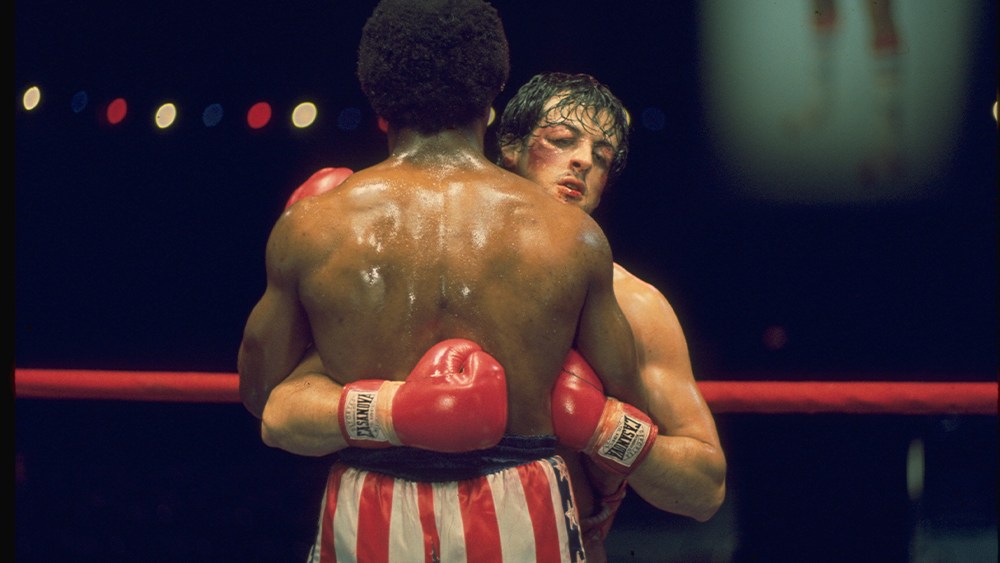
When Sylvester Stallone first walked into the offices of producers Irwin Winkler and Robert Chartoff, he was another struggling actor looking for his big break. The producers weren’t casting anything at the time, but as Stallone prepared to leave, he mentioned that he was also a writer. Intrigued, they invited him to send over a screenplay. Although Winkler and Chartoff passed on the initial script, they recognized Stallone’s potential and encouraged him to share whatever he wrote next. A week later, he returned with Rocky. “We thought it was really a great script,” Winkler recalled, nearly 50 years after the film’s release. “It was a story about somebody who has very little and believes in himself.” There was just one catch: Stallone insisted on playing the title character himself. “The studios were against it,” Winkler said. “They didn’t want to do the movie in general, and they certainly didn’t want to do it with him. But we persevered, just like he does in the movie.” Inspired in part by the real-life heavyweight bout between Muhammad Ali and underdog Chuck Wepner, the film’s central message was simple: Winning wasn’t necessarily about defeating your opponent, but proving you belonged in the ring in the first place. Sylvester Stallone as Rocky Balboa Image Courtesy of Amazon MGM Studios Working with an approximately $1 million budget, Winkler and Chartoff personally guaranteed the production’s costs, ultimately covering roughly $25,000 in overages themselves. The limited budget also forced the filmmakers to get creative. Take Rocky and Adrian’s romantic outing at the ice-skating rink. Initially intended to be a scene surrounded by other skaters, the filmmakers reimagined the scene with Rocky persuading a rink employee to let the couple skate alone after hours. “Because we couldn’t afford to hire extras, we did it with nobody, just because of the budget,” Winkler said. “I think it’s memorable because it’s just the two of them alone.” The result was a quietly intimate moment that captured the film’s emotional authenticity. Rather than disguising its modest resources, Rocky embraced them, grounding its characters in the everyday struggles of working-class Philadelphia. That authenticity would become one of the film’s defining qualities, helping transform a small independent production into an unlikely Hollywood sensation. Talia Shire as Adrian Pennino and Sylvester Stallone as Rocky Balboa Image Courtesy of Amazon MGM Studios For Winkler, the gamble began paying off when Stallone’s performance and composer Bill Conti’s triumphant score finally came together. “We saw the strength of his performance, and then Bill Conti’s music on top of it,” Winkler said. “We said, ‘Okay, this is gonna be something.’” Released in 1976, Rocky became a box-office phenomenon, won three Academy Awards, including Best Picture, and launched a franchise that has endured for half a century. For filmmaker Peter Farrelly, the impact was immediate. “I just remember being blown away,” recalled Farrelly, who said he was about 18 years old the first time he saw Rocky in theaters. “I remember coming out of the theater and being like, ‘Woo!’ And I didn’t know what I was wooing about. I was inspired, but to do what, I didn’t know.” Sylvester Stallone as Rocky Balboa alongside Burgess Meredith as trainer Mickey Goldmill Image Courtesy of Amazon MGM Studios Farrelly likened the experience to watching his favorite team win a championship. He immediately began encouraging his friends to see the film, unaware that nearly five decades later, he would direct a movie about Rocky’s creation. “Stallone’s story and Rocky’s story are identical, almost,” Farrelly said. That parallel became the foundation of I Play Rocky, Farrelly’s new film chronicling Stallone’s fight to bring his screenplay to the screen. For screenwriter Peter Gamble, the project was deeply personal. After spending years ghostwriting and contributing creatively to successful productions outside of the spotlight, Gamble began searching for an opportunity to establish himself as a writer in his own right. “I had this really weird experience of having done things that were really big, and people loved it, but they didn’t know me,” Gamble said. “I was invisible. I felt unseen.” When his manager suggested exploring Stallone’s story as a potential biopic, Gamble immediately recognized something of himself in the struggling actor who refused to accept Hollywood’s limitations. Inspired by Stallone’s famously rapid writing process, Gamble challenged himself to complete his own screenplay in approximately two weeks. But much like the original Rocky, getting the film made proved considerably more difficult than writing it. The project spent years in development as its producers struggled to secure financing, with the delays ultimately bringing the film’s release into alignment with Rocky’s 50th anniversary. For Gamble, the connection between the two films extends beyond their unlikely journeys to the screen. At their core, both are stories about the universal desire to be recognized for what you have to offer. “Everyone has a moment where you go, ‘I feel like I got something in my heart and my soul that I can offer the universe if only someone would see it,’” Gamble said. Fifty years later, Rocky remains a reminder that sometimes going the distance is a victory in itself.
The Underdog Story Behind the Underdog Story
Full Article
Original Source
Read the full article at Hollywoodreporter →KhanList aggregates and links to publicly available news content. We do not host full articles from third-party sources. Always verify important information with original sources.