
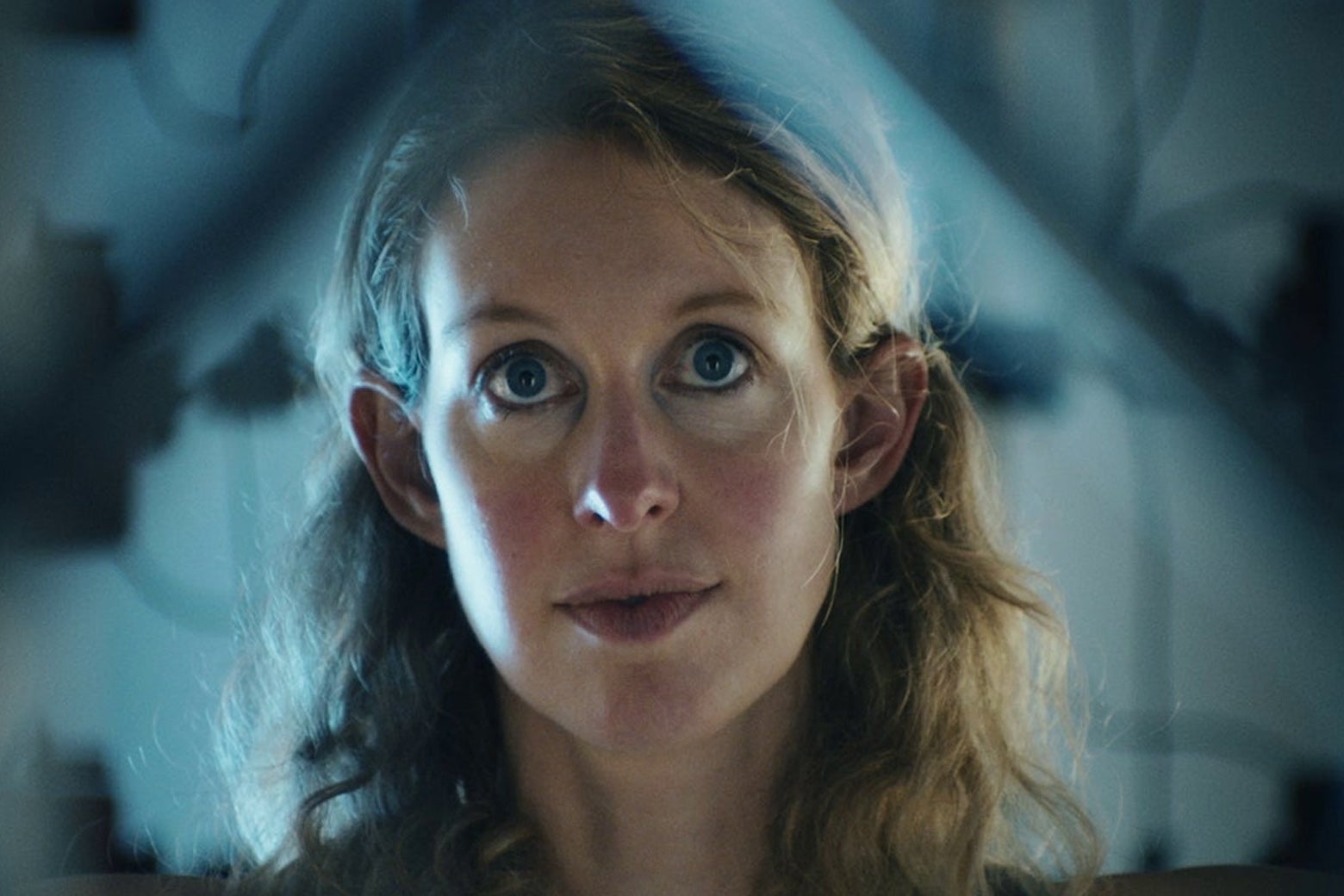
Movies You Can See Everything’s Magic Trick Elizabeth Holmes is a fraudster. It’s astonishing what Nathan Fielder’s movie makes of her. By Enter your email to receive alerts for this author. Sign in or create an account to better manage your email preferences. Unsubscribe from email alerts Are you sure you want to unsubscribe from email alerts for Shannon Palus? Oct 26, 202612:27 PM A24 This article contains spoilers for You Can See Everything. You Can See Everything, Nathan Fielder and Lance Oppenheim’s box-office sensation that has unexpectedly emerged as a possible Best Picture contender at the Oscars, has a deceptively simple premise: For roughly a month before she heads to prison, a film crew spends every day with Elizabeth Holmes, the disgraced CEO of Theranos who was convicted in 2022 of defrauding investors with false promises of a revolutionary blood testing technology. Fielder actually lives with Holmes, her partner Billy Evans, and her two small kids for a portion of filming. He talks to both Holmes and Evans at length, and appears on screen as a kind of narrator through which the viewer can follow the events of the movie. He asks Holmes if she has ever told a lie. She says she has not. Another time, he asks Holmes if she is deceiving him. With the camera trained on her wide blue eyes and giant smile, she assures him she is not. So what happened here, Fielder asks; did the press and the legal system just take down a random innocent person? A freakishly doe-eyed Elizabeth Holmes maintains that she has no clue. The truth of the matter, Fielder maintains, is elusive. Following a screening of the film, he told critics: “I really am struggling to this day to understand exactly what I experienced. And one of the things I’m genuinely excited about is for this movie to come out and for people to help me understand what I experienced. Truly, to this day, I don’t quite know what I went through.” I’ll bite. He spent a month or so hanging out with a fraudster who was extremely committed to not admitting to her fraud. She thought that providing an absurd level of access to someone who was interested in doing an artsy sort of character study on her—it was Holmes and her partner who apparently approached A24, the film’s production company and distributor—would help rehab her image. As it turns out, she was right. Holmes is, by some, now considered a victim of misogynistic double standards, of domineering men, of circumstance and injustice. It’s not necessarily what Fielder intended, but his much-lauded masterpiece and the magic trick that its ambiguity pulls off has left many viewers with a strengthened muscle to ferret out crumbs of nuance in statements where, in truth, none exists. You can howl at me a little bit, here. I am a science journalist by training, and I am not a Nathan Fielder fan, and I guess I would actively describe myself as not really getting his whole deal. I like to think that I am not the kind of person who finishes consuming a searching, inventive piece of art that blurs the line between reality and fiction and says, “Hmm would this be better if it were a ProPublica article?” Still, I kind of wished this movie were, instead, a ProPublica article, by which I mean that it included more facts. Like the fact that the beach shack that Holmes and Evans stay in leading up to her prison sentence apparently costs around $28,000 a month to rent. Or the fact that Holmes and Evans didn’t drive from California to Texas to begin her prison sentence, as is implied in the film—they took a private jet. Fielder is admittedly far from a conventional documentarian as you might define the term, and You Can See Everything does open with a brief montage outlining the Theranos fraud, but would intermittently highlighting these other facts on screen have made a terrible movie? (Well, I’m not the person who John Carreyrou, the journalist who took down Elizabeth Holmes, suggests should win an Oscar.) Without reminders of these facts, You Can See Everything lulls the viewer into a kind of spell. I, a longtime Holmes obsessive who once ate up the cover stories that featured the blond girlboss who had dropped out of Stanford, have consumed just about everything Theranos scandal there is to consume. I know that her technology didn’t remotely deliver on its promises, to the point where Theranos would use the machines of other companies to actually do tests, an issue that Fielder and Holmes in one scene reduce to a debate between the words “could” and “can.” (Can Theranos’ technology do what it claimed? Well it could, one day. This is actually an extremely common sleight of hand in consumer health tech, where gadgets are often propped up by some scant preliminary data.) I followed along when the Elizabeth Holmes fantasy came crashing down in 2015 with Carreyrou’s exposé in the Wall Street Journal, his truly fantastic book Bad Blood, and then an ABC News podcast, a traditional HBO documentary with talking heads, and a fictionalized Hulu show starring Amanda Seyfried, whose performance is based on many, many hours of Holmes’ official testimony.I’m fully aware that the con has been explored from all angles, and the verdict is clear: The girlboss was faking it. And yet, at one point during Fielder’s movie—be warned of spoilers, emotionally speaking—I was on the edge of my seat wondering if this poor woman really was just set up by a bunch of mean men who were controlling her. I had the feeling in my body of Oh my god, we’re going to break her out of this trap she is in! I then had the stomach-sinking sensation of crashing down from the tippy-top of Space Mountain, back to Earth. It was amazing that You Can See Everything could make me, of all people, feel this way—that’s art! I did, in spite of myself, leave the theater more sympathetic to Holmes than I had been. Allow Carreyrou to put us back on solid ground: He writes that, for some, the end result of viewing is the conclusion “apparently that Elizabeth Holmes is unknowable and everything is ambiguous,” although the truth is that the Theranos saga “was a ruthless cover-up of a breathtaking fraud, and she was at the controls.” Where did my sympathy for Holmes, in spite of myself, come from? It wasn’t quite because the viewer is asked to consider Holmes as a human being. (Holmes is freshly postpartum in the movie, and is shown breastfeeding, but the amount of screentime that is not devoted to bodily fluids is honestly shocking, just given the reality of biology.) It’s more because of the ways the film succeeds in blurring her, treating Holmes’ many “misstatements” over the years as “more debatable than they were,” as biotech journalist Matthew Herper of Stat put it. Herper knows a thing or two about Holmes’ misstatements; as Theranos was coming undone, she lied to his face on stage. Theranos whistleblower Tyler Shultz seems to concur, calling the film “a piece of art with the intent of creating ambiguity.” (In exchange for speaking out against Holmes’ company, Shultz was followed by private investigators, and his family spent hundreds of thousands of dollars in legal fees.) Again, I don’t know about Fielder’s intent, but by devoting significant time to quibbling over specific word choices and what they mean—a major thread is whether the New York Times slightly misprinted a quote; the newspaper maintains it didn’t—You Can See Everything successfully pulls off what Shultz says it does. That deliberate ambiguity and questioning of reality is the movie’s superpower, and what Fielder does best in his work. I didn’t expect him to show up at Holmes’ rental home and start listing off facts about how she did people wrong, or have blaring text flashing “This is bad” at various moments, but by training the camera so closely on his subject, the film does miss key external clues as to who she is. In particular, Fielder spends time questioning, with Holmes and with others, whether she cares about money, which is important because it establishes whether she had a real motive to commit fraud. But in understanding whether someone cares about money, it’s usually more helpful to look at what surrounds them than to look directly at their face—really, no one rich will tell you outright that they care about money. We briefly meet Holmes’ father, who worked at Enron—OK, maybe her whole upbringing happened on a rotten foundation of greed?—who quickly blurts out at one point that his daughter was raped during her brief time at Stanford. This allegation, along with the fact that she shortly after became involved with a much older man, her co-conspirator Ramesh “Sunny” Balwani at Theranos, has been recruited online into a simple kind of arithmetic: A traumatized young woman was taken further advantage of, became the face of a billion-dollar scheme, and is now going to prison for crimes she, maybe, can’t quite be blamed for. But this simplification ignores the reality that plenty of people are raped, and do not go on to commit wide-scale fraud that also has the effect of terrorizing patients. Already, there have been signs of turning Holmes’ victimhood into a kind of Franken-girlboss-dom, painting her as a survivor, someone who has done wrong but, due to trauma, is owed a new lease on the ability to be trusted. Journalist Elizabeth Plank helps lay the groundwork in a post on Substack, positioning Holmes as the rightful recipient of criminal charges, yes, but also a victim of Fielder’s filmmaking: “A man can lie about his accomplishments, but a woman does it and suddenly we’re producing a six-part documentary about the disturbing psychology of female ambition.” (I do not think that is what Fielder’s film, or any of the Elizabeth Holmes industrial complex, is about.) There is even unauthorized third-party merch popping up out there: Fans—of the film? of Holmes? it’s hard to say—can purchase a stylish hat that reads: “God forbid a girl lie a little to her investors.” It comes in eight colorways. I don’t blame Fielder or A24 for viewers generating such conspiracy-laced takes on the film. A friend whose difficult, grueling, nuanced work as a writer has been horribly twisted and cherry-picked by bad actors once told me that those bad actors will cite the phonebook to help make their case. You can’t make things with an eye toward what each and every consumer will take from them. And yet, each and every consumer of media now has access to a platform to post their own inflammatory takes, and some will inevitably ride the rails of gender ideology straight into the sun. What Holmes will do with this leverage will be up to her. She and Evans may not be profiting monetarily from You Can See Everything, but it’s an unavoidable fact that to give someone attention in 2026, as Fielder did for Holmes, is to give them a powerful currency of a different kind. Would I have assigned a piece where a writer goes to Elizabeth Holmes’ beach cottage for 34 days, had I had the opportunity? Of course I would have. I traffic in the attention business, too. More charitably: It is simply an interesting story, and it has made for an interesting movie. The truth of what happened within that house is in fact contained neatly within the film itself. In one scene in the film, Fielder describes a trick where a magician puts an ice pick through his hand, and explains that it is not, in fact, a trick at all: The ice pick is actually going through his hand. Nothing particularly nuanced or complex happened in that house: A liar lied and lied and lied and lied. And ouchy ouch, it hurts. Read more in Slate about You Can See Everything. Crime Feminism Fraud Medicine Movies Science Silicon Valley Documentaries You Can See Everything
The Truth at the Heart of You Can See Everything Is More Obvious Than You Think
Full Article
Original Source
Read the full article at Slate →KhanList aggregates and links to publicly available news content. We do not host full articles from third-party sources. Always verify important information with original sources.