
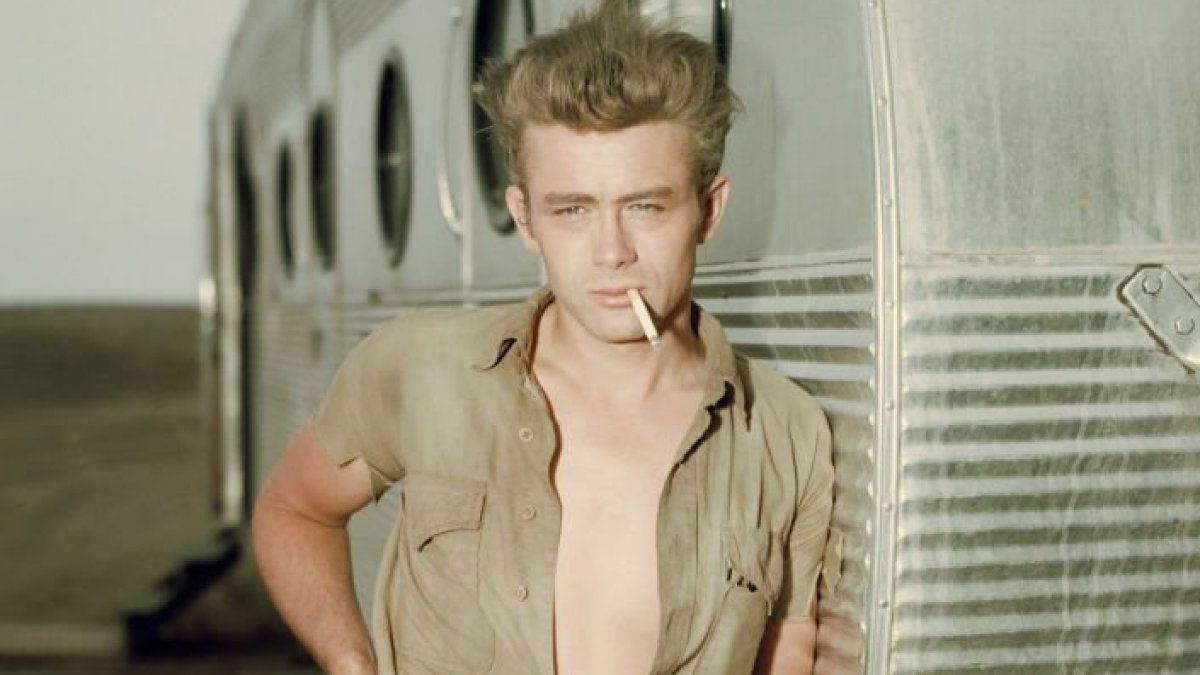
On a Warner Bros soundstage in Burbank, California, in the summer of 1954, Elia Kazan was wrestling with the Bible. The scene, from his adaptation of John Steinbeck’s allegorical novel East of Eden, required the pious farmer Adam Trask to erupt in rage when his wayward son Cal insolently reads out scripture. Six takes in, Raymond Massey, who played Adam, remained resolutely unruffled. He had no time for his screen son, a 23-year-old New York stage actor who would vanish to meditate before a take, or bounce and shake his wrists while everyone waited. His name was James Dean. Kazan took the young man aside and whispered in his ear. When the cameras rolled again, he looked down at the page and intoned: “The Lord is my shepherd, I shall not suck cock, up your ass, f**k you, shit, piss.” Massey leapt up from the table – “I will not play with such a person! You’d better call my lawyers…” – whereupon Kazan called cut, explaining: “I told Jimmy to say that.” The dialogue was dubbed in later, but the fury, splenetic and real, stayed on screen. Zoe Kazan, Elia’s granddaughter, has now adapted the novel for Netflix, and the streamer has thrown the kitchen sink at it. Spread across seven episodes, it takes in the whole multigenerational sweep of Steinbeck’s magnum opus, unlike the film, which tackled only the final stretch. It is opulent and tremendously acted, with Florence Pugh’s monstrous Cathy Ames moved from the margins to the centre. Yet, the most memorable role in the 1955 film, taken by a complete nobody, was Cal. ‘East of Eden’ was James Dean’s first major film role. The year after he made it, he died aged 24 (Photo: John Springer Collection/Corbis/ Getty) Within 15 months of that Bible scene, Dean would be dead at 24, after a student’s Ford turned across the path of his Porsche Spyder. Frozen forever as the absurdly photogenic embodiment of living fast and dying young, he enjoys an iconic status out of all proportion to three starring roles, after a career that ended almost before it began. Dean’s second Broadway role was the one that caught Hollywood’s eye, as the seductive houseboy in a dramatisation of Gide’s The Immoralist. Kazan, fresh from his third collaboration with Marlon Brando (On the Waterfront), was after someone younger and rawer to play the unloved son. In March 1954, he collected his new protégé from West 68th Street in a black Cadillac, his luggage two paper parcels tied with string. Dean slid onto the back seat and said: “Whoosh. Never thought I’d ride in one of these.” “Get used to it,” Kazan replied. On the flight west, Kazan studied a face that the biographers Joe and Jay Hyams describe as “formed with exquisite subtlety; a straight, narrow nose, high cheekbones, a mouth curved and mobile as a girl’s”. The camera would love him, and then some. The press knew little about him. Since the same director had launched Brando, the comparison more or less wrote itself. Dean played up to it, of course, signing off one letter “Jim (Brando Clift) Dean”. For all the surface similarities, the two men were less alike than headlines implied. Brando had been drilled by the formidable acting teacher Stella Adler, whereas Dean – one of the youngest students of Lee Strasberg – stormed out during one withering critique. Kazan was blunt about the difference: Brando “had excellent technique”, he said, while “Dean had no technique to speak of. He would either get the scene right immediately, without any detailed direction – and that was 95 per cent of the time – or he couldn’t get it at all”. Rather than school him, Kazan set about channelling what was already there, beginning with the richest seam of all: Dean’s father. During a visit at the veterans’ hospital where Winton Dean worked, Kazan watched the father and son run out of things to say. He realised that Cal’s story was Dean’s own – that he held a grudge “against all fathers” – and used this to goad the young star accordingly. Joseph Zada, above right, plays Dean’s role of Cal Trask in the new ‘East of Eden’, with Joe Anders as Aron Trask (Photo: Netflix) Kazan also sensed, during the New York screen tests, a sexual tension between Dean and Richard Davalos, who played Cal’s brother Aron. He set out to nurture this by installing the pair in a one-room flat opposite the studio. Whatever passed between them, Kazan had read something real in Dean, who is widely believed to have been bisexual. The longing he brought to Cal is not only that of a son. In Rebel Without a Cause, the film that would make him the poster boy for angst-ridden outsiders, his scenes with Sal Mineo carry an unmistakable homoerotic charge. Unkind critics have long written Dean off as a diluted Brando wannabe, and use East of Eden to make the argument. As the highly strung “bad” son, Dean is a restless semaphore of shrugs, sniggers and flinches, his mumbled delivery sitting as awkwardly in the 1917 setting as his haircut. Yet, he’s a character to whom we don’t so much relate as cling for dear life. Teenagers recognised themselves in him instantly. Throughout my childhood, my parents had Dennis Stock’s famous photograph of him, shoulders hunched against the Times Square rain and cigarette dangling from his lip, on their dining-room wall; it now hangs in my study, in my eyeline as I write this. East of Eden, released in March 1955, was the only one of his three star vehicles he lived to see; the other two were released after his death. Lent a mythic glow by Nicholas Ray’s colour-coding – red windbreaker, white T-shirt, blue jeans – his Jim Stark in Rebel Without a Cause is the best performance: all sly, panther-like effrontery and the urtext for every misunderstood teenager since. By contrast, Giant, a sprawling three-hour soap, asks him to age into an oil tycoon, and the greasepaint never convinces. How he would have coped with additional fame is anyone’s guess; East of Eden was alone sufficient to make him a star, and he was already tortured. Before shooting, he confessed to his riding coach: “I’m not a motion picture actor, and I’m frightened to death of being one.” Kazan told him to be prepared, but he never quite was. “I fought it for a long time,” Dean told The Hollywood Reporter a few weeks before the crash. “I’m famous, all right, and I guess this is what I wanted, so now how do I face it?” Far from dimming the devotion, Dean’s death intensified it: a year on, Variety reported that he was still receiving 5,000 to 6,000 letters a week, a good many from teenagers convinced he had survived the crash disfigured, and been rushed to a private sanitarium. “I know you are not dead,” ran one letter. “I know you are just hiding.” Warner Bros, with Giant still to sell, called in psychologists to help handle the cult. So began the hagiolatry that has shadowed Dean’s memory for 70 years. Viewed now, East of Eden can still knock the wind out of you, never more so than in the unscripted moment when Cal, his birthday gift of money rejected, breaks down and flings his arms around his father. Massey, who once threatened to call his lawyers rather than co-star with such a person, stands rigid. That’s the James Dean worth remembering: not the coolest guy in America, looking like an advert for cigarettes or jeans, but a desperate boy, clinging to a father who repels his embrace. ‘East of Eden’, starring Florence Pugh, is available to stream on Netflix
The truth about James Dean
Full Article
Original Source
Read the full article at Inews →KhanList aggregates and links to publicly available news content. We do not host full articles from third-party sources. Always verify important information with original sources.