
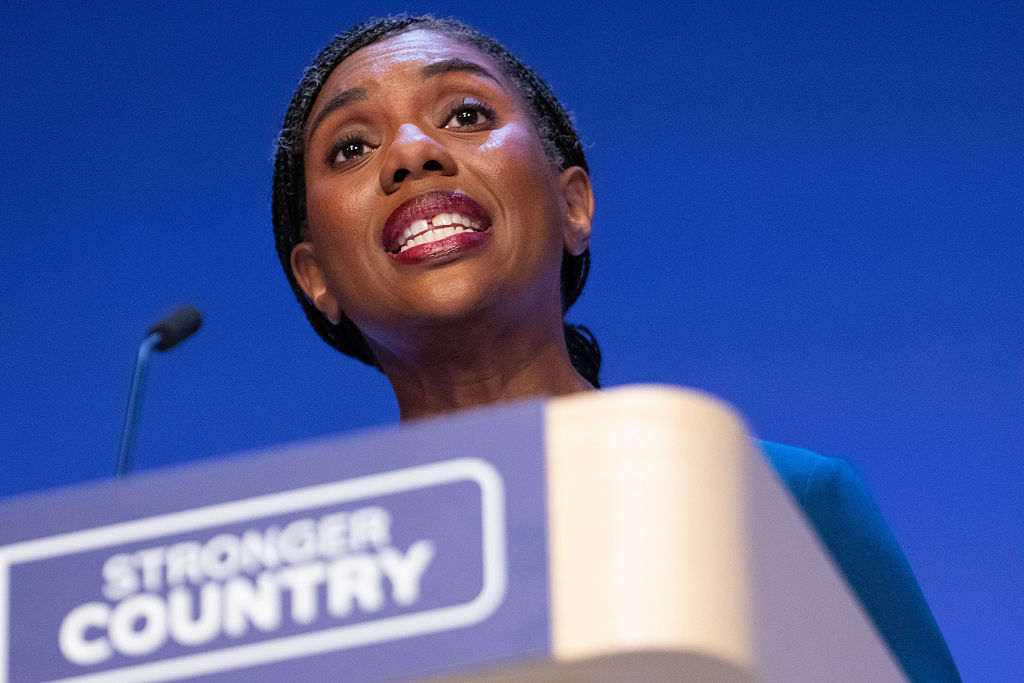
Foreign Affairs The crowd at last week’s Conservative Party Conference had questions that the party is uninterested in answering. UK Special Coverage (Gary Roberts/SOPA Images/LightRocket via Getty Images) Over the summer, the British government continued to struggle to control its borders. Despite falling overall numbers of arrivals, illegal immigrants have still successfully landed on British beaches, evading the authorities, and the state’s response has been instead to focus on arresting protesters and anti-immigration activists. After years of telling the British people that the government would stop the boats and “smash the gangs” who are trafficking people over, while presiding over the opposite, the British state is lurching into a crisis of legitimacy over immigration. The government has abandoned its half-hearted deal with France to return illegal immigrants across the Channel and now appears to be coordinating with the French authorities to land dinghies of illegal immigrants on British shores and usher them into taxpayer-funded accommodation. Meanwhile, attempts to reduce migrant access to welfare and delay permanent settlement of low-wage migrants who arrived in the wake of the pandemic seem to be dying a death by a thousand cuts, picked away by Labour MPs whose ideology boils down to open borders welfarism. This may bake in the rapid demographic change seen in the last five years, increase the welfare burden significantly, and make reversing it much harder politically and constitutionally. As such one might expect immigration policy to be one of the main themes of the Conservative Party’s annual conference, which was held last week in Birmingham. Immigration is consistently rated by the British public as either the most or second-most pressing issue facing the country, and with evident justice: After all, the composition of a nation informs its culture, its economy, and its fiscal viability. Regrettably, there was little mention of immigration on the program. One center-right think tank, the Centre for Policy Studies—founded by Margaret Thatcher in the 1970s—hosted the only discussion on immigration at this year’s conference, which I’ll detail below. (My own organization, the Prosperity Institute, ran two events, one on Brexit and the other on the future of the health service, promoting some of its recent research. It did, however, run two events related to immigration at last year's conference, where the subject was similarly underdiscussed.) Individual organizations in the wider conservative ecosystem are free to deploy their resources as they see fit, but the subject of immigration was a notable absence this year. Despite some broad mentions of immigration in the speeches of the party leader Kemi Badenoch and Shadow Home Secretary Chris Philp, the overwhelming atmosphere of the conference was of a party which was far keener to talk about other things. There was a strong sense among many activists that they would prefer the party to try to revive an imagined liberal victory of 2015, in which the Tories won a small majority under David Cameron, instead of the giant 2019 victory under Boris Johnson, which put Brexit and border control at the center of the Tory proposition. I was fortunate enough to speak on the single panel addressing immigration. The absence of immigration on the conference’s agenda was certainly felt by members of the audience at this panel. One asked why there were so few discussions on it, and hoped that the party would devote serious time thinking about the operational realities of border control, deportations, and the future visa regime. He was certainly right. To the credit of the two Conservative MPs speaking at the event, they agreed with the thrust of his question, and stated their commitment to developing detailed plans for making this a reality, and also to leaving the European Convention on Human Rights (ECHR). But the problem of trust remains. If reports that the party is targeting the so-called “Waitrose woman”—code for affluent, socially-liberal women who shop at the country's most premium supermarket—are true, then it is likely that meaningful action on border control will sit in tension with this strategy. The panel focussed on immigration and its relation to brain-drain. The Boriswave comes into the country, and Britain’s young and frustrated leave; so the framing goes. It is undeniable that modern Britain is not a friendly place to its young and aspirational. The jobs market for new graduates is brutal, with hiring scaling back across sectors. This isn’t just a consequence of greater AI deployment; it is downstream of the Labour government introducing new taxes on employment, forcing minimum wages to unsustainable levels, and adding a raft of expensive employment rights which have made hiring junior staff prohibitively expensive. This is on top of a brutal housing market that has already been immiserating Britain’s millennials and zoomers for nearly two decades. So there is certainly an element of truth in framing mass immigration and brain-drain as two sides of the same coin. Audience members suggested the malaise facing Britain’s young isn’t just about economic policy; it’s about the country changing before their eyes in a way they did not like and felt they could not control. One attendee remarked on the changes he had observed in his lifetime living in Luton in Bedfordshire. Luton is an industrial town known for car manufacturing in the northern commuter belt of London. Despite being set in the midpoint between the rolling Chiltern Hills, bucolic Hertfordshire, and agricultural Cambridgeshire, the town itself has become heavily Muslim in the last two generations, with a large population of people from Pakistan and their descendants. Luton is a segregated town, with a radical and dangerous element in its Muslim population. In 2009, a group of Muslims protested against the homecoming parade of the Royal Anglian regiment, local soldiers returning from a tour of duty in Iraq. This was followed by a group of radical Muslims from Luton staging a poppy-burning protest in London in 2010. It was in this environment that the English Defence League was established, a nationalist street movement founded by Tommy Robinson. Luton should be looked at as a case study in the failure of mass immigration, yet today it is ignored by the political class out of embarrassment. Subscribe Today Get daily emails in your inbox Questions about demographic change and whether it can be undone suggested an audience which was crying out for answers to the greatest question of the day from a party uninterested in providing them. Despite the Conservatives and Reform UK alike aligning in theory on quite a similar immigration policy, the tone of Conservative Party Conference 2026 suggested the Tories were apathetic about addressing it in much detail or with much vigour. Immigration was largely treated through the lens of stopping illegal immigration rather than taking a more radical—and necessary—approach to stopping mass legal immigration. American readers may see a parallel with establishment conservatives of their own. Indeed, when Tory MP Katie Lam raised the importance of “cultural coherence” when considering immigration policy last year, she was criticized by her own party, despite the fact she was talking about its own agreed immigration policy. It seems that the party is happier to bank its policies to leave the ECHR and extend the settlement period for new migrants and talk about other things closer to its comfort zone. The Conservative Party has had a reasonably successful past few months. Its leader, Kemi Badenoch, has secured her position at the helm of the party and is the strongest she has been since her election as party leader in 2024. The party is benefiting from the troubles facing Reform UK over its donation scandal. But it is impossible to shake the impression that it is becoming complacent and returning to a comfortable corner discussing taxation and defense, rather than thornier issues like demographics and immigration. This is unwise. The demographic trends are clear, and they are not friendly to either the Conservatives or Reform UK in the medium term. If the party is serious about returning to power, not just once but for multiple terms, it must be serious about immigration and multiculturalism, and serious about ending and reversing 30 years of political vandalism.
The Tories Still Do Not Want to Address Immigration
Full Article
Original Source
Read the full article at Theamericanconservative →KhanList aggregates and links to publicly available news content. We do not host full articles from third-party sources. Always verify important information with original sources.