
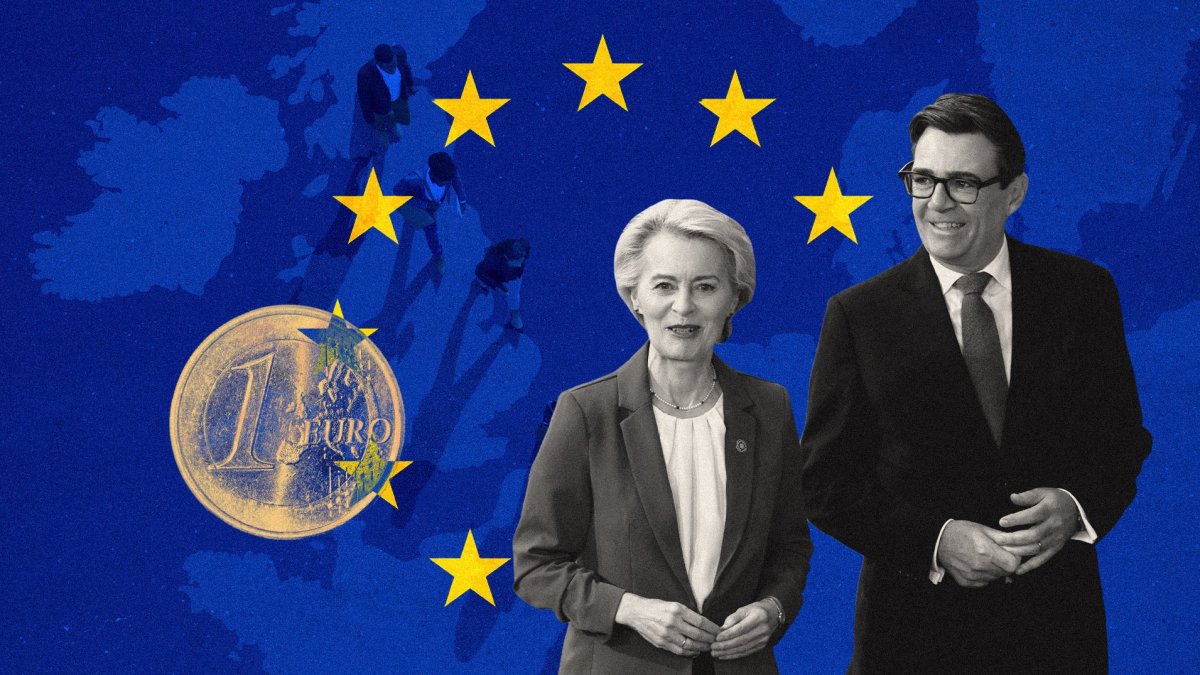
The UK would have to apply to join the euro under any move to rejoin the EU, insiders have warned. And as a new member, the UK would also likely have to pay more into the EU budget than before Brexit, as the rebate negotiated under Margaret Thatcher will not be reapplied, they added. Additionally, if Andy Burnham opts to negotiate a special deal for the UK instead of fully rejoining, he would likely have to accept free movement of people, several EU sources told The i Paper. These controversial negotiating points show that despite the warmth on both sides, forging a significant new relationship with Europe is likely to prove a protracted and complex process. The briefings come with European officials turning their attention to where the UK-EU relationship could go next, despite the ink barely being dry on the Brexit reset deals signed by the Prime Minister in Brussels on Friday. The text of the treaties, published on Thursday, show the UK’s agreement for easier food trade is dependent on honouring an agreement to allow 100,000 under 32s’ to work, study and travel in the UK a year, and vice versa. Burnham’s warm reception at the EU-UK summit, and his declaration that he would like to see Britain back in the European Union in his lifetime, have raised expectations of a fundamental shift in Britain’s relationship with its biggest trading partner. As The i Paper reported last week, appetite is waning for the kind of piecemeal Brexit reset deals that Burnham signed last week.The four main options Ultimately there are only four, well-trodden options for a deeper relationship, according to several EU diplomats – the status quo, joining the customs union or single market, or wholesale rejoining the bloc. There are signs of some flexibility within this, with some in the EU suggesting a Swiss-style special deal – finely tuned to suit the politics of the Alpine nation – may be possible. But the UK would not be able to enjoy deeper ties than Switzerland, which is effectively in the single market, for fewer obligations – Bern accepts free movement of people, for example. Despite the official position being that the UK should decide what it wants and then ask the EU for it, sources now indicate there is a willingness to hold informal “brainstorming” conversations with Burnham and his team about what may be possible. This would be done through day-to-day contact between the PM and EU leaders, and between British and European ministers and officials. The willingness to work through options with London comes as senior EU figures now realise “they have an interest in how the conversation in the UK goes”, according to one source. Some in the EU think that rejoining is the only option for the UK. The Swiss relationship is seen as fragile and complicated while a country of the UK’s size would struggle to be a Norway-style rule-taker if it plumped for customs union or single market membership only. Mika Aaltola, a Finnish MEP who has been involved in parliamentary exchanges with Britain, acknowledged that countries such as France, Spain and Ireland remain wary of British cherry-picking, but argues that there are growing incentives for both sides to compromise. UK will not be allowed to cherry pick He backs Burnham’s proposal for a brainstorming exercise with the EU and suggests that prominent figures from both sides, working independently of governments, could draw up a blueprint for a new relationship. “It’s not the Norway option. It’s not the Switzerland option. It’s the kind of UK model that allows both sides to say that we gain something,” he said. President of the European Commission Ursula von der Leyen, Prime Minister Andy Burnham and President of the European Council Antonio Costa grasp hands in a gesture of solidarity after an EU-UK Summit on November 20. (Photo by Sean Gallup/Getty Images) However, the overwhelming view in EU capitals and Brussels is that the UK will not be allowed to cherry pick the benefits of membership without the obligations. Fabian Zuleeg, chief executive of the European Policy Centre, a Brussels think tank, believes Burnham could make more immediate progress by focusing on defence, security and industrial cooperation rather than conventional trade issues. “I think the difficulty is that, for domestic political reasons, Andy Burnham decided that it had to be all about the economy. But that is the one area where there’s actually very little room for manoeuvre,” he said. “The EU is not going to become less concerned about cherry-picking.” Some EU countries believe Burnham is nevertheless right to highlight the need to move closer together in the face of Chinese and American trade aggression. “Focusing on protectionism is a positive move”, according to one source, while another said “uncertainties” in the London-Washington relationship make ties with Brussels more important. Aaltola said: “This alignment, even in the absence of real momentum, is going to happen because of the US pushing us away. The billiard balls on the table are moving because of external forces as well”. The long road to rejoining, via the euro If Burnham does decide to rejoin, it will trigger a formal process with an application followed by negotiations on 35 chapters split into six blocks, each of which needs to be approved by EU member states, before a final overall sign-off from European countries, including, if necessary, parliamentary votes or their own referenda. At some point within this process, a UK referendum would be likely. This will mean the UK will have to apply to join the EU with a statement that it plans to join the euro eventually, even if it tries to negotiate an exemption during accession talks. Most believe an opt-out from the euro is likely, and although the EU will not be able to officially confirm this before negotiations, European leaders “would try to communicate the message”, as Brussels’ former chief Brexit negotiator Michel Barnier has done in recent weeks. However, some believe that a derogation from the euro is not necessarily a fait accompli. Brexit expert Anand Menon said the UK would probably get a carve-out from the Schengen borderless zone – the other major controversy around the neck of membership – because Ireland does not participate and has a Common Travel Area with Britain. But the euro is “different”, the director of the UK In A Changing Europe think-tank said. “I don’t think many member states are going to be in the business of trying to weaken the commitments of membership. Euro as a bargaining chip “Particularly because that will be seized upon by other member states and so no one else will join the euro if they are not careful.” There may also be an attempt to use the issue as leverage in negotiations on other areas, although Menon said any UK attempts to revive benefits it had while previously a member, such as Thatcher’s budget rebate or an opt-out from Brussels’ justice and home affairs measures, would fail. They could use it [the euro] as a bargaining chip, but they are going to get the rest of what they want anyway. “There is no way we are getting opt-outs from justice and home affairs, there is no way we are getting a budget rebate.” EU member states will meanwhile be pushing in negotiations for maximum contributions to the Brussels budget, to save their own cash. Menon said: “Everyone will think on the basis of national politics, the first thing in national politics will be: how will we save some cash? “And I think they would go from there. “We’re not going to get shaken down – what they would say is we are going to apply the rules fairly to you but you happen to be quite a big member state with quite a big national income, don’t expect special treatment.” How long would it take? It is meanwhile unclear how long the process would last, with some in the EU believing it might be possible to negotiate UK membership in one election cycle, as the country’s legal framework remains similar to when it was a member. Others however caution that attempting to fast-track Britain’s accession, or give Burnham special treatment, could prove complicated as other countries negotiating membership such as Montenegro or Albania, could make the same demands. Whatever Burnham decides, it will be fraught with political and practical hurdles.
The three biggest obstacles to the UK rejoining the EU
Full Article
Original Source
Read the full article at Inews →KhanList aggregates and links to publicly available news content. We do not host full articles from third-party sources. Always verify important information with original sources.