
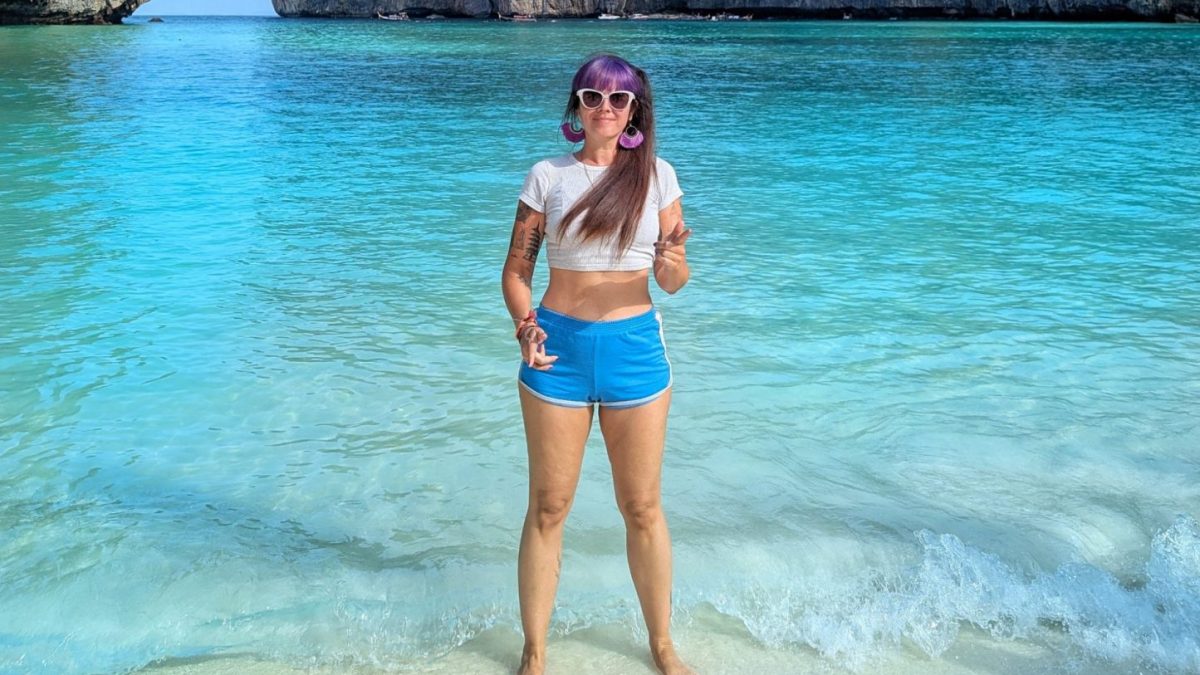
Squatting down, barefoot on the white sand shore, it’s hard to picture the crystalline blue waters of Maya Bay as anything but pristine. Gazing into the transparent ripples, we spot schools of tiny blacktip reef sharks, which prefer the shallows near the water’s edge. On a lucky day, manta and stingrays pass through, too. My Thai friend Nan is even more excited than I am. “Look, look, baby sharks!” she says, bouncing up and down, alerting other sightseers around us. Perhaps it means more to Nan as she remembers the state this site was in when she was last here over a decade ago. Blacktip reef sharks like this one can now be spotted at the once overtouristed and polluted beach (Photo: Petcharat Korbuakesorn/Getty) Maya Bay’s meteoric rise to fame following the 2000 release of the film The Beach, starring Leonardo DiCaprio, led to vast overtourism and the destruction of more than 80 per cent of its coral reef. The alcove bay, on the western side of Koh Phi Phi Leh – an island off Thailand’s west coast – closed to visitors in 2018. Prior to that, it was visited by 5,000 tourists a day and totally gridlocked with boats, which were squeezed in every inch of water, leaving a trail of flotsam engine pollution behind them. The closure of Maya Bay was initially slated to last four months but, thanks to the pandemic and advice from local environmentalists, it was completely off limits to visitors for four years, between 2018 and 2022. This year, it once again closed for its annual, two-month conservation period and reopened on 1 October. These days boats are banned from the bay, and instead park at a new jetty on the other side of Koh Phi Phi Leh. A raised boardwalk guides us across the island to a viewing platform dotted with information panels detailing how the bay is a shark breeding ground. Steps lead down to dazzling sand, where park rangers fastidiously monitor the water’s edge to stop overzealous sightseers from wading in – visitors are banned from entering the water here, and a tannoy announces that steep fines (up to 100,000 Thai baht, just shy of £2,400) await anyone who does. Visitors are no longer allowed in the water at Maya Bay (Photo: 500px Plus/Getty) Seeing blacktips cruise past feels hopeful; a sign that the most famous beach in the world is back to an ecologically sound state, thanks to the stringent efforts of the country’s national parks department. Having lived in Thailand for five years, I’m particularly impressed by the devotion of the park rangers who are firm but fair and look like they’re having a great time – one even sings the Baby Shark song over his megaphone. Maya Bay is not the only corner of the Phi Phi archipelago that’s working to reverse the effects of overtourism. While the south side of Koh Phi Phi Don (the largest isle) is lined with hostels and a rowdy party scene that I’ve managed to avoid, it’s a delight to discover that the north of the island is an idyllic time capsule of Phi Phi’s bygone years. Shorts I stay in Loh Bakao, at SAii Phi Phi Island Village, a resort stretching along the full length of a blissfully quiet beach and only reachable by boat. Its 200 luxurious huts and villas fully blend into the environment – so much so that as we approach by boat, I can hardly see the little buildings, hidden between tall coconut trees. Staying at this slice of paradise in shoulder season is surprisingly affordable, with rooms starting at £150 in October – I’ve paid more for motels on the M25. In the December and January peak season, I’d be looking at £290 a night for the same room. Shoulder season travel has many perks. SAii Phi Phi Island Village sits in a quiet part of Koh Phi Phi Don (Photo: Lucie Grace) Accompanied by Khun Jacky, the resort’s head of experiences, I stroll around the Marine Discovery Centre, which is aimed at educating guests on local ecology while supporting the growth of the island’s marine life. I’m particularly charmed by the hundreds of clownfish in its huge aquariums, and the team are gearing up to release the bamboo sharks that have been nursed here. There are also impressive coral regrowth programmes run by in-house marine biologists. Jacky has worked at SAii for 28 years, overseeing everything from the scuba excursions to astronomer-led stargazing evenings. The most booked trip, he tells me, is island hopping aboard a traditional wooden longtail boat, which of course includes Maya Bay. Given his long tenure, I can’t help but ask what life was like before DiCaprio and Maya mania. Does he remember things changing after The Beach came out? “We actually had five of the actors stay here during the filming,” Jacky says, proudly. “For many decades boats toured the beaches and bays of Koh Phi Phi Leh, but a lot less, only leaving from Phi Phi. After the movie, day trips were coming from far away, like Phuket and Krabi, and suddenly there were too many people.” Visitor numbers are now limited to 4,100 a day and boats are given a one-hour time slot at the new jetty. We set off for the bay – 40 minutes away from SAii by private longtail – at 7.30am, to beat the crowds, who arrive en masse by 10am. By the time we leave, the jetty is noticeably far busier. SAii resort runs a mangrove-planting programme. The trees help to protect coastal areas against waves, storms and erosion (Photo: Dronesmedia/Getty) Back at the hotel, we don wellies and sunhats before driving out to the mangrove forests that surround this secluded end of Phi Phi Don. Tree planting is another of SAii’s environmental initiatives, and one that’s of particular significance to the staff. “The mangroves saved us from the tsunami,” says room division manager Khun Poy. “Without them there would have been disaster here, but the mangroves broke the wave and only the canal channels flooded.” Planting the saplings turns out to be the highlight of my trip; there’s something fulfilling about giving back to the environment, knowing how it looks after us. How to get there Tui Airways and Virgin Atlantic fly non-stop from the UK to Phuket, from which companies such as Bundhaya run regular speedboat services to Phi Phi. SAii can also arrange speedboat transfers from Phuket to the resort. Where to stay SAii Phi Phi Island Village has doubles from £150, B&B.
The Thai beach ruined by tourist crowds that’s coming back to life
Full Article
Original Source
Read the full article at Inews →KhanList aggregates and links to publicly available news content. We do not host full articles from third-party sources. Always verify important information with original sources.