
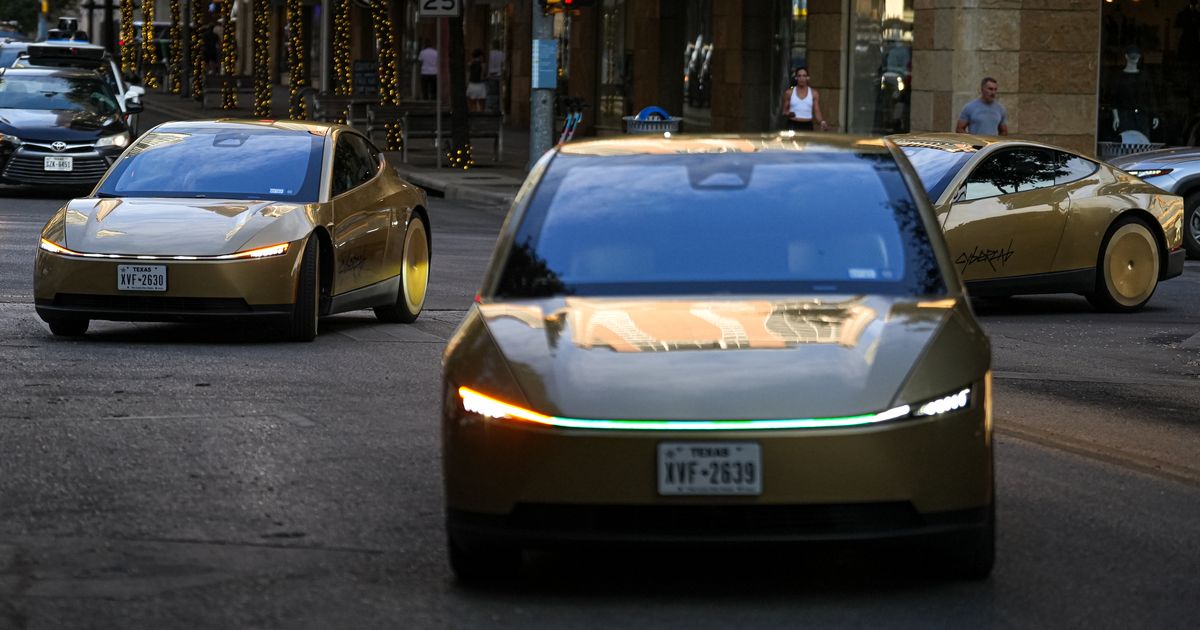
The Tesla Cybercab invasion is here, sort of. Photo: Aaron E. Martinez/The Austin American-Statesman/Getty Images Those stopping by Mt. Sinai’s Chelsea medical center in late July may have stumbled upon a rare mechanical bird: a brassy gold Tesla Cybercab, parked right across the street. It’s not clear how long ago Tesla let its robotaxis loose on the city’s streets or how many are currently cruising around the five boroughs, but for gear and Tesla heads, it’s become something of a sport documenting their sightings along the Cross Island Expressway or stuck in midtown traffic, the latest signs of Elon Musk’s promised, Blade Runner–esque future. But if anyone is expecting to be shepherded around by one of these blingy two-seaters in the near term, they’re going to get quite the letdown. While driverless Tesla Cybercabs have begun to zip around cities in Florida and Texas as part of autonomous robotaxi fleets that have no steering wheels, no brakes, and no side mirrors, a city Department of Transportation spokesman tells me that the Cybercabs here are testers equipped with a steering wheel as well as gas and brake pedals. (A Cybercab spotted by Gothamist the other day did, in fact, have a steering wheel and a human sitting behind it.) This almost certainly has to do with the fact that state law requires a person to keep at least one hand on the steering wheel of any car on the road. But Missy Cummings, the director of George Mason University’s robotics and automation center, thinks the test is likely a strategy to warm locals and lawmakers up to the fully driverless design. “Tesla first brings the safety-driven ones there to acclimate everyone, and then they hope to bring in the other ones,” she says. Which, on some of the most congested and chaotic streets in the country, could create some pretty serious headaches. “This is a nightmare for first responders,” she says, explaining that without the controls, they’d have no way of clearing them in an emergency. “Why would you let that on your city streets?” (There does appear to be some kind of hidden panel in the car that allows humans to honk, steer, and reverse, but for at least one test driver those controls weren’t fully working.) Tesla also is currently under investigation over whether the Cybercab’s lack of a steering wheel or brake pedals violates federal safety regulations. The bigger question is how the Cybercabs were quietly loosed on city streets, even with their human controls. When Alphabet wanted to test its autonomous Waymo Jaguars in Manhattan and Brooklyn, it had to get permits from the city and state. (Those permits, meanwhile, lapsed this spring, and Waymo has had to wait for their renewal.) Tesla, meanwhile, has avoided dealing with any of the red tape because, as the company has claimed, its Cybercabs aren’t anywhere close to operating without a human in the driver’s seat. The city DOT spokesman tells me the Cybercabs that people have spotted in recent weeks are currently operating with an “advanced driver assistance system” that may hand off control to a human driver out of the blue (which is what Tesla cars already seem to offer: a suite of self-driving features that can be overridden by a human). Elsewhere, however, the company is offering its Cybercabs to consumers as a driverless chauffeur service that can be hailed with an app, an experience that, at least according to one reviewer, was close to being driven around by a “slightly stoned teenager.” Tesla is also opening up fleet sales to those interested in running their own robotaxi companies. Matt Wansley, a law professor at Cardozo focusing on AI and automated driving regulation, says being cryptic about how autonomous its vehicles actually are is part of Tesla’s usual playbook. The company markets itself to consumers as being on the cusp of a fully automated driving system, but with regulators, it hedges with a more conservative description of its technology as a mere “driver-assistance system.” “It’s clear that the intent of Tesla is to build an automated driving system,” Wansley says. “They just don’t want to say that because it would trigger all these regulatory requirements that they don’t want to deal with.” What Tesla is getting for now, with its stealth pilot, is perhaps the most valuable: data about New York City’s streets. The Tesla Cybercabs Are Less Cyber Than They Seem Your product is saved! You’ll receive emails when your saved products go on sale. Manage preferences.
The Tesla Cybercabs Are Less Cyber Than They Seem
Full Article
Original Source
Read the full article at Curbed →KhanList aggregates and links to publicly available news content. We do not host full articles from third-party sources. Always verify important information with original sources.