
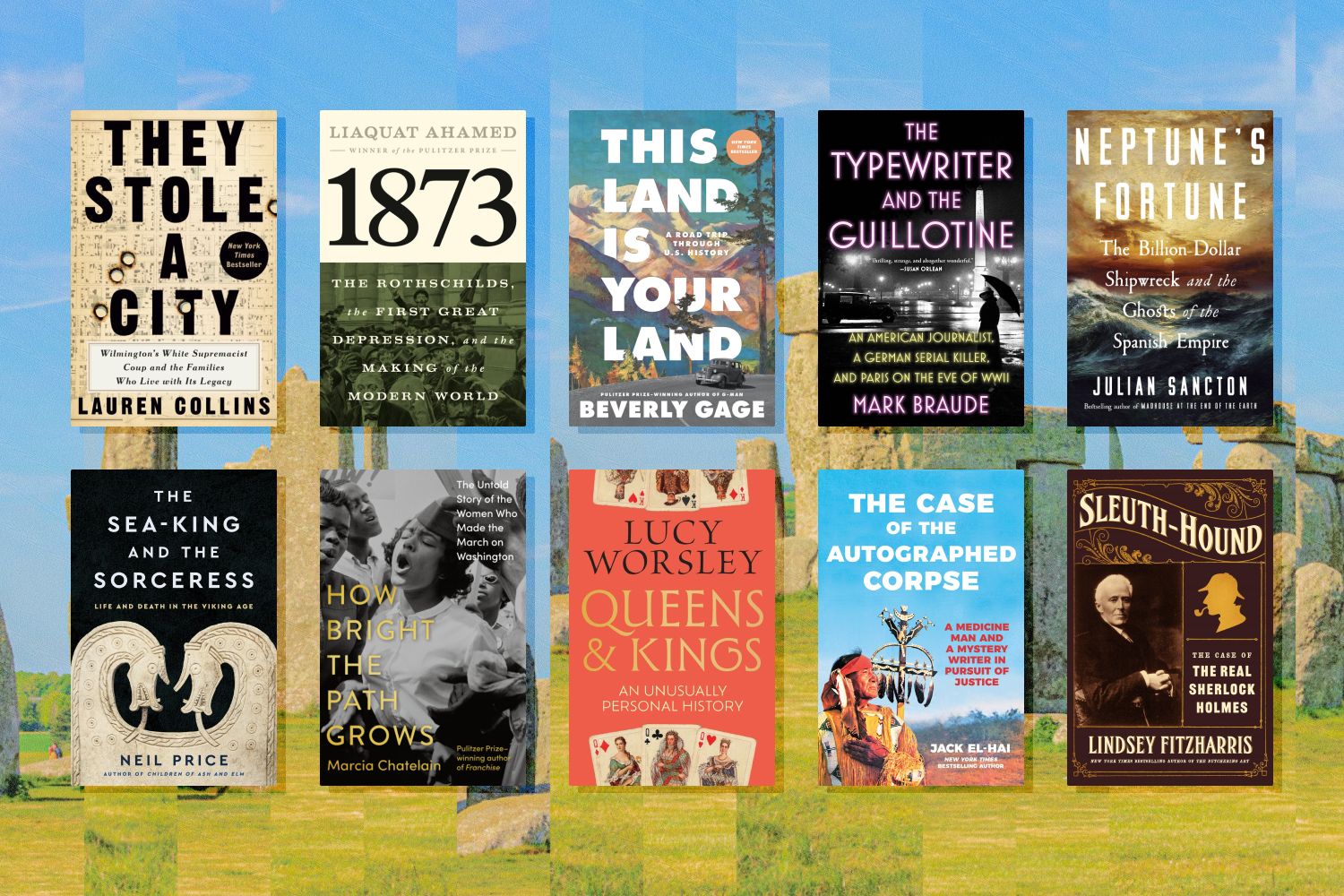
Our favorite titles of the year resurrect overlooked histories and examine how the United States ended up where it is today November 24, 2026 7:45 a.m. Smithsonian magazine’s picks for the best history books of 2026 include Beverly Gage’s This Land Is Your Land, Lucy Worsley’s Queens and Kings, and Marcia Chatelain’s How Bright the Path Grows. Illustration by Emily Lankiewicz In 2026, the United States marked its 250th birthday with new books, documentaries, exhibitions, commemorative magazines and celebratory events galore. The semiquincentennial offered a polarized nation a chance to come together in recognition of the founders who adopted the Declaration of Independence on July 4, 1776, as well as the manifold individuals—famous and little known alike—who have shaped U.S. history in the two and a half centuries since. At the same time, the anniversary underscored the divide in how Americans believe that their country’s story should be told. Amid this debate (not to mention a worrying drop in nonfiction book sales), recognizing the work of scholars who have dedicated their lives to unraveling the complexities of the past is more essential than ever. Unsurprisingly, many of the titles we’ve chosen to highlight this year feature American change makers, including George Washington, journalist Janet Flanner and the women behind the 1963 March on Washington for Jobs and Freedom. But U.S. history is far from the only topic covered on our list: Fans of British royalty, World War II and shipwrecks will also find something to enjoy. From a biography of the Scottish physician who inspired Sherlock Holmes to the story of the 1898 Wilmington massacre, these are ten of Smithsonian magazine’s favorite history books of 2026. This Land Is Your Land: A Road Trip Through U.S. History by Beverly Gage In 2023, Beverly Gage won a Pulitzer Prize for G-Man, her monumental biography of FBI Director J. Edgar Hoover. The Yale University historian’s newest book, This Land Is Your Land, has a much broader scope, using a cross-country road trip as a vehicle for chronicling America’s past. “A funny thing can happen when you sit alone at a desk for years, poring over the papers of one strange, long-dead man,” Gage writes. “You end up really wanting to be around some other people.” To fulfill this desire for human connection, Gage visited “museums, historic sites, roadside attractions, monuments, living-history pageants, battlefield re-enactments and souvenir shops” across the country, ultimately deciding to focus on 13 places that reflect “the major debates, conflicts and transformations” of American history. Regardless of whether Gage transports readers to familiar haunts like Philadelphia, where George Washington’s wartime tent is on view at the Museum of the American Revolution, or less-trafficked sites such as Medora, North Dakota—home to Theodore Roosevelt’s Maltese Cross Cabin—she emerges as a lively, insightful tour guide, blending her personal experiences on the road with accounts of foundational moments in the nation’s past. The historian effortlessly accomplishes her goal of attempting to “explore, if not reconcile, the greatest tensions of American history—to understand where we are as a nation by traveling through the past rather than looking away.” Sleuth-Hound: The Case of the Real Sherlock Holmes by Lindsey Fitzharris Who was the real-life inspiration for Sherlock Holmes, the iconic detective created by Scottish writer Arthur Conan Doyle? Sleuth-Hound, the latest book by medical historian Lindsey Fitzharris, introduces readers to the colorful character behind the magnifying glass: Joseph Bell, a Scottish surgeon whose university lectures imparted lifelong lessons to a young Conan Doyle. Much like Holmes, Bell arrived at conclusions through careful observation, revealing diagnoses in a dramatic manner akin to the deerstalker-clad detective’s undressing of suspected criminals. On one occasion, the surgeon identified a man of short stature with a distinctive swagger as a former soldier who’d played the bagpipes in a Highland regiment. When the patient contradicted this assessment, Bell had his clothes stripped off, exposing a telltale brand on his chest: “D” for deserter. “For Bell, every patient was a text to be studied,” Fitzharris writes. “Symptoms could divulge secrets, gestures could disclose clues and the most minute detail could help him decipher a medical riddle.” Sleuth-Hound showcases Fitzharris’ characteristic wit and her gift for detailing the macabre without veering into unsavory territory. In addition to outlining Bell’s many similarities to Holmes, the author examines a less-studied aspect of the surgeon’s career: his contributions to the nascent field of forensic science. Working with colleague Henry Duncan Littlejohn, Bell weighed in on some of Britain’s biggest cases of the day, from Jack the Ripper to the poisoning of a woman named Elizabeth Chantrelle. “Long before fingerprinting became routine,” Fitzharris argues, “before DNA became an invaluable method of revealing the invisible, Bell taught that the truth was usually hiding just under the surface of everyday things, and that a well-trained eye could force it to break cover.” How Bright the Path Grows: The Untold Story of the Women Who Made the March on Washington by Marcia Chatelain Accounts of the March on Washington often center on Martin Luther King Jr., the civil rights leader who famously delivered his “I Have a Dream” speech from the steps of the Lincoln Memorial on August 28, 1963. Although Marcia Chatelain, a Pulitzer Prize-winning historian at the University of Pennsylvania, acknowledges that King’s “bravery and commitment deserve mountains of reverence,” she argues that “this image of [him] as the singular hero of the civil rights movement has come at the expense of other stories, and of a more nuanced portrait of the struggle.” Chatelain’s newest book, How Bright the Path Grows, seeks to correct this imbalance by spotlighting 13 women who played a role in the march, from activist Rosa Parks to gospel singer Mahalia Jackson to Prince Estella Melson Lee, the widow of a Black businessman who was murdered for encouraging Black Americans to exercise their right to vote. Exhaustively researched and beautifully told, How Bright the Path Grows demonstrates that Black women were just as responsible for the march’s success as their male peers. Yet they were sidelined both at the time and in the decades since. Initially, the march’s program included no female speakers, with women only featured as performers. Chatelain suggests that this lineup sent a clear message to Anna Arnold Hedgeman, the only woman on the march’s administrative committee: “Women were fit to entertain, but not to lead.” Hedgeman balked at the arrangement, telling her male colleagues that “it is incredible that no woman should appear as a speaker at the historic March on Washington.” Ultimately, the few women who appeared onstage at the event, including Josephine Baker, Gloria Richardson and Lena Horne, barely had a chance to speak. But their stories didn’t end with the march: As Chatelain reveals in the book’s epilogue, the women continued to fight for equality. “Like every Black woman who marched that day, they all felt the suffocating hold of racism and sexism,” the historian writes. “And in the face of it all, they refused to let their own dreams die.” The Sea-King and the Sorceress: Life and Death in the Viking Age by Neil Price Neil Price, an archaeologist at Sweden’s Uppsala University, is one of the world’s foremost experts on Vikings. With his 2020 book, Children of Ash and Elm, he offered up an encyclopedic yet engaging overview of the seafaring Scandinavians’ lives, from politics to religion to art. Now, Price has published yet another groundbreaking look at Viking culture. The Sea-King and the Sorceress has a narrower focus than Children of Ash and Elm: As the archaeologist notes, he eschewed a “straightforward historical narrative” in favor of presenting “a more personal set of encounters with the Viking Age Scandinavians, and to a degree also with immigrants or visitors to the Nordic region.” The result is a highly readable volume that simultaneously dispels the many myths surrounding the Vikings and seeks to restore the humanity of the long-dead. To craft his intimate portraits, Price analyzed 21 graves spanning the 8th through 11th centuries, in locations as far-flung as Estonia, Greenland and Sapmi (the ancestral land of the Indigenous Sami people). He gave each interred individual a nickname that reflected their role in Viking society: the sea-king and the sorceress of the book’s title, for instance, but also such figures as the farmer (a woman who died around age 45 in tenth-century Denmark, her life “one of constant labor”) and the ambassador (a ninth-century poet dispatched to Viking territory by the Caliphate of Córdoba, a Muslim state in what is now Spain). “Burials can offer a kind of mirror image of attitudes to life, reflected in social responses to death,” Price writes. “In their preparations for a new existence in another world, or a continued, different life in this one, graves can embody all kinds of concerns expressed by the living on behalf of the dead—a society’s fears and uncertainties, limits and possibilities—and in so doing, allow us to understand a little more of who they were.” The Typewriter and the Guillotine: An American Journalist, a German Serial Killer and Paris on the Eve of WWII by Mark Braude The Typewriter and the Guillotine is a dual biography of two individuals whose lives briefly intersected in interwar Paris. The first was New Yorker correspondent Janet Flanner, a “representative of American self-invention, American wit and American love for democracy, who discovered that she did her best work outside of America,” Mark Braude, a historian at Stanford University, writes in the book’s introduction. The second was Eugen Weidmann, a “German confidence man and killer, a man so misshapen that when the Nazis occupied Paris, they tried to destroy all record of his crimes to avoid being tainted by association.” His death by guillotine in 1939 marked France’s last public execution—an event that Flanner chronicled for the New Yorker. Braude juxtaposes Flanner and Weidmann in an effort to “capture both the brutality of the era … and the strength people summoned to survive it, as they fought to maintain some measure of civility while watching civilization fold in on itself.” But Flannery is the true focus of The Typewriter and the Guillotine. In the 1920s and ’30s, the journalist captivated New Yorker readers with her “Letter From Paris” dispatches, offering up pen portraits of the city’s American expatriate community. Before long, however, she turned her attention to a growing threat to democracy in neighboring Germany: Adolf Hitler. In a three-part profile of the Nazi leader, she cannily described Hitler as a “natural and masterly advertiser, a phenomenal propagandist within his limits, the greatest mob orator in German annals and one of the most inventive organizers in European history.” Flannery was one of the first American journalists to take Hitler’s rise to power seriously, yet she is little remembered by the general public today. Braude’s masterful work of narrative nonfiction reintroduces Americans to a pioneering queer writer whose observations feel eerily prescient at a moment when fascism is once again on the rise. Queens and Kings: An Unusually Personal History by Lucy Worsley Lucy Worsley is one of Britain’s most beloved historians. The former chief curator at Historic Royal Palaces (HRP), the charity that manages the United Kingdom’s unoccupied palaces, Worsley is known for the effortless charm that she brings to documentaries and podcasts on topics ranging from the Tudors to the American Revolution. In Queens and Kings, she translates this verve onto the page, imbuing accounts of Henry VIII, the Tower of London, the Stuarts, the Hanoverians, Queen Victoria and the modern monarchy with her signature wit. Part memoir, part history, Queens and Kings opens with Worsley’s first day on the job at HRP. “It seemed unlikely then, but I would, in time, learn to make my way through the labyrinth of Hampton Court” and the five other palaces under HRP’s jurisdiction, she recalls. “I’d slowly become familiar with the princesses and princes, courtiers and servants who’d walked these corridors and cloisters before me. It’s their stories I want to tell here, giving you a flavor, if I can, of what it was like to learn them from within palace walls.” Worsley writes with candor, describing the Field of Cloth of Gold, a 1520 peace summit between England and France, as “completely useless” and admitting that “personally, I’m not such a fan” of Victoria’s husband, Prince Albert. Although the historian dedicates ample space to the men of the British monarchy, her passion for sharing the stories of women shines through, whether her subjects are unnamed and forgotten, like the laundresses who scrubbed the clothing of the royal household, or queens unfairly disparaged by later generations, such as Mary I and Katherine Howard, the fifth wife of Henry VIII. By the end of Queens and Kings, few readers will disagree with Worsley’s assessment that she held the “best job in history” for 21 years. They Stole a City: Wilmington’s White Supremacist Coup and the Families Who Live With Its Legacy by Lauren Collins In 1898, white supremacists massacred as many as several hundred Black Americans in Wilmington, North Carolina. Angered by the fact that Black men held positions of power in the local government, the mob stormed City Hall, burned down the office of a Black-owned newspaper, and drove Black families and their white Republican allies out of the city. The takeover—the only successful coup d’état on American soil—devastated a thriving community that had gained a reputation as a “Mecca for Negroes.” But the Wilmington massacre has long been overlooked. When journalist Lauren Collins set out to write a book about the coup, she assumed that her account would be grounded in the past. Instead, the New Yorker staff writer explains in They Stole a City, she found that “November 10, 1898, is a centuries-long day that isn’t over yet.” To examine this legacy, Collins traced the stories of four Wilmington families—relatives of both white perpetrators and Black survivors—across 125 years. “In collaboration with these living descendants, I have sought to create a more complete account of 1898 than that which can be understood solely from the archive,” the author writes. Collins isn’t the first to examine the Wilmington massacre in depth in recent years. A native of the city herself, she only learned about the coup in 2016, after watching a documentary called Wilmington on Fire. They Stole a City also builds on the work of journalist David Zucchino, whose 2020 book on the coup won a Pulitzer Prize. But Collins’ account is unique in its emphasis on the massacre’s present-day reverberations, viewed through the lens of those most directly affected by the violence. Timely, necessary and unflinchingly direct, They Stole a City argues that “white supremacy was not a regression or a blip,” Collins told NPR earlier this year. “It’s a through line of American history, and the one that has persisted for a very long time into the present day. I’ve seen how damaging it can be to suppress our history, and also, more recently, I’ve seen how good it can be when we confront these things.” The Case of the Autographed Corpse: A Medicine Man and a Mystery Writer in Pursuit of Justice by Jack El-Hai Journalist Jack El-Hai first chronicled the 1933 murder of Margaret Edwards, a White Mountain Apache woman, in a 2020 Smithsonian article. Now, he has revisited the topic to weave together a propulsive, deeply researched account of the killing and the miscarriage of justice that followed it. Although Margaret’s husband, an Apache medicine man named Silas John Edwards, was found guilty of his wife’s murder, the evidence that led to this conviction was slim, limited largely to the fact that his initials were inscribed on several of the rocks used to bludgeon her to death. As El-Hai—the author of The Nazi and the Psychiatrist, a 2013 book that served as the basis for last year’s Nuremberg film—writes in The Case of the Autographed Corpse, “No reasonable person could believe that Silas John would carve his initials into a stone, leave it behind after committing a brutal murder and then proclaim his innocence.” To piece together Silas John’s story, El-Hai interviewed his relatives, friends and acquaintances; reviewed court documents and evidence from Margaret’s murder case; and trawled through new materials from various archives. After spending 17 years behind bars, Silas John found an unlikely ally in lawyer Erle Stanley Gardner, author of the Perry Mason detective novels. Gardner ran a so-called Court of Last Resort out of the pages of Argosy magazine, re-examining old cases to exonerate the wrongly accused in the vein of the modern-day Innocence Project. At Silas John’s urging, Gardner and his colleagues revisited the evidence and identified a different Apache man as the likely killer. Thanks in large part to these efforts, Silas John was paroled; he returned home and resumed his leadership of the Holy Ground religious movement, which enabled Apache people to “free themselves from the restraints of reservation existence and determine the content of their own lives,” according to The Case of the Autographed Corpse. He died in 1977 at age 96. 1873: The Rothschilds, the First Great Depression and the Making of the Modern World by Liaquat Ahamed Economic experts and novices alike will find Liaquat Ahamed’s new book engaging, accessible and unnervingly timely. A prequel of sorts to the financial historian and former investment manager’s Pulitzer Prize-winning Lords of Finance, which focused on the 20th-century Great Depression, the volume explores the lesser-known Panic of 1873. That year, stock market crashes sparked in part by mass speculation in the railroad industry wreaked havoc on the global economy. Ahamed tells the story of the panic through the lens of the Rothschild family, the European banking dynasty that faced baseless antisemitic accusations as it weathered the storm. He explores the forces that drove the crisis, as well as its effect on the economic powerhouses of Germany, Britain, the U.S. and France. Although “the immediate economic impact of all the financial turbulence proved to be relatively modest” outside of the U.S., the author writes, the panic “generated a giant squeeze in the volume of global liquidity, and it had enormous unintended economic, social and political consequences that would unfold for decades.” These included the demonetization of silver and a dramatic drop in prices, which redistributed wealth from debtors to creditors and ushered in the Gilded Age by widening the gap between the ultrarich and the poor. Ahamed expertly unpacks the legacy of these changes, weaving an instructive tale with clear parallels to the present. Neptune’s Fortune: The Billion-Dollar Shipwreck and the Ghosts of the Spanish Empire by Julian Sancton A Spanish ship called the San José sank in 1708 with a cargo of roughly 7 million to 12 million pesos; it would later be referred to as “the world’s richest shipwreck.” Tasked with transporting treasure from the Americas to Spain, the San José “was the last of the great galleons, the last representative of this trans-Atlantic system, a major vector of globalization, of the transformation of the Western Hemisphere,” journalist Julian Sancton told Smithsonian earlier this year. In Neptune’s Fortune, Sancton recounts the stories of both the San José and Roger Dooley, the eccentric Cuban American archaeologist who dedicated decades to discovering its wreck. Drawing on hundreds of hours of interviews with the reclusive Dooley, Sancton presents an engrossing, sympathetic portrait of a man described by his enemies as an “avaricious treasure hunter,” a “grave robber” and a “charlatan.” The larger-than-life tale begins in 1984, when Dooley—then an employee of Cuba’s state-run archaeology service, acting under orders from dictator Fidel Castro—stumbled onto a mention of the San José in the archives. Sancton details the unlikely events that ensued, culminating in the discovery of the galleon in 2015 and the contentious legal battle that followed. Dooley, whose contributions were essential to the search, “was not so preoccupied by mundane questions of borders and sovereignty,” Sancton writes. But the foreign powers that laid claim to the wreck—including Colombia, Spain, Peru and several Indigenous Bolivian communities—very much were. “Everything that followed the discovery would be a fight,” Sancton adds, and Dooley soon found himself pushed out of the narrative surrounding the historic find. With unprecedented access to key players in the quest for the San José, Sancton artfully unravels the story of a ship and its afterlife, offering up a gripping tale of betrayal, intrigue and the decline of a once-great empire. A Note to our Readers Smithsonian magazine participates in affiliate link advertising programs. If you purchase an item through these links, we receive a commission. You Might Also Like Get the latest History stories in your inbox. More about: Adolf Hitler African American History American History Books British History Civil Rights Crime Death Economics European History Henry VIII Journalism Kings Monarchs Native American History Native Americans Nazis Non-Fiction Queens Racism Ships Shipwrecks Tudors Vikings
The Ten Best History Books of 2026
Full Article
Original Source
Read the full article at Smithsonianmag →KhanList aggregates and links to publicly available news content. We do not host full articles from third-party sources. Always verify important information with original sources.